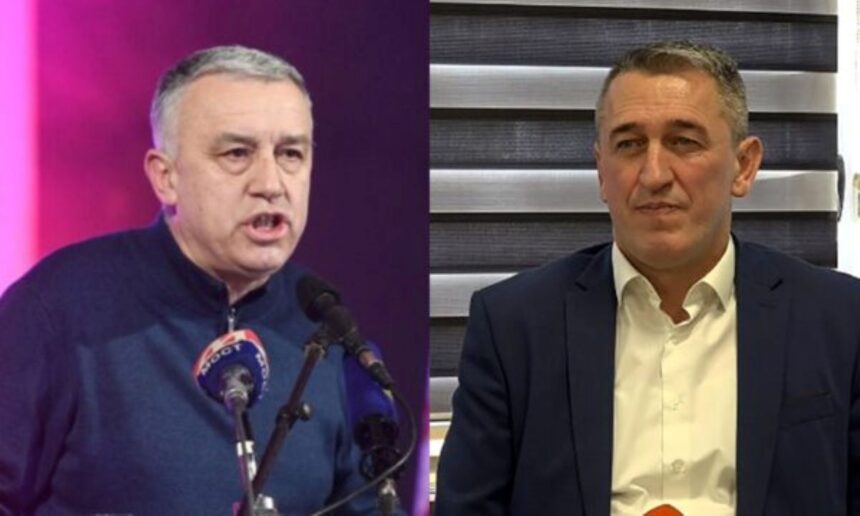
A fierce political dispute has erupted in Kosovo following the preliminary results of the June 7 snap parliamentary elections. The head of the Serb List (Lista Serbe), Zlatan Elek, has openly accused Nenad Rašić, leader of the Freedom, Justice, and Survival Party (Za Slobodu, Pravdu i Opstanak), of securing a seat in the Assembly of Kosovo through structural manipulation and the backing of ethnic Albanian voters.
According to preliminary data based on regular ballots, Lista Serbe secured the vast majority of the Serb community’s vote share, capturing 43,071 votes. This trajectory projects the party to claim nine out of the ten parliamentary seats constitutionally reserved for the Serb minority. Rašić’s party captured ,5,285 votes, positioning him to take the tenth and final reserved seat
Allegations of “Political Engineering”
At the core of the confrontation are allegations by Elek that Rašić’s political survival is tethered to Prime Minister Albin Kurti’s administration, in which Rašić has served two terms as the Minister for Communities and Returns.
Elek labeled Rašić’s performance within predominantly Serb-populated areas as a “catastrophic failure,” claiming he failed to reach even 3,000 votes among his primary constituency.
“He won only 2,795 votes in Serb areas. Therefore, his friends—Kurti and his associates—took care of him, and he received 2,257 votes in Albanian-majority areas,” Elek stated. “Is it possible for Serbs to be represented by a man whom Albanians vote for?”
To back his claims, the Lista Serbe leader pointed out that Rašić received ballots in municipalities such as Prizren, Drenas, Gjakova, Podujeva, Suhareka, Malisheva, Hani i Elezit, and South Mitrovica—regions where the ethnic Serb population is virtually non-existent. Elek confirmed that his party has officially approached the international community, calling the phenomenon a clear case of “political engineering” and alleging that Lista Serbe was systemically defrauded.
Rašić Defends Cross-Community Support
Speaking to Radio Free Europe (RFE), Nenad Rašić firmly rejected the accusations, asserting that the cornerstone of his political mandate remains the Kosovo Serb electorate. He attributed any additional support to non-Serb minority communities who benefited from his tenure as minister over the last three and a half years, rather than ethnic Albanians.
Rašić highlighted steady growth within key northern municipalities as evidence of his organic political ascent.
“Our base consists of Serb votes. The continuity of growth we see in elections is obvious, despite the immense pressure exerted by Lista Serbe,” Rašić told RFE. “In Leposavić, this growth is particularly visible. In December 2025, we had around 830 votes, whereas now we have around 1,200—marking a popularity increase of roughly 40 percent.”
The Broader Debate on Reserved Seats
This controversy is not an isolated incident. Following the prior parliamentary elections in December 2025, the mechanism of reserved legislative seats in Kosovo has come under intense scrutiny, with critics questioning whether the system functions as a genuine constitutional safeguard for minorities or an instrument vulnerable to cross-voting tactics.
During the previous cycle, Emilija Redžepi, leader of the New Democratic Party representing the Bosniak community, leveled similar “vote manipulation” allegations against Rašić. Redžepi pointed to roughly 200 votes Rašić received in Bosniak-majority villages within the Prizren municipality.
The Supreme Court of Kosovo ultimately dismissed Redžepi’s appeal, ruling that the judiciary cannot legally police individual voter intent, reaffirming that every citizen holds the democratic right to vote for any certified candidate of their choosing.
Under Kosovo’s constitutional framework, the 120-seat Assembly permanently allocates 20 seats to non-majority communities:
- 10 seats are strictly reserved for the ethnic Serb community.
- 10 seats are divided among other minority groups, including Bosniaks, Roma, Ashkali, Egyptians, Turks, and Gorani.
As election watchdogs finalize the official count, the ongoing friction highlights deep-seated polarization regarding legitimate political representation within Kosovo’s institutional landscape.