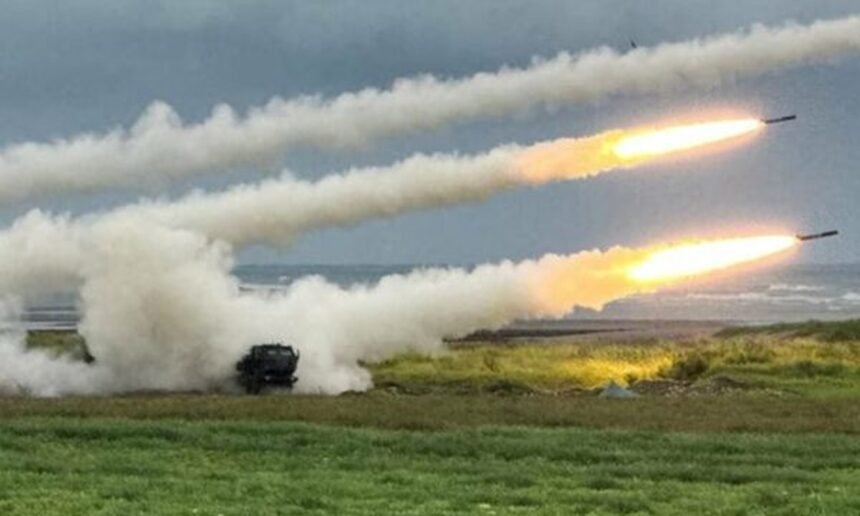
Taiwan’s military has conducted a new exercise featuring its recently acquired HIMARS (High Mobility Artillery Rocket System), simulating strikes against a potential Chinese invasion force and showcasing its ability to rapidly fire and relocate to avoid enemy counterattacks.
China China considers the democratically governed island of Taiwan Taiwan part of its territory and has never ruled out the use of force to bring the island under its control. Chinese warships and military aircraft continue to operate regularly around Taiwan.
The U.S.-made HIMARS system, produced by Lockheed Martin, was previously tested on Taiwan’s eastern coast. Wednesday’s exercise marked the first time precision-guided rockets were fired on the island’s western coast, near Taichung.
Taiwanese military officials said the drill demonstrated HIMARS’ “shoot-and-scoot” capability, allowing launchers to quickly withdraw after firing and reduce the risk of detection and targeting by enemy forces.
“HIMARS demonstrated the unit’s strong combat capabilities and successfully completed the exercise,” said company commander Ko Ming-pin.
The system has gained global attention through its extensive use by Ukraine in the war against Russia, where it has been employed to strike high-value military targets.
Taiwan is increasingly investing in asymmetric warfare capabilities, focusing on highly mobile and survivable weapons systems designed to make any invasion attempt costly and difficult. Military planners often describe this strategy as turning Taiwan into a “porcupine” — heavily defended and difficult to conquer.
With a range of approximately 300 kilometers, HIMARS could potentially strike targets along China’s southeastern coast, including parts of Fujian Province across the Taiwan Strait.
Taiwan plans to integrate HIMARS with its domestically developed Thunderbolt-2000 rocket launchers, aiming to target Chinese forces as they leave ports or attempt amphibious landings on Taiwan’s western shores.
The Taiwanese government continues to reject Beijing’s sovereignty claims, maintaining that only the people of Taiwan can decide the island’s future.