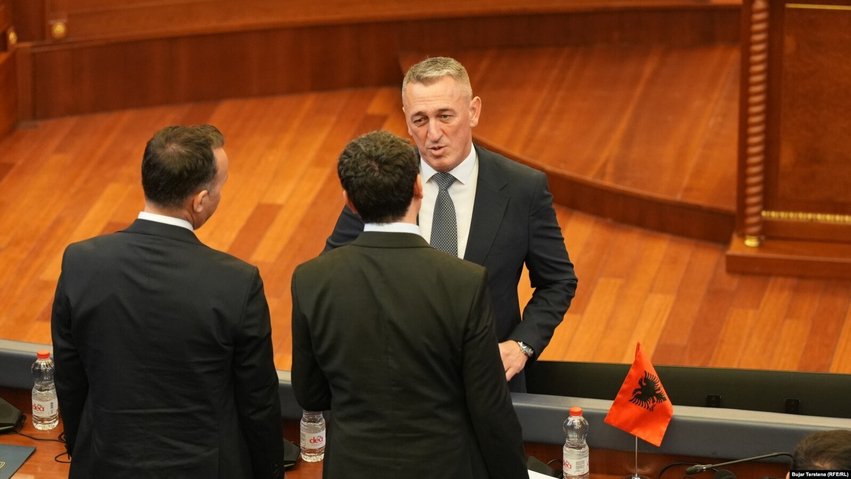
Following the recent elections held on June 7, 2026, the preliminary results released by the Central Election Commission (CEC) have ignited a fierce constitutional and political debate. While the results indicate that the Party for Freedom, Justice, and Survival led by Nenad Rašić has secured one seat in the Assembly of Kosovo, the dominant Serb political entity, Lista Serbe, is fiercely contesting the legitimacy of his mandate.
This clash reopens a fundamental systemic question regarding the 20 reserved seats for non-majority communities in Kosovo’s 120-seat Assembly, 10 of which are explicitly allocated to the ethnic Serb community.
The Core of the Dispute: Votes vs. Representation
According to the preliminary numbers, Lista Serbe secured roughly 43,000 votes, capturing 9 out of the 10 reserved seats, while Rašić’s party gathered 5,285 votes to claim the final allocated seat.
Total Serb-Allocated Seats: 10
│
├── Lista Serbe: 9 Seats (~43,000 votes)
└── Party for Freedom, Justice, and Survival (Rašić): 1 Seat (5,285 votes)
The Opposing Arguments
- The Accusation from Lista Serbe: Party leader Zlatan Elek accuses Rašić of “stealing” a Serb-designated mandate using the votes of ethnic Albanians and other non-Serb communities. To back his claim, Elek pointed out that Rašić pulled votes from municipalities with virtually zero registered Serb residents in the 2024 census, such as Shtime (0 Serbs), Han i Elezit (3), and Kaçanik (6). In these areas, Rašić outperformed Lista Serbe significantly (e.g., scoring 14-0 in Gllogoc and 31-0 in Suharekë).
- Rašić’s Defense: Speaking to Radio Free Europe, Rašić firmly rejected the accusations, asserting that the core of his support came from Kosovo Serbs. However, he did not deny receiving crossover votes from other non-majority groups, attributing this to his visible, moderate, and practical policies during his three-year tenure as the Minister for Communities and Returns.
The Legal Reality vs. Geopolitical Alignment
Legal and political analysts view the crisis through two completely different lenses: strict constitutional law versus ground-level political representation.
1. The Strict Legal Framework
From a purely juridical standpoint, Rašić’s seat is fully valid. Kadri Kryeziu, a former judge of the Constitutional Court of Kosovo, clarified that under existing constitutional jurisprudence, any candidate has the right to accumulate votes from any community across Kosovo without facing ethnic accounting.
“There is nothing contestable. Anyone living in Kosovo has the right to vote freely according to their convictions,” Kryeziu stated, adding that crossover voting does not diminish the legality of the reserved seat system.
2. The Representation Crisis
Permanently tethered to this structural debate is a deeper political reality. Miodrag Marinkoviq from the NGO Center for Affirmative Social Actions (CASA) in North Mitrovica argues that the issue is not legality, but genuine community representation. Rašić is a close ally of Acting Prime Minister Albin Kurti, serving as a minister in two of his cabinets.
This alignment comes at a time when Kurti’s administration has systematically dismantled parallel Serbian-backed institutions in Kosovo and pushed to integrate the local Serbian health and education systems into Prishtina’s legal framework—policies that the mainstream Kosovo Serb population views as an existential threat.
A Tool for Political Engineering?
Marinkoviq warns that the Rašić case highlights a broader governance pattern by Albin Kurti. By utilizing gaps in the electoral framework, the ruling majority can effectively bypass the democratically chosen representatives of the Serb majority (Lista Serbe, which Kurti has refused to cooperate with, especially following the 2023 Banjska attack) and hand institutional positions—such as the constitutionally guaranteed Serb cabinet post and the Deputy Speaker of the Assembly—to aligned minority politicians.
Historical Precedents of Vote Manipulation
The phenomenon of manipulating minority-reserved seats through majoritarian engineering is a recurring issue in Kosovo politics:
| Election Year | Political Entity Involved | The Controversy | Judicial Outcome |
| 2021 | Adriana Hoxhiq (United Community) & Roma Initiative | Accused of orchestrating over 4,800 proxy votes inside Serb-majority municipalities via Lista Serbe’s electorate to edge out authentic Bosniak and Roma parties. | The Supreme Court annulled the votes, stripping Hoxhiq and the Roma Initiative of their won seats due to coordinated electoral fraud. |
| 2025 | Nenad Rašić | Accused by Bosniak leader Emilija Rexhepi of picking up around 200 anomalous votes in purely Bosniak villages in Prizren. | The Supreme Court rejected the complaint, citing a lack of concrete fraud evidence and upholding voter freedom. |
| 2026 | Nenad Rašić | Accused by Lista Serbe of using Albanian votes in areas devoid of Serb residents to cross the threshold for a reserved seat. | Current Political Standoff; legally protected by the 2023 Constitutional Court ruling protecting cross-ethnic voting unless systematic fraud is proven. |
As the dust settles on the June 7 elections, the ongoing dispute underscores an urgent need raised by local watchdogs: comprehensive electoral reform to clearly define and safeguard the spirit of non-majority protective mechanisms from being converted into instruments of political calculation.