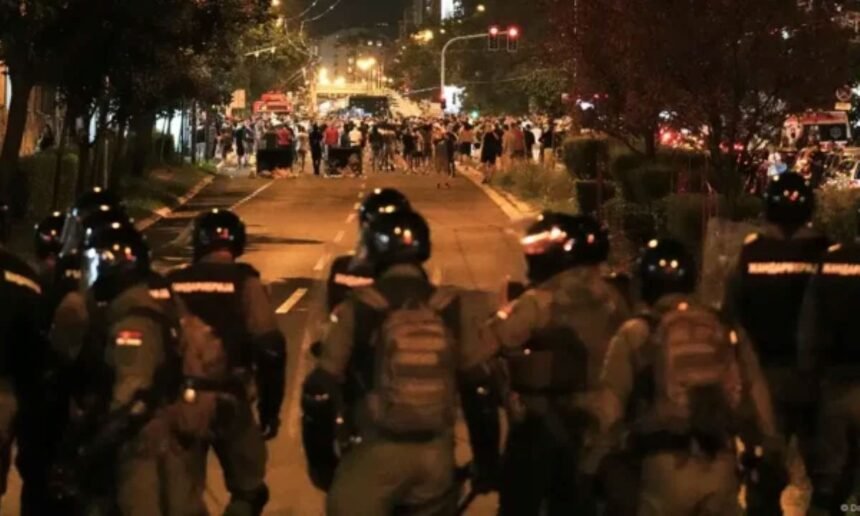
The Council of Europe’s Commissioner for Human Rights, Michael O’Flaherty, has issued a stark warning regarding the state of accountability in Serbia. The international rights chief expressed deep concern over reports that Serbian authorities may quietly drop criminal proceedings against police officers accused of severe brutality against a female student during the Belgrade protests of July 2025.
According to reports, the state is looking to resolve the heavy charges using a controversial legal loophole: deferred criminal prosecution (the principle of opportunity), which allows offenders to clear their records by paying a fine or making a humanitarian donation.
A Threat to Public Trust and the Rule of Law
Taking to his official account on X, Commissioner O’Flaherty made it clear that handling structural police misconduct through administrative shortcuts sets a dangerous precedent for Europe’s human rights landscape.
“I am deeply concerned by reports that criminal proceedings for serious police misconduct against a female student during the Belgrade protests in July 2025 could be halted through deferred criminal prosecution,” O’Flaherty stated. “Such actions severely jeopardize efforts toward institutional accountability and the rule of law.”
Council of Europe Warning Matrix
│
├── Current Path ──► Deferred Prosecution (Fine / Amnesty) ──► Fosters Impunity
└── Demanded Path ─► Effective Investigations & Sanctions ──► Restores Public Trust
The Commissioner warned that cutting short criminal accountability in high-profile cases of state violence risks obliterating whatever remaining confidence Serbian citizens have in their own law enforcement agencies.
Demands for Clear, Deterrent Sanctions
The CoE Human Rights chief emphasized that the only path toward stabilizing democratic norms in the Western Balkan nation is through transparent and uncompromised justice. He explicitly called on Belgrade to execute:
- Rigorous, independent investigations into the excessive use of force.
- Unobstructed criminal prosecution of the officers who overstepped legal boundaries.
- Deterrent punitive measures designed to permanently prevent future police overreach during public demonstrations.
The July 2025 protests in Belgrade saw tens of thousands of citizens hit the streets over democratic backsliding and institutional corruption, demonstrations that were met with heavy-handed tactics by riot police. By calling international attention to the student’s case, the Council of Europe is signaling to Serbia—a member state—that using legal maneuvers to shelter officers “who follow orders” will directly impact its international standing and European integration goals.