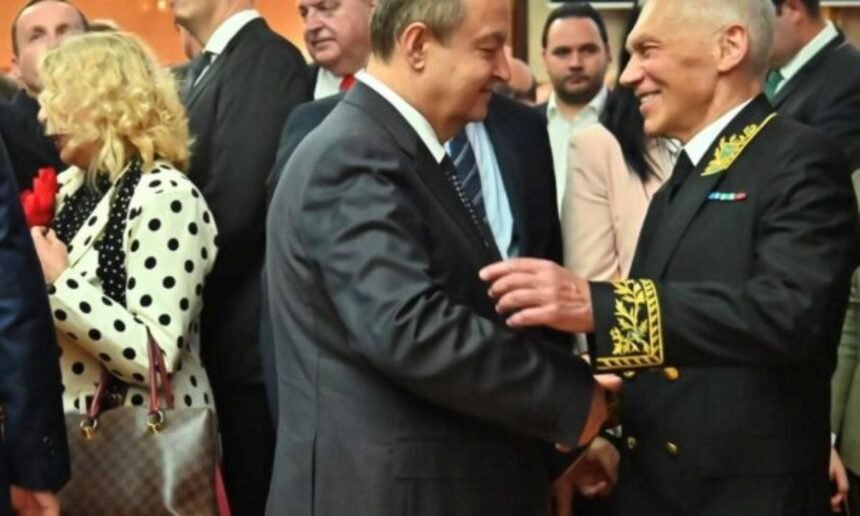
While official Belgrade continues to assure Brussels and Washington that it remains committed to its European integration path, the visual landscape inside the Russian Embassy tells a radically different geopolitical story.
A massive turnout of Serbia’s highest state officials and prominent religious leaders gathered at a lavish reception celebrating “Russia Day,” sending an unmistakable and alarming signal to the West regarding the current regime’s true foreign policy priorities.
The high-profile event exposed the systematic, deep-seated connections linking the Serbian political elite directly to Vladimir Putin’s Kremlin, charting a course that directly diverges from Western security frameworks.
A Geopolitical Symphony in Defiance of Europe
At a time when democratic nations remain locked in the tightest European security crisis since World War II, the enthusiastic display of affinity toward Moscow by Serbian state actors positions Belgrade as a distinct outlier on the continent. By turning out in full force, Serbia has once again consciously turned its back on aligning with the European Union’s Common Foreign and Security Policy.
The host of the evening, Russian Ambassador Aleksandr Botsan-Kharchenko, seized the moment to deliver a speech emphasizing the unyielding ideological brotherhood between the two nations.
“The Russian and Serbian national anthems sound like a single, unified symphony,” Botsan-Kharchenko told the packed room of dignitaries.
While the Ambassador admitted that the global landscape from Moscow’s perspective is far from ideal—stating that Russia “does not view the world through rose-colored glasses”—he fiercely emphasized that Russia is rapidly protecting its sovereign interests alongside “friendly countries,” placing Serbia firmly at the top of that list.
The Illusion of “Military and Political Neutrality”
Belgrade has long maintained a public doctrine of strict military and political neutrality. However, regional security analysts note that the blanket presence of Serbia’s ruling class at a state gala hosted by a diplomatically isolated, heavily sanctioned embassy effectively shatters that narrative.
Belgrade's Double-Sided Diplomacy
│
├── To Brussels & Washington ──► The Outer Shell: "We are committed to joining the EU"
└── To Moscow (Russia Day)   ──► The Core Reality: High-level alignment & operational dependency
By maintaining open channels, hosting state visits, and celebrating Russian national holidays alongside Kremlin envoys, Belgrade is consciously acting as the primary window for Russian influence right in the geographic heart of Europe. As Western pressure intensifies on the Balkans to isolate Moscow, the Russia Day gala proves that the Serbian leadership values its deep historical and strategic anchor with the Kremlin far too much to cut the cord.