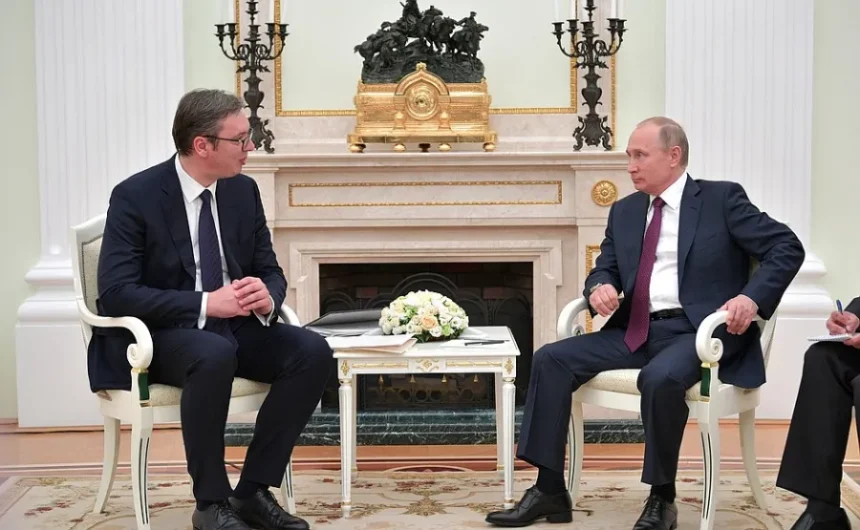
Serbian President Aleksandar Vučić downplayed the long-term impact of NATO’s newly announced plans to downscale its Kosovo Force (KFOR) mission.
Speaking from the capital of Georgia during his ongoing state visit on Tuesday evening, Vučić emphasized that despite Washington’s desire to draw down its operational footprint in Southeastern Europe, the overarching balance of security on the ground will remain structurally unchanged.
The remarks follow an official June 12 announcement by NATO’s Supreme Allied Commander Europe (SACEUR), U.S. Air Force General Alexus G. Grynkewich, indicating that the alliance will systematically “optimize” and reduce its current 4,600-strong peacekeeping force over the course of the next year due to localized stabilization.
1. Dismantling the Drawdown: Vučić’s Technical Realism
Despite internal domestic anxieties regarding the security of ethnic minorities in Kosovo, Vučić took a highly calculated, pragmatic view of the strategic restructuring.
The Mechanics of the Scheduled KFOR Optimizations

 [ AMERICAN WITHDRAWAL ] ──► CALIBRATED REDUCTIONS
 • Washington—which fields roughly 600 active personnel at Camp Bondsteel—has
   signaled clear intent to scale back its direct European deployments.

 [ ALLIED BALANCE ] ──► CONTINUOUS ROTATIONAL PARITY
 • Vučić pointed out that European partners intend to fill the resulting resource gaps:
   "Others will maintain their troops at the same level, so essentially nothing changes."

 [ MANDATED PROTECTION ] ──► CHARGE OF RELIGIOUS SITES
 • The Serbian presidency reiterated its clear expectation that NATO must continue
   to unconditionally guarantee the safety of local Serbs and Orthodox heritage landmarks.
“The United States will certainly reduce its presence gradually, but others will keep their numbers at the exact same level. Therefore, fundamentally, absolutely nothing will change on the ground.”
— Serbian President Aleksandar Vučić in Tbilisi
2. The Genesis of the Cuts: NATO’s Success Parameter
The restructuring marked the 27th anniversary of NATO’s entry into Kosovo in 1999. The decision to scale back follows a lengthy evaluation showing that local administrative and civil security networks have achieved an independent operational threshold.
The Timeline and Safety Valves of the NATO Strategy
┌────────────────────────────────────────────────────────────────────────┐
│                                                                        │
│  [ REVERSING THE 2023 SURGE ] ─────────────────────────────────────┐   │
│  • Following intense civil unrest and localized clashes in Zvečan      │   │
│    in 2023, NATO deployed 1,000 emergency reserve forces to the area.  │   │
│    Those continuous rotational reserve assignments ceased this January.│   │
│                                                                        │   │
│  [ STEADY CONDITIONS ON THE GROUND ] ──────────────────────────────┤   │
│  • General Grynkewich confirmed the current tactical reality provides │   │
│    an ideal opportunity to downsize KFOR's overall posture while       │   │
│    maintaining strict operational impartiality across all zones.       │   │
│                                                                        │   │
│  [ THE IMMEDIATE REVERSAL CLAUSE ] ────────────────────────────────┘   │
│  • The alliance stressed that all reductions remain explicitly tied    │
│    to field intelligence. If security conditions in the north slip,    │
│    the troop cuts can be instantly frozen or completely reversed.      │
└────────────────────────────────────────────────────────────────────────┘
3. The Geopolitical Buffer: Ensuring No Security Vacuum
While Pristina continues to lobby Brussels for accelerated European Union integration and official candidate recognition, the sudden optimization of Western military assets has drawn intense analysis from regional observers.
| Country Contingent | Current Status | Posture Outlook (2026-2027) |
| United States | ~600 active personnel deployed. | Anticipating a highly structured, gradual drawdown of frontline personnel throughout the year. |
| Switzerland (Swisscoy) | Maximum cap locked at 215 troops. | Completely unaffected; Swiss forces remain dedicated to critical logistics, headquarters command, and air monitoring. |
| European Allies | Making up the bulk of the remaining 4,600 peacekeepers. | Expected to maintain status-quo presence under normal national deployment and rotation cycles. |
NATO command explicitly emphasized that it will not allow a security vacuum to emerge in the Western Balkans. The military alliance reiterated that long-term regional stability remains directly bound to the ongoing European Union-facilitated diplomatic dialogue between Belgrade and Pristina, urging both capitals to avoid provocative unilateral actions as the phased military restructuring rolls forward.