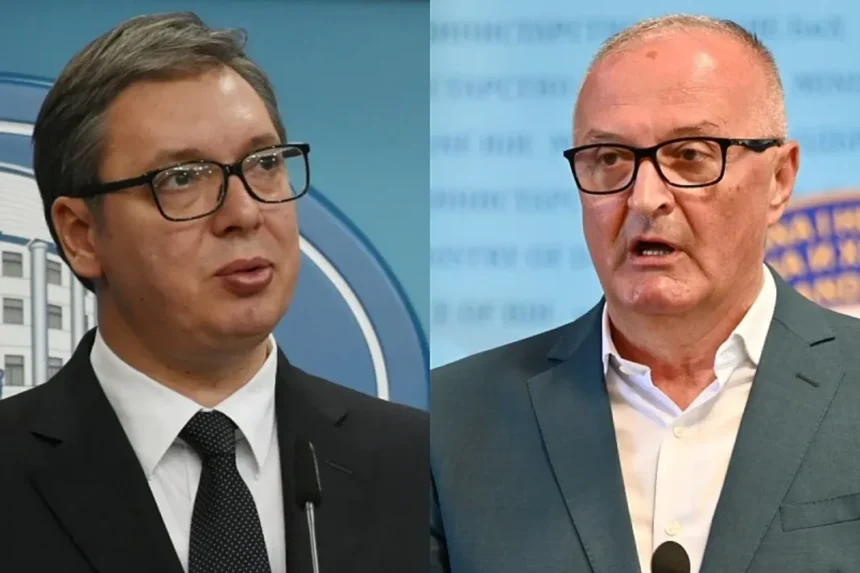
Serbian President Aleksandar Vučić and Bosnia and Herzegovina’s Defense Minister Zukan Helez have exchanged a series of sharp accusations following a dispute over the security arrangements during Vučić’s recent visit to Bugojno.
The confrontation began after Helez claimed that members of the Police of the Central Bosnia Canton had intervened against a group of armed men who were allegedly not part of Vučić’s officially registered security detail.
Vučić rejected the allegations, calling them lies and insisting that the men seen in the area were members of the Special Anti-Terrorist Unit (SAJ) of the Ministry of Interior of Republika Srpska, rather than Serbian security personnel.
“Do you know what a lie that is? There is not a single man from Serbia,” Vučić said, arguing that the personnel from Republika Srpska were operating within their own jurisdiction.
He also accused Helez of repeatedly making false claims and challenged the minister over why he had not arrested him during his visit if the allegations were serious.
“Why didn’t you arrest me, you liar?” Vučić said. “You have been lying for two years. Why didn’t you arrest me when I came to you?”
Helez responded by saying that Bosnia and Herzegovina’s institutions had monitored Vučić’s movements throughout his visit and that any valid arrest warrant would have been enforced.
“Let President Aleksandar Vučić know that we followed his every move during his visit to Bosnia and Herzegovina. If there had been a request for his arrest, he would have been arrested,” Helez said.
The defense minister also accused Vučić of turning his visit into a political spectacle and criticized what he described as a broader policy of exploiting the issue of Serbs in the region for political purposes.
Helez then issued a provocative challenge, inviting Vučić to walk with him through Belgrade, Novi Sad and Niš without the large security presence that normally accompanies the Serbian president.
“If you dare, let us walk together through Belgrade, Novi Sad and Niš — me as the defense minister of Bosnia and Herzegovina and you as the president of Serbia,” Helez said.
He further accused Vučić of pursuing what he called a “Greater Serbian policy,” arguing that areas where the Serbian president claims to defend Serbs have instead experienced division, emigration and population decline.
Helez stressed that his criticism was directed at what he described as nationalist politics rather than at the Serbian population itself, saying that regional disputes should be addressed through peace and cooperation rather than territorial or ethnic divisions.
The exchange comes amid heightened political tensions between Belgrade and Sarajevo and follows renewed scrutiny of the movement of armed personnel and security teams during visits by senior Serbian officials to Bosnia and Herzegovina.
The dispute also highlights the continuing sensitivity surrounding security arrangements, political rhetoric and the status of Serb communities across the region, particularly when senior officials from Serbia visit areas with a complex wartime and political history.