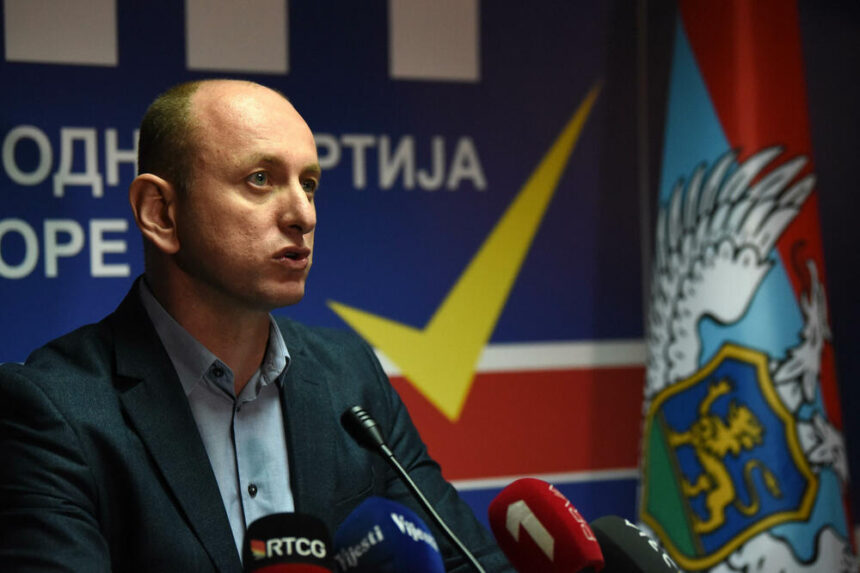
Facing deep political isolation after recently exiting the ruling coalition, Milan Knežević, the leader of the pro-Serbian Democratic People’s Party (DNP), has launched a highly controversial campaign to revoke Montenegro’s recognition of Kosovo.
The political gambit—undertaken simultaneously at both the municipal and state parliament levels—is being roundly dismissed by prominent domestic analysts as an act of political desperation. Experts argue that Knežević, lacking any substantive socio-economic or institutional platform ahead of next year’s parliamentary elections, is reverting to predictable identity politics to mobilize a shrinking, nationalist voter base.
1. The Dual-Track Revocation Scheme
Knežević confirmed that his party’s presidency has granted him “full authorization” to initiate formal procedures to retract the 2008 recognition. The strategy operates across two parallel tracks, shifting from hyper-local municipal actions to macro-state resolutions.
Knežević's Multi-Tiered Anti-Recognition Strategy

 [ MUNICIPAL DECLARATIONS ] ──► DELEGITIMIZING THE STATE
 • Launching local resolutions in Zeta and other pro-Serbian municipalities
   declaring the recognition of Kosovo "null and void" within local borders.

 [ STATE PARLIAMENTARY MOTION ] ──► LEGISLATIVE RESISTANCE
 • Submitting a formal draft resolution to the Skupština forcing the Government
   of Milojko Spajić to reverse its pan-European foreign policy alignment.

 [ ECCLESIASTICAL BACKING ]   ──► SPIRITUAL MOBILIZATION
 • Actively lobbying Metropolitan Joanikije and Bishop Metodije of the Serbian
   Orthodox Church (SPC) to secure institutional religious endorsements.
The political escalation comes exactly one week after the state parliament refused to put the DNP’s proposal to formalize the historical tricolor flag (trobojka) on the legislative agenda—a defeat that ultimately triggered the DNP’s departure from the executive cabinet.
2. Expert Analysis: Political Survival vs. Institutional Futility
Prominent political commentators and legal experts have quickly dismantled the strategic weight of Knežević’s announcement, labeling it as performative theater rather than serious statecraft.
Expert Critiques of the DNP Identity Gambit
┌────────────────────────────────────────────────────────────────────────┐
│                                                                        │
│  [ THE ANALYSIS OF NIKOLETA ĐUKANOVIĆ ] ──────────────────────────┐   │
│  • Compares the move to an desperate "election-eve mobilization."      │   │
│    Stresses that Knežević is fully aware that the initiative has zero  │   │
│    chance of passing through established state institutions.           │   │
│                                                                        │   │
│  [ THE CRITIQUE OF MILKA TADIĆ MIJOVIĆ ] ──────────────────────────┤   │
│  • Condemns the initiative as a symptom of governance bankruptcy.     │   │
│    Argues Knežević is fundamentally incapable of designing economic,   │   │
│    educational, or healthcare reforms, making him a "90s relic."      │   │
│                                                                        │   │
│  [ THE LEGAL BURDEN OF PROOF ] ────────────────────────────────────┘   │
│  • Legal experts confirm local municipal "derecognitions" possess absolutely│
│    no constitutional or international legal validity, as foreign policy│
│    belongs strictly to the state executive, not local assemblies.      │
└────────────────────────────────────────────────────────────────────────┘
3. History Repeats Itself: The Performance Tracking Record
This is not the first time Knežević has deployed this exact playbook during critical election windows. A look at the historical timeline reveals a consistent pattern of using the Kosovo issue as tactical campaign noise, only to let the initiatives quietly dissolve once political leverage is secured.
| Timeline Focus | Tactical Political Action | Actual Institutional Outcome |
| October 2008 | Milo Đukanović’s government formally recognizes Kosovo as an independent state. | Triggers mass riots and a two-week hunger strike by current Parliament Speaker Andrija Mandić. |
| May–August 2023 | Prior to the 2023 elections, Knežević’s coalition promises a “Zeta Declaration” to void recognition locally. | Total Parliamentary Sabotage: DNP and DF councilors repeatedly skip their own scheduled sessions five consecutive times to safeguard coalition talks. |
| April–June 2026 | The DNP exits Spajić’s government after identity demands fail; revives the state-level revocation push. | Met with absolute silence from current ruling parties and local orthodox dioceses. |
Ultimately, Knežević’s maneuver exposes a deepening rift within Montenegro’s pro-Serbian political bloc. While his former ally Andrija Mandić has adopted a more pragmatic, institutional approach to hold onto power, Knežević is pulling his party back into radical opposition terrain. By resurrecting a divisive regional issue that has been settled policy for nearly two decades, the DNP risks proving its critics right: that it remains a single-issue movement, structurally dependent on regional conflict to justify its political existence.