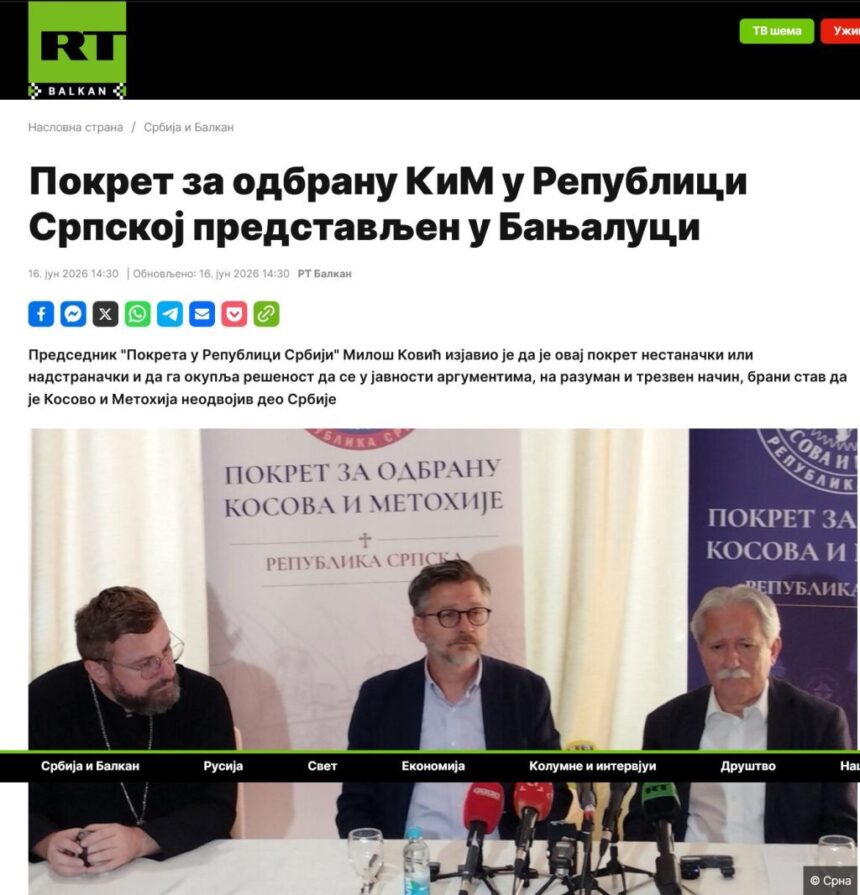
A newly established citizens’ association named the “Movement for the Defense of Kosovo in Republika Srpska” has been officially launched in Banja Luka. The organization is heavily backed by circles that have spent years promoting ultranationalist narratives and contesting the internationally recognized political realities of the Western Balkans.
While the founders claim their mission is to “unite the Serbian people in defense of Kosovo,” analysts note that it remains entirely unclear who Kosovo is being “defended” from by an organization operating hundreds of kilometers away. Instead, the movement appears to be a vehicle for maintaining regional ethno-political friction.
1. The Leadership: Darko Djogo and the Exploitation of the Church
At the helm of this extremist base is Darko Djogo, a priest of the Serbian Orthodox Church. His prominent role once again highlights how certain ecclesiastical structures are instrumentalized as political tools to serve Greater Serbian ideology.
Djogo has openly advocated for applying Belgrade’s aggressive political matrix within Bosnia and Herzegovina, publicly stating that Republika Srpska can only survive on the “anachronistic and mythomaniac foundations of Vidovdan”—a stance viewed by critics as a direct affront to modern democratic values and civilizational progress.
The Familial Roots of Radikalism

 [ RISTO DJOGO (THE FATHER) ] ──► WARTIME PROPAGANDA CHIEF
 • Darko Djogo is the son of Risto Djogo, a notorious wartime propagandist
   who served as the right-hand man to convicted war criminal Radovan Karadzic.

 [ TV PALE FABRICATIONS ]     ──► ETHNIC DEHUMANIZATION
 • During the 1990s, Risto Djogo orchestrated monstrous media lies via TV Pale,
   including the fascist fabrication that Serb children were being thrown to the
   lions in the Sarajevo zoo.

 [ ICTY EXPERT DETERMINATION ] ──► THE PATHWAY TO GENOCIDE
 • Expert reports for the International Criminal Tribunal for the former Yugoslavia
   (ICTY) concluded that Djogo's propaganda was a key instrument in inciting
   ethnic hatred and preparing the ground for genocide.
2. Key Ideologues: Milos Kovic and Slobodan Samardzic
The movement draws significant intellectual backing from prominent revisionist figures who utilize national myths to mobilize the masses.
Prominent Promoters of the Ultranationalist Movement
┌────────────────────────────────────────────────────────────────────────┐
│                                                                        │
│  [ MILOS KOVIC • HISTORIAN ] ──────────────────────────────────────┐   │
│  • Known for defending 1990s policies and contesting international    │   │
│    court verdicts regarding the Yugoslav wars.                  │   │
│  • Uses the "Kosovo Covenant" myth to radicalize supporters.│   │
│  • Previously banned from Bosnia & Herzegovina; recently declared a    │   │
│    threat to public order and banned from entering Croatia.  │   │
│                                                                        │   │
│  [ SLOBODAN SAMARDZIC • POLITICIAN ] ──────────────────────────────┤   │
│  • Former Minister for Kosovo in the government of Vojislav Kostunica  │   │
│    who fiercely opposes EU-led normalization between Belgrade & Pristina.│
│  • Calls for a "unified front" that promotes regional confrontation    │   │
│    over peaceful diplomatic dialogue.                          │
└────────────────────────────────────────────────────────────────────────┘
3. Strategic Implications: Keeping the Balkans Frozen in the Past
The emergence of this movement directly contradicts the overarching geopolitical goals of the international community in Southeastern Europe.
| Regional Vector | Western Balkan Integration Goals | The Movement’s Objective |
| Regional Security | The European Union and Western allies demand regional cooperation, reconciliation, and democratic progress. | 制造Friction: Drawing political energy from unresolved historical conflicts to block regional stability. |
| Media & Discourse | Promoting objective, fact-based information to foster peaceful co-existence. | Instrumentalization: Reviving 1990s-style media tactics to incite nationalism and dehumanize non-Serb populations. |
| Democratic Future | Moving forward toward full European integration and modern civic values. | Mythological Anchoring: Keeping the local populace trapped in the conflicts of the past century. |
Ultimately, the launch of this organization raises a critical dilemma for the region. At a time when stability and democratic growth are paramount, the Western Balkans does not need another external “defense of Kosovo”. Instead, the region requires initiatives that contribute to democratic values, reconciliation, and a shared European future.