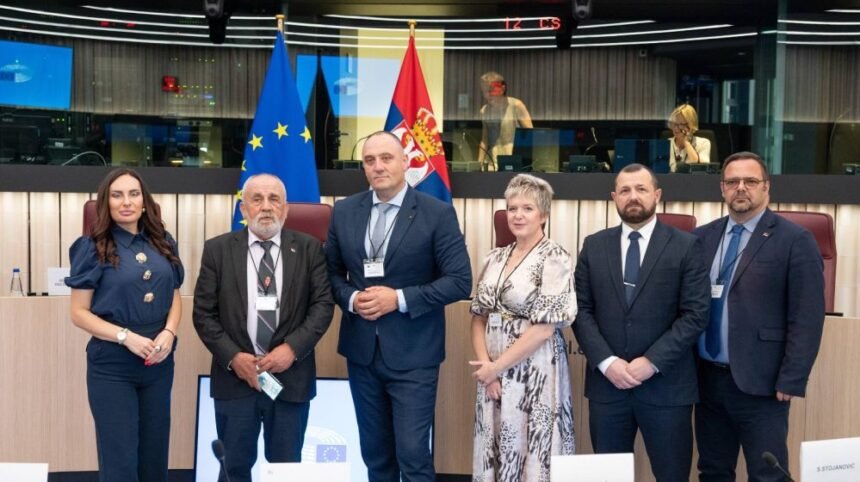
High-level diplomatic friction overshadowed the 18th meeting of the EU-Serbia Stabilization and Association Parliamentary Committee (SAPC) on Thursday, exposing a deep divide between Brussels’ integration demands and Belgrade’s domestic political narrative.
The summit, designed to audit Serbia’s progress under the Stabilization and Association Agreement (SAA), quickly devolved into a war of words. European lawmakers warned of frozen funds, while representatives of Serbia’s ruling coalition accused Brussels of leveling political ultimatums.
1. “No Progress, No Money”: The EU’s Financial Ultimatum
The primary point of contention centered on the rule of law and the implementation of democratic reforms. Members of the European Parliament (MEPs) delivered an unyielding message regarding the execution of essential institutional overhauls.
The European Parliament’s Core Demands & Consequences

 [ THE ACCELERATION PROTOCOL ] ──► CONDITIONAL CORRIDORS
 • Brussels officials reiterated that advancing EU membership tracks is
   entirely bound to verifiable leaps in democratic standards.

 [ VENICE COMMISSION HOLDUPS ] ──► REFORM STAGNATION
 • Serbia has yet to fully harmonize its judiciary with the expert criteria
   laid out by the Venice Commission, delaying regional integration.

 [ THE €1 BILLION REVENUE PERK ] ──► ECONOMIC JEOPARDY
 • MEPs confirmed that failure to adopt binding rule-of-law milestones will
   result in Serbia being blocked from accessing its Growth Plan allocation.
“The message from our side was crystal clear. If they want to open a new chapter, the tasks must be accomplished… If there is no progress, there is no money.”
— Vladimir Prebilič, Member of the European Parliament (Greens)
2. Belgrade Rejects “Blackmail” Label Amid Domestic Definement
Serbian representatives from the ruling Progressive Party (SNS) and the Alliance of Vojvodina Hungarians (SVM) fiercely pushed back against European critiques. They maintained that the delegation acted in a highly responsible, statesperson-like manner and rejected assertions that they behaved as if they were being coerced.
The Ruling Coalition's Diplomatic Defense
┌────────────────────────────────────────────────────────────────────────┐
│                                                                        │
│  [ THE PREBILIČ REJECT ] ──────────────────────────────────────────┐   │
│  • SNS and coalition lawmakers claimed MEP Prebilič completely         │   │
│    misunderstood the discussions, stating his view was uncorroborated.│   │
│                                                                        │   │
│  [ THE REM DEADLOCK ] ─────────────────────────────────────────────┤   │
│  • SVM MP Elvira Kovač argued that the government is not blocking the  │   │
│    Regulatory Authority for Electronic Media (REM) Council, blaming    │   │
│    boycotting NGOs for stalling the finalized appointments.             │   │
│                                                                        │   │
│  [ CLUSTER 3 MOMENTUM ] ───────────────────────────────────────────┘   │
│  • Coalition members insist that Serbia has met enough benchmarks to    │
│    unblock Cluster 3, implementing 7 out of 9 Venice Commission ideas. │
└────────────────────────────────────────────────────────────────────────┘
3. Opposition Boycotts and internal Silencing Allegations
The sharpest divisions, however, were not between Belgrade and Brussels, but within the fractured Serbian political spectrum itself. The delegation exposed systemic polarization, with independent elements accusing the ruling regime of weaponizing propaganda abroad.
| Faction / Representative | Position on Strasbourg Summit | Assessment of Serbia’s Reality |
| Vladimir Đorđević (POKS Opposition) | Attended and condemned the SNS delegation. Accused the committee co-chair of actively shortening his speaking time to suppress his testimony. | “Listening to the SNS, you’d think they were describing Switzerland. To them, the media is free and the government is the victim.” |
| Borko Stefanović (SSP Pro-EU Opposition) | Boycotted the event entirely alongside major pro-European opposition blocs, labeling the trip an empty public relations stunt. | “A contentless school excursion… A cheap attempt to deceive citizens that the regime wants to implement its EU obligations.” |
4. Strategic Analysis: A Diminishing Window of Opportunity
Independent political analysts indicate that the ruling coalition’s defensive posture reflects a standard rhetorical pivot. By framing strict accession requirements as external “pressure” or “blackmail,” Belgrade seeks to insulate itself from domestic accountability regarding frozen integrations.
With regional neighbors like Montenegro and Albania rapidly advancing into the final stages of their accession negotiations, Serbia’s fixation on merely unlocking Cluster 3 risks falling behind. As Brussels ties its financial packages directly to anti-corruption and judicial independence, Belgrade’s reluctance to enact tangible domestic overhauls could turn its European ambitions into a case of “too little, too late.”