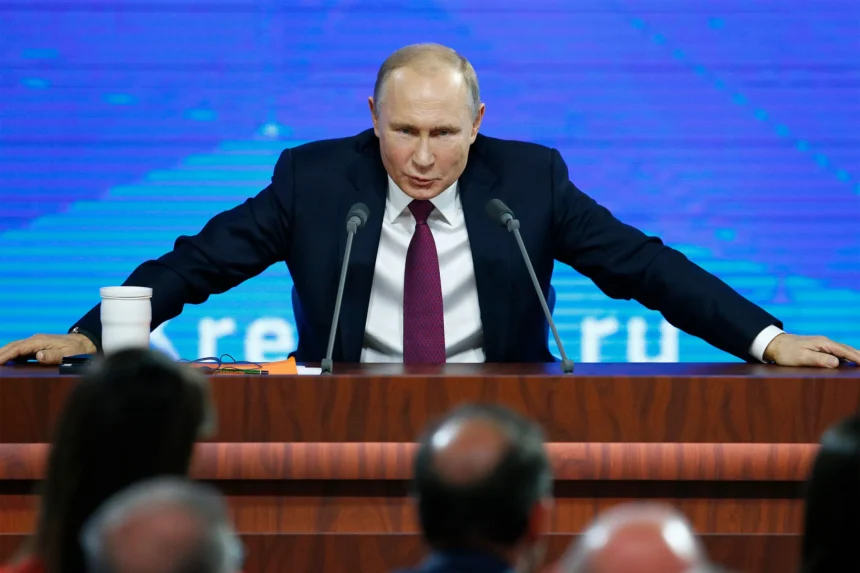
As President Vladimir Putin convened the annual St. Petersburg International Economic Forum, smoke rising from a nearby Ukrainian drone strike on a critical oil facility served as a stark visual reminder of the ongoing conflict. Now deep into a protracted, full-scale invasion of Ukraine—a war the Kremlin originally intended to conclude within weeks—Russia finds itself caught in an institutional and economic trap engineered by its own leadership.
While Ukrainian strikes deep inside Russian territory emphasize the ongoing military friction, political scientists and regional experts warn that the greatest barrier to peace lies within Russia’s transformed domestic landscape. According to a recent study published in Foreign Affairs by political scientists Seva Gunitsky and Jeremy Morris, Putin has inadvertently “fallen into a war trap that… no one can easily dismantle.”
1. The War as a Total Economic Order
Over more than four years of continuous mobilization, Russia’s internal economy, labor markets, and regional budgets have completely reoriented around the conflict. What began as a temporary military operation has hardened into a permanent nationwide institutional network.
“We are talking about the shadow economy, labor markets, regional budgets, and even the social hierarchy within the country—all reoriented around the conflict,” explains George Gunitsky, Chair of Peace and Conflict Studies at the University of Toronto, in an interview with Radio Free Europe/Radio Liberty. “In this sense, it has turned into a nationwide institutional and economic order whose inertia limits even Putin himself.”
The structural shift has created widespread structural dependencies:
- Military-Industrial Reliance: The defense sector, which directly employs millions of Russian citizens, relies completely on the continuation of hostilities to maintain high production levels and financial liquidity.
- Financial Flow Dependencies: Entire geographic regions, factory towns, and lower-income demographics have become deeply dependent on war-related financial streams—ranging from inflated manufacturing wages to high state payouts for military contracts.
- The Risk of Sudden Peace: Economists warn that a sudden halt to the war would trigger immediate systemic shocks, including widespread industrial collapse, mass unemployment, and localized economic depressions.
2. The Social Crisis: The Return of Combat Veterans
A cessation of hostilities poses acute social risks for the Kremlin, most notably the repatriation of hundreds of thousands of mobilized men. Among those returning are thousands of violent convicts who were recruited directly from penal colonies under state pardons in exchange for battlefield service.
Reports of violent crimes committed across Russian municipalities by returning veterans are already rising. Analysts contrast the long-term, slow-burning strains of war with the sudden shockwaves of a peacetime transition:
| Metric | The Cost of Continuing the War | The Cost of Ending the War |
| Economic Impact | High inflation, structural labor shortages, and civic stagnation. | Mass industrial unemployment and a potential collapse of the defense sector. |
| Social Danger | Gradual, distributed societal exhaustion. | An immediate, concentrated veteran integration crisis and spikes in violent crime. |
| Political Risk | Manageable, low-level domestic dissent. | High elite frustration, social shockwaves, and threats to regime legitimacy. |
As Gunitsky notes, “Historically, regimes almost always choose slow bleeding over an acute crisis.” To date, the Kremlin has consistently opted for the former.
3. Delayed Decisions and the Illusion of Victory
Despite cultivating a public persona of a decisive and unyielding leader of action, Russia expert Mark Galeotti describes Putin as an inherently hesitant actor who structurally defers major structural pivots or risky policy changes.
Furthermore, stopping the war now would leave the Kremlin with very little to show for a campaign that has exacted an immense human toll. Western intelligence reports estimated Russian casualties at nearly 500,000 killed or wounded. Because Putin unilaterally declared the Ukrainian oblasts of Donetsk, Luhansk, Zaporizhzhia, and Kherson as formal territories of the Russian Federation, any peace deal that fails to secure full control over these regions risks exposing political vulnerability.
“If there is a peace agreement that cannot be convincingly sold as a victory, it creates extraordinary tension,” Gunitsky warns.
4. The Technocratic Debate and the Status Quo
While public opinion polling indicates that a majority of Russian citizens support shifting toward peace negotiations over continued battlefield attrition, the ruling elite remains deeply fractured.
A silent political campaign is reportedly playing out among Russia’s business elite and technocrats, who are attempting to convince Putin that he can simply declare a symbolic triumph, freeze the current frontlines, and leave a permanent threat over Ukraine like a “Sword of Damocles.”
However, Sam Greene, a professor at the Russia Institute at King’s College London, points out that neither the hardline military factions nor the moderate economic technocrats believe the current status quo serves their long-term interests. While they disagree fundamentally on the future, both factions increasingly agree that the present path is unsustainable. In the absence of a definitive structural pivot from Putin, the inertia of the war machine guarantees that the conflict continues.