
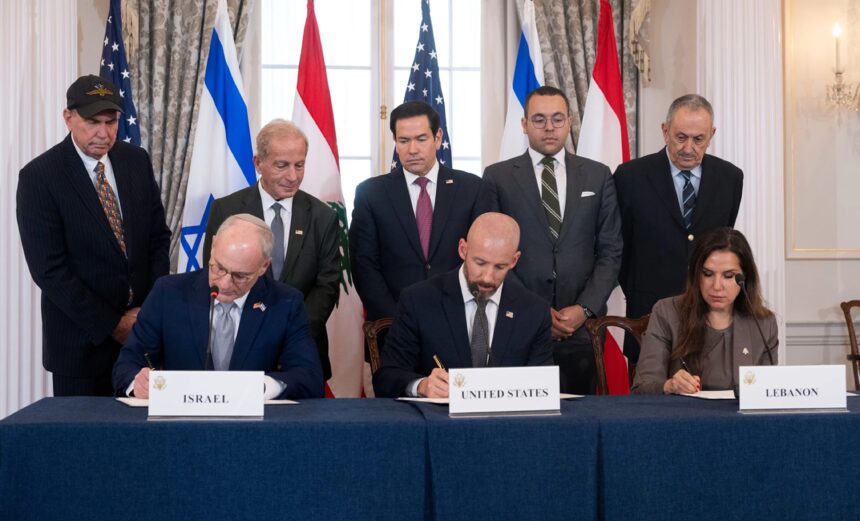
A new diplomatic development has taken place in Washington, where U.S. Secretary of State Marco Rubio hosted the ambassadors of Israel and Lebanon for the signing of a framework agreement.
The agreement is being viewed as the first step toward ending the months-long conflict that began following the outbreak of the broader war between Israel and Iran on February 28. During that period, Israeli forces carried out a ground operation in Lebanon aimed at targeting Hezbollah positions.
The document was signed by Israel’s Ambassador to the United States, Yechiel Leiter, and Lebanon’s Ambassador, Nada Hamadeh Moawad. While the parties disclosed few technical details, the agreement confirms the establishment of a direct bilateral channel, separate from the talks held last week in Zurich between Washington and Tehran.
Diplomatic representatives from both countries outlined their long-term objectives, emphasizing the pursuit of lasting peace and the restoration of full state sovereignty over territories affected by military operations.
“This framework is the first step toward restoring Lebanon’s sovereignty and territorial integrity by securing a permanent and final cessation of hostilities, allowing our people to return to their land,” said Lebanon’s Ambassador to the United States, Nada Hamadeh Moawad.
Israeli Ambassador Yechiel Leiter stated that the ultimate objective remains the establishment of peaceful relations, where citizens of both countries can move freely. However, he stressed that this goal depends on the Lebanese Army’s ability, with U.S. support, to disarm and dismantle Hezbollah’s military infrastructure.
Israeli Prime Minister Benjamin Netanyahu described the agreement as a “major achievement,” announcing that Israeli forces will continue to maintain positions within the “security zone” in southern Lebanon for as long as Hezbollah is considered a threat. At the same time, preparations are underway for the gradual transfer of control to the Lebanese Armed Forces through the creation of two pilot zones.
The plan had previously been confirmed by Lebanese President Joseph Aoun, who said its objective is to enable displaced residents to return to their homes under the authority of a state exercising full sovereignty over its territory.
However, the agreement signed in Washington does not include Hezbollah, which has categorically rejected any plan to surrender its weapons or recognize the Lebanese government’s direct negotiations with Israel.
In a statement to Al-Mayadeen television, Hezbollah parliamentary bloc member Hassan Fadlallah strongly criticized the agreement and warned of serious consequences for Lebanon’s stability.
“The Lebanese authorities will not be able to implement the agreement signed in Washington unless they enter into a civil war with American support,” Fadlallah said.
According to Hezbollah, previous United Nations agreements require the group only to withdraw from areas south of the Litani River, not to disarm across all of Lebanon. This position, combined with recent incidents on the ground, including Israeli airstrikes that reportedly killed Lebanese Army officers, suggests that implementing the framework agreement is likely to face significant operational challenges in the days ahead.