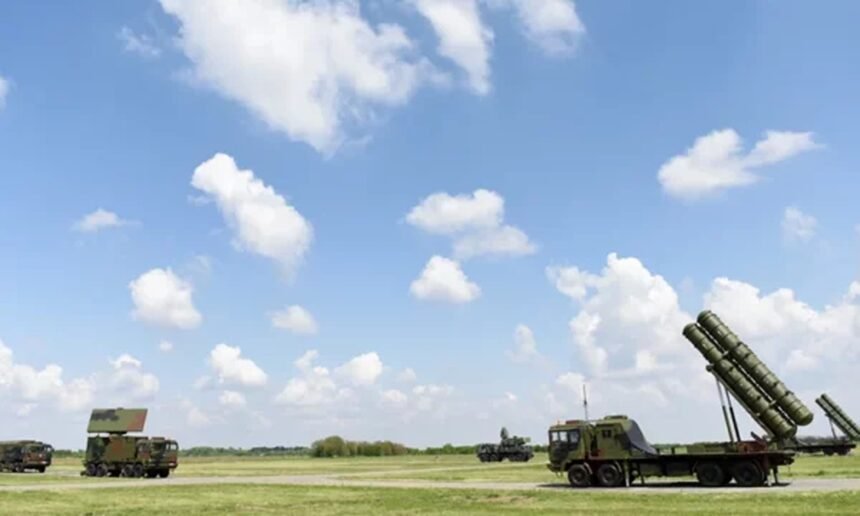
Serbia continues expanding its military arsenal with Chinese-made weapons. During a military exercise and weapons display on June 28, Serbian President Aleksandar Vučić announced that the country will purchase additional CM-400 supersonic ballistic missiles, along with new military aircraft.
Vučić described the CM-400 missiles as “terrifying missiles” and said Serbia plans to increase its stockpile.
Katarina Đokić, a researcher at the Stockholm International Peace Research Institute, told Radio Free Europe/Radio Liberty that the announcement strongly suggests Serbia’s new fighter aircraft will also be purchased from China.
“It makes little sense to buy such expensive missiles for aircraft that will soon no longer be operational,” she said.
Vučić first confirmed in March that Serbia had purchased Chinese missiles, although Serbian authorities have yet to disclose their price or the number acquired.
According to international arms registers, Serbia is the only country in Europe to possess CM-400 missiles, while China has become its largest military supplier.
The purchase of Chinese weapons is part of the strengthening relationship between China and Serbia, which officials from both countries have repeatedly described as an “ironclad friendship.”
The European Union and the United States have repeatedly warned Serbia about the risks of deepening military cooperation with China, particularly as Serbia remains a candidate for EU membership.
A “Credible Alternative”
According to Đokić, there are several reasons why Serbia continues turning to China for military equipment.
“China presents itself as a credible alternative, especially considering that its weapons are generally cheaper than Western-made systems,” she said.
She added that political considerations also limit Serbia’s ability to purchase more advanced weapons from the United States, one of the world’s largest arms exporters.
“Since Serbia is not a NATO member, it is not considered a reliable partner by the United States. When it comes to sophisticated systems such as fighter aircraft or advanced air-defense systems, the U.S. sells them to its allies,” Đokić explained.
She also noted that Chinese weapons are largely based on Soviet military technology, which Serbia already operates, making integration into its existing arsenal relatively straightforward.
In addition to the missiles, the Serbian Armed Forces received Chinese CH-92A armed drones in 2020—the country’s first Chinese weapons system to enter operational military service.
Serbia later acquired CH-95 combat drones, as well as the Chinese FK-3 and HQ-17 air-defense systems.
Cooperation Continues Despite Western Warnings
Serbia’s growing purchases of Chinese military equipment have drawn strong international criticism.
In June, the European Parliament Committee on Foreign Affairs strongly condemned Serbia’s acquisition of CM-400 missiles, stating that the purchase contradicts the European Union’s Common Foreign and Security Policy.
According to the committee, the acquisition “raises serious questions about Serbia’s geopolitical orientation.”
Meanwhile, during a December 2025 hearing of the U.S. House Foreign Affairs Committee on the Western Balkans, lawmakers argued that both China and Russia continue contributing to regional instability.
Republican Congressman Keith Self said China is expanding its influence through military exercises and arms sales to Serbia.
Serbian foreign policy analyst Boško Jakšić believes Serbia’s purchases send a clear political message at a time when both Washington and Brussels expect Belgrade to reduce its ties with both China and Russia.
“This contradicts what Serbia officially declares—its commitment to European Union integration,” Jakšić said.
Message to the Region
Vučić’s announcement of Serbia’s purchase of Chinese CM-400 missiles also raised concerns across the Western Balkans.
Croatian Prime Minister Andrej Plenković said Zagreb would discuss the issue with its NATO allies.
“We will consult our partners within the Alliance and alert them to this new addition to Serbia’s military arsenal,” Plenković said.
Vučić responded by insisting that “Zagreb will not decide what weapons Serbia will possess.”
He also claimed Serbia is preparing for a possible threat from what he described as an alliance between Kosovo, Albania, and Croatia.
In March 2025, Kosovo, Albania, and Croatia signed a declaration on cooperation in defense and security. Serbian officials described the agreement as a threat to Serbia’s security, while all three signatories rejected those claims.
Vučić stated that the Chinese CM-400 missiles have a range of between 200 and 400 kilometers, describing them as highly destructive weapons.
Đokić said regional reactions are understandable given that it remains unclear what Serbia ultimately intends to achieve through its military buildup.
Jakšić believes Serbian authorities are pursuing a policy of strategic balancing while simultaneously fueling a regional arms race.
“All of this fits into a policy of irrational spending. With our money, Vučić is buying political support—from Beijing to Paris and Moscow,” he said.
Military Spending Continues to Increase
During the June 28 military display, Vučić told reporters that Serbia’s armed forces now operate missiles from China, the United States, Russia, France, and domestic manufacturers.
According to SIPRI data, China has become Serbia’s largest arms supplier in recent years, followed by:
- France, accounting for 12 percent of imports;
- Russia, accounting for 7 percent.
One of Serbia’s largest recent military purchases remains its acquisition of 12 Dassault Rafale fighter jets from France in a deal worth €2.7 billion.
From Russia, Serbia has acquired used Mikoyan MiG-29 fighter jets, helicopters, the Pantsir-S1, and 9M133 Kornet anti-tank missiles.
Rising Defense Spending
According to SIPRI’s 2025 data, Serbia spends more on defense than any other country in the Western Balkans, most of which are NATO members.
Đokić noted that Serbia’s defense spending has steadily increased since 2017, although the reasons behind this trend remain unclear.
She pointed out that Serbia’s strategic defense documents do not clearly identify the threats facing the country.
“On the one hand, it was expected that Serbia would eventually modernize its military arsenal. On the other hand, there is still no clear explanation of what exactly these weapons are intended for,” she said.
Serbian officials have repeatedly insisted that Serbia has no intention of attacking any neighboring country.
Đokić also observed that higher defense spending is becoming a broader European trend, largely driven by Russia’s full-scale invasion of Ukraine in 2022 and increased pressure on NATO members to strengthen their military capabilities.
Although Serbia has participated in NATO’s Partnership for Peace program since 2006, it continues to maintain its policy of military neutrality.