
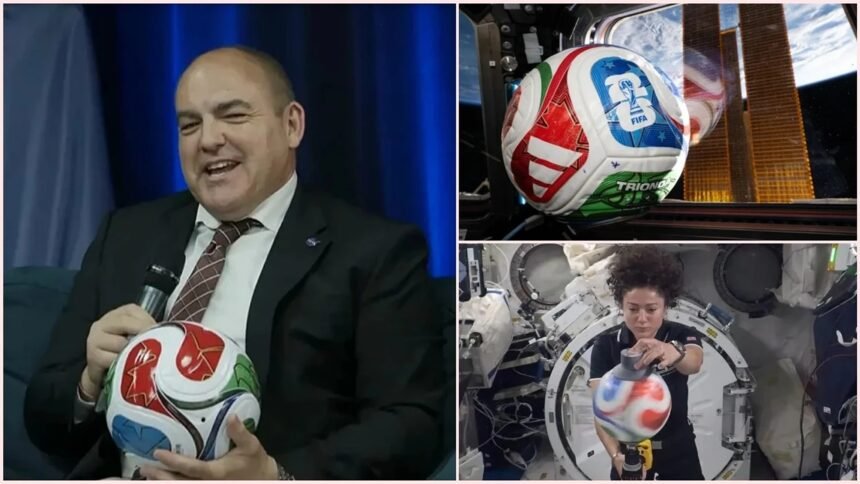
The United States men’s national soccer team has received an unusual promise that could serve as extra motivation for the 2026 FIFA World Cup. If the team wins the tournament, NASA has pledged to send a soccer ball to the surface of the Moon.
The announcement was made by NASA Administrator Jared Isaacman during a presentation on the Artemis program, which aims to return humans to the Moon and establish a sustainable base near its south pole.
“A little extra motivation for Team USA. We’ll go even further than Alan Shepard, who played golf on the Moon, by sending a soccer ball there,” Isaacman said.
He was referring to astronaut Alan Shepard, commander of the Apollo 14 mission, who made history on February 6, 1971, by hitting two golf balls on the lunar surface, becoming the first person to play a sport beyond Earth.
Unlike Shepard’s personal initiative, the soccer ball NASA plans to send to the Moon would be part of an officially approved agency project.
Carlos García-Galán, head of NASA’s Moon Base program, is also involved in the initiative. Isaacman joked that it has not yet been decided which spacecraft will transport the ball, humorously assigning that responsibility to García-Galán.
García-Galán welcomed the idea with the same sense of humor, saying it would be an extraordinary moment if the United States were to win the World Cup and the project became a reality.
However, the road to the world title remains challenging for the Americans. Although the United States is one of the tournament’s host nations, alongside Canada and Mexico, the team must overcome strong opponents to reach the final.
Historically, the U.S. national team has struggled in the FIFA World Cup knockout stages. Before this edition, it had won only two knockout matches, with one of those victories dating back to 1930.
This time, however, the team has shown impressive form. The United States finished top of its group after victories over Paraguay and Australia, while a defeat to Türkiye did not affect its qualification.
In the first knockout round, the U.S. secured a 2-0 victory over Bosnia and Herzegovina and will now face Belgium in the Round of 16, a match widely regarded as its toughest test so far.
If the Americans overcome Belgium, they will move one step closer to lifting the World Cup trophy—and turning NASA’s promise into reality.
This would not be the first time a World Cup soccer ball has traveled into space. NASA previously sent an official tournament ball to the International Space Station, where astronauts were filmed playing with it inside the Japanese Kibo module.
In a post published on X on June 20, NASA said the initiative is intended to inspire younger generations by connecting space exploration with sports, technology, and innovation.
If the United States wins the 2026 FIFA World Cup, football history could gain another remarkable milestone, with an official tournament soccer ball becoming one of the few sporting objects ever to reach the surface of the Moon.