The official visit of Albanian President Bajram Begaj to the municipalities of Preševo and Bujanovac has triggered a wave of sharp reactions across the Serbian public, opening up a complex debate involving state sovereignty, security protocols, and diplomatic precedents.
While regional leaders frequently conduct working visits to ethnic minority communities across the Western Balkans, the specific logistics surrounding Begaj’s itinerary have drawn heavy scrutiny from local politicians, security analysts, and the media.
The “Long Barrels” Controversy Outside Bujanovac Municipality
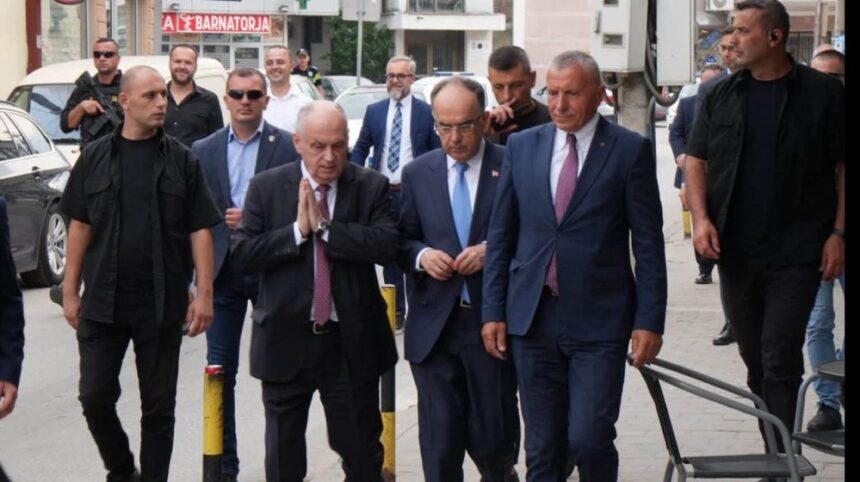
The primary catalyst for public alarm was the visual presence of security personnel armed with automatic rifles (“long barrels”) stationed directly outside the Bujanovac municipal building during the President’s arrival.
                       ┌── Institutional Rule: Armed foreign details require explicit MUP & BIA approval.
THE SECURITY PROTOCOL ─┼── Presidential Clarification: Vučić states the armed personnel belonged to Serbian units.
                       └── Public Skepticism: Opposition figures question the identity of the armed detail.
Under Serbian law governing the visits of foreign heads of state, foreign presidential guards operate under strict coordination with domestic services, and carrying automatic weaponry requires explicit prior clearance from the Security-Information Agency (BIA) and the Ministry of Internal Affairs (MUP).
Responding to sharp inquiries, Serbian President Aleksandar Vučić clarified that Begaj had received all necessary state approvals for his visit, adding that the heavily armed personnel on-site were actually Serbian security forces assigned to guarantee the perimeter. Despite this, segments of the public and local opposition politicians have openly questioned the true identity of the armed detail.
Crossing the Administrative Line: A Significant Protocol Shift
Beyond the immediate security optics, political analysts have highlighted a much larger diplomatic shift: Begaj entered central Serbia directly from Kosovo via the Končulj administrative crossing, rather than flying into Belgrade’s Nikola Tesla Airport.
This routing carries immense geopolitical friction:
- The Sovereignty Dispute: Because Serbia does not recognize Kosovo’s 2008 declaration of independence, Belgrade views the administrative line as an internal boundary rather than an international border.
- The Protocol Precedent: Historically, Belgrade has blocked foreign state officials from using Kosovo as a transit point into central Serbia. Critics argue that by officially approving this route, the government in Belgrade has practically treated the administrative crossing as an international border link, contradicting its own constitutional stance.
Furthermore, Begaj completely bypassed Belgrade, holding zero meetings with Serbian state officials—a move that, while legally permissible for working visits, is traditionally viewed in diplomacy as an intentional omission of the host country’s state sovereignty.
Low Public Turnout and Local Impact
Despite the high-level political friction generated in Belgrade, observers noted a stark disconnect on the ground in southern Serbia.
Although local ethnic Albanian political leaders had publicly called on the community to turn out in large numbers to welcome the Albanian President, ordinary citizens largely stayed away, leaving only local politicians and official delegations to attend the scheduled events.
The visit highlights the persistent fragility of regional diplomacy, demonstrating how routine cross-border ethnic engagements can quickly transform into broader disputes over territorial integrity and security jurisdiction in the Western Balkans.