Six candidates for the position of United Nations Secretary-General will debate on Thursday in the General Assembly hall, one week before the official start of the decisive election process for an organization facing a deep crisis.
In a race with no clear favorite and limited enthusiasm, the candidates will answer questions from diplomats, UN staff, and civil society representatives during a 90-minute session. The event begins at 5 p.m. local time and will be broadcast by Bloomberg.
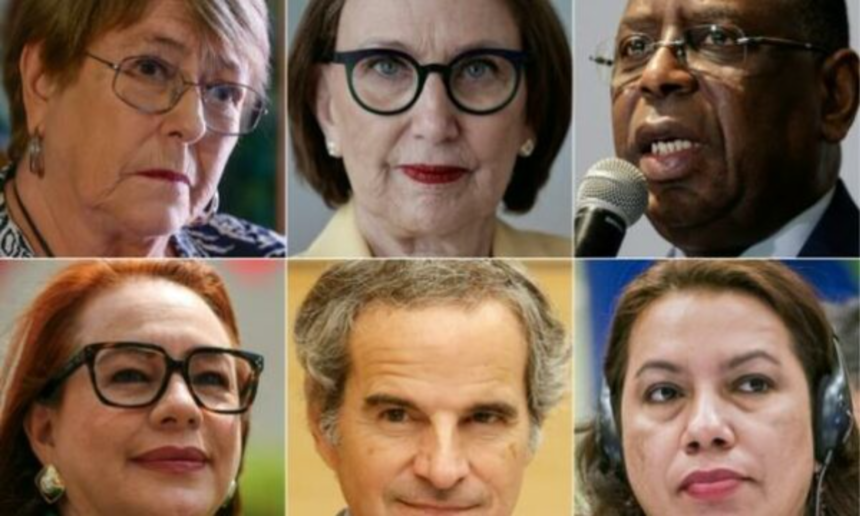
The candidates seeking to succeed outgoing Secretary-General Antonio Guterres are Michelle Bachelet of Chile, Maria Fernanda Espinosa of Ecuador, Rafael Grossi of Argentina, Rebeca Grynspan of Costa Rica, Carolyn Rodrigues-Birkett of Guyana, and Macky Sall of Senegal.
“This public UN discussion will provide a rare opportunity to present the candidates’ ideas, priorities, and leadership vision for one of the most important offices in the world,” said UN General Assembly President Annalena Baerbock.
“In an increasingly divided world, the United Nations needs not only an exceptional chief administrator who can adapt the organization to the 21st century, but also a leader with integrity who is ready to strongly defend the UN Charter and its three pillars,” she added.
The United Nations is facing a serious financial and credibility crisis, while the administration of US President Donald Trump has accused the organization of wasteful spending, excessive activities, and insufficient results.
For this reason, the United States is calling for a return to the organization’s core goals of peace and security, while other countries emphasize the equal importance of the remaining two pillars: human rights and development.
Analyst Richard Gowan from the International Crisis Group told AFP that under these circumstances, “the race appears to lack energy” compared with the more dynamic 2016 campaign, when there were more candidates and greater uncertainty before Guterres was selected.
“This time, everyone agrees that the race is extremely important for the future of the UN, but the campaign itself has been quite cautious. There is a sense that candidates are carefully choosing their moves so as not to offend the United States and other veto powers,” he added.
The candidates have already faced three hours of questions from representatives of all 193 UN member states.
Most of them have emphasized the need for continued reform of the organization to make it more effective, as well as the importance of greater involvement by the secretary-general in global peacekeeping efforts.
The 15-member UN Security Council will hold its first closed and anonymous vote on the candidates on July 30.
After this “first test vote,” an undetermined number of similar ballots will follow until one candidate secures the required nine votes and is not blocked by a veto from one of the five permanent members of the Security Council.
The name of the selected candidate will then be sent to the General Assembly for formal appointment.
The new secretary-general will take office on January 1, 2027.
Several diplomats interviewed by AFP were cautious in predicting the outcome, saying many capitals had not yet made a final decision.
“I think Grossi is still the most frequently mentioned favorite, but he is not guaranteed to win. Candidates such as Grynspan and Rodrigues-Birkett also have a large number of supporters,” Gowan said, adding that a surprise candidate could still emerge.
Several names continue to circulate in UN corridors and the media, including FIFA President Gianni Infantino, whom the New York Post reported that President Trump allegedly would like to see leading the United Nations.
Under a tradition of geographical rotation that is not always followed, Latin America is seeking the position this time.
Many countries are also calling, for the first time in history, for a woman to lead the United Nations.