A three-day debate on a no-confidence motion against the Government of Serbia led by Prime Minister Đuro Macut has begun in the National Assembly, with political parties discussing possible scenarios, including the government’s resignation and the holding of early parliamentary elections.
The debate was requested by 62 opposition lawmakers in February, while the required signatures and quorum for the session were later provided by 109 lawmakers from the ruling majority.
Political actors are now awaiting the outcome of the parliamentary process, with expectations ranging from a possible government collapse to the resignation of Prime Minister Macut for political reasons.
A scenario in which the government survives the no-confidence vote has also not been ruled out, as a way for the ruling coalition to demonstrate that the opposition does not have enough votes to remove it. However, analysts and opposition representatives suggest that Macut’s resignation could still follow due to broader political calculations.
President Aleksandar Vučić’s second term expires in May 2027, but he is expected to resign earlier and participate in early parliamentary elections as a candidate for prime minister. Vučić has previously announced that elections could be held in the autumn.
The head of the parliamentary group “Aleksandar Vučić – Serbia Must Not Stop,” Milenko Jovanov, said that after the debate, conditions could be created for calling early parliamentary elections.
Jovanov argued that the opposition does not have the capacity to vote down the government, claiming that the ruling majority allowed the debate to take place so citizens could hear about the government’s achievements over the past year.
“The opposition has no capacity to pass a no-confidence vote against the Government of Serbia,” Jovanov said, adding that the debate would allow the ruling coalition to present its record ahead of a possible election campaign.
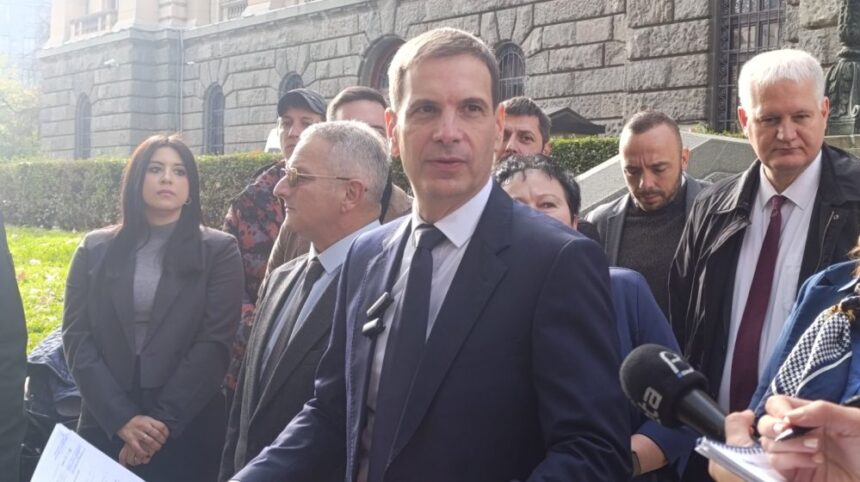
Meanwhile, the NADA coalition, composed of the New Democratic Party of Serbia (Nova DSS) and the Monarchists, continued its boycott of parliamentary work and announced that its 10 MPs would not participate in the debate.
Nova DSS leader Miloš Jovanović said that the current parliament had lost legitimacy and no longer represented the will of citizens.
“This parliamentary composition lost legitimacy long ago when the regime began using force against citizens and abusing institutions in order to remain in power,” Jovanović said, calling for fair and free elections.
Dušan Radosavljević, co-president of the Monarchists – Movement for the Kingdom of Serbia, also called on opposition parties to join the boycott, arguing that there was no reason for the authorities to delay elections.
The debate comes amid continued political tensions in Serbia, with the future of the Macut government and the timing of possible early elections becoming central issues in the country’s political landscape.