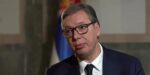
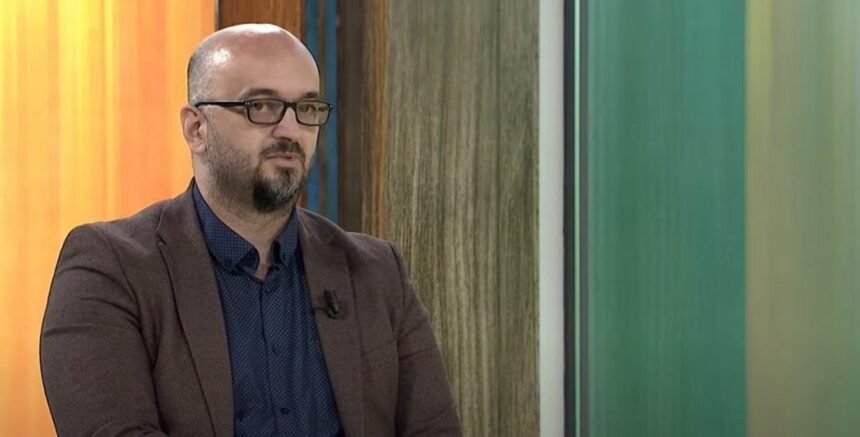
Security expert Drizan Shala believes that the latest statements by Serbian President Aleksandar Vučić reflect Belgrade’s strategic direction and an effort to build a narrative that could justify a military intervention in Kosovo.
He also criticized the European Union’s approach toward Serbia, arguing that Brussels is applying double standards.
In an interview, Shala said the message Vučić delivered to newly commissioned cadets at Serbia’s Military Academy should be seen as a warning for security in the Western Balkans.
“During the graduation ceremony at Serbia’s Military Academy, Aleksandar Vučić conveyed a highly significant message regarding regional security threats facing the Western Balkans. He told the newly graduated officers that they must prepare for a crucial issue that will define the coming decade. He said they must be ready to defend the land and that their oath includes defending the land of Kosovo, which Serbia considers part of its territory under its Constitution, while claiming that UN Security Council Resolution 1244 is no longer valid,” Shala said.
According to Shala, recent statements by Serbian officials indicate that Belgrade is attempting to create conditions for a possible military intervention.
“This demonstrates that Serbia is deliberately planning how to intervene, as it believes the international legitimacy guaranteeing peace and security in the Republic of Kosovo no longer exists. This political will has also been reflected in statements by one of Vučić’s ministers, who said that ‘we should carry out ethnic cleansing as happened in the 1990s.’ All of this points to the strategic orientation of official Belgrade. Aleksandar Vučić and his political leadership are attempting, under any eventual circumstances, to create the political momentum and narrative for military intervention,” he said.
The security expert also criticized the European Union’s policy toward Serbia, arguing that the lack of a firm response to statements by Serbian officials gives Belgrade greater room to maneuver.
“The European Union is applying double standards, which in practice provide President Vučić with more space for action and political maneuvering. By avoiding sanctions against official positions expressed by Serbia’s institutional leaders, the EU appears to believe it can pull Serbia away from Russia’s orbit. However, the past two decades have shown that Serbia has never genuinely represented the policies or values of the European Union in the Western Balkans,” Shala stated.
He added that, in his view, this approach is having a negative impact on regional security.
“Serbia has consistently sought to maintain a balance in its relations with the international community, but in practice this has allowed it greater freedom to act. Therefore, the European Union’s position is contradictory and ultimately contributes to developments that directly undermine collective security in the Western Balkans,” he said.
A few days ago, Serbian President Aleksandar Vučić told newly commissioned officers at the Military Academy to be prepared to defend what he described as Serbia’s “holy land,” referring to Kosovo.
Meanwhile, several weeks earlier, Serbian minister Paunović stated that, had she been in the position of Slobodan Milošević, she would have carried out the ethnic cleansing of Kosovo.
On Wednesday, Serbian Parliament Speaker Ana Brnabić also reacted after an MP referred to Kosovo as a neighboring state, stressing that this does not reflect the official position of the Serbian Parliament.
“For the National Assembly of the Republic of Serbia, these are not our neighbors. Kosovo is an integral part of the Republic of Serbia—an autonomous province, the Autonomous Province of Kosovo. These are not our neighbors. That may be your opinion, and it is clearly your position, which is why I did not interrupt you, but it is not the official position of the National Assembly of the Republic of Serbia. Thank you,” Brnabić said.