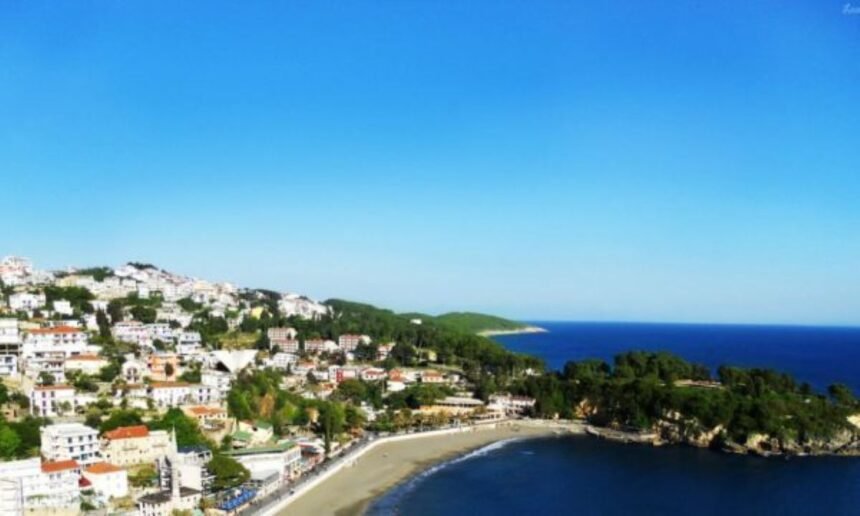
A political dispute over whether Ulcinj should be described as an “Albanian city” has reignited a sensitive debate over ethnic identity, local politics and the character of Montenegro as a multiethnic state.
Montenegrin Deputy Prime Minister and Minister of Economic Development Nik Gjeloshaj, leader of the Albanian Forum, sparked the controversy by describing Ulcinj as an “Albanian city” and accusing its local leadership of corruption. He also pledged that the city would be “liberated” in the 2027 local elections.
“Ulcinj is a city with an Albanian majority. Ulcinj is an Albanian city,” Gjeloshaj wrote on Instagram, adding that he envisioned the coastal municipality becoming a major European tourism center.
His remarks came a day after a heated parliamentary debate involving representatives of the Albanian Forum and the Albanian Alliance during discussions on amendments to Montenegro’s Law on Local Self-Government.
The debate focused partly on the status of historic urban centers such as Ulcinj and Kotor. Albanian Alliance MP Ilir Çapuni argued that historic cities were being stripped of their status, while Albanian Forum MP Artan Çobi described Ulcinj as an ancient Illyrian city with which Albanians around the world identify.
“Ulcinj was an Albanian city that was defended. Historical circumstances and the great powers determined that it would become part of Montenegro,” Çobi said, later clarifying that he was referring to the fact that Albanians constituted the majority of the population at the time.
The controversy quickly moved from parliament to social media and the wider political arena.
Gjeloshaj defended the terminology, arguing that references to an “Albanian municipality” or “Albanian city” do not imply territorial belonging to Albania, but rather describe the historical, cultural and demographic identity of communities within Montenegro.
He also accused parts of Montenegrin society of continuing to display strong anti-Albanian sentiment.
“When we say ‘Albanian municipality’ or ‘Albanian city’, we do not mean that they belong to Albania, but describe their historical, cultural and demographic identity within Montenegro,” Gjeloshaj said.
He stressed that his political activity was aimed at protecting Albanian interests while simultaneously working in the interests of all Montenegrin citizens, arguing that minority rights and Montenegro’s European integration were not contradictory goals.
The mayor of Ulcinj, Genci Nimanbegu, however, dismissed Gjeloshaj’s intervention as “belated wisdom” and suggested that the rhetoric was primarily motivated by the upcoming elections.
Asked what he understood by the description of Ulcinj as an “Albanian city”, Nimanbegu gave a brief answer: “Pre-election.”
The dispute has also drawn criticism from Montenegro’s opposition, with Democratic Party of Socialists leader Danijel Živković warning that the language used by politicians could have broader consequences for the country’s political identity.
Živković distinguished between saying that Ulcinj has an Albanian majority, which he described as a fact, and calling it an “Albanian city”, which he said constitutes a political message that could open the door to similar claims about cities associated with Serbs, Bosniaks or Montenegrins.
“If we accept the logic that Cetinje is Montenegrin, Andrijevica Serbian, Rožaje Bosniak and Ulcinj Albanian, Montenegro ceases to be a state and becomes a collection of national territories,” Živković warned.
He argued that every city in Montenegro belongs to all of its citizens regardless of ethnicity and defended the concept of a civic state in which citizens can preserve their ethnic, religious and cultural identities without turning territory into exclusive ethnic domains.
The dispute over “whose Ulcinj is it?” highlights the continued sensitivity of identity politics in Montenegro, where ethnic, historical and political questions remain closely intertwined.
While Albanian political representatives emphasize Ulcinj’s overwhelmingly Albanian historical and demographic character, their opponents warn that defining cities primarily along ethnic lines risks undermining Montenegro’s civic identity and deepening political divisions ahead of the 2027 local elections.