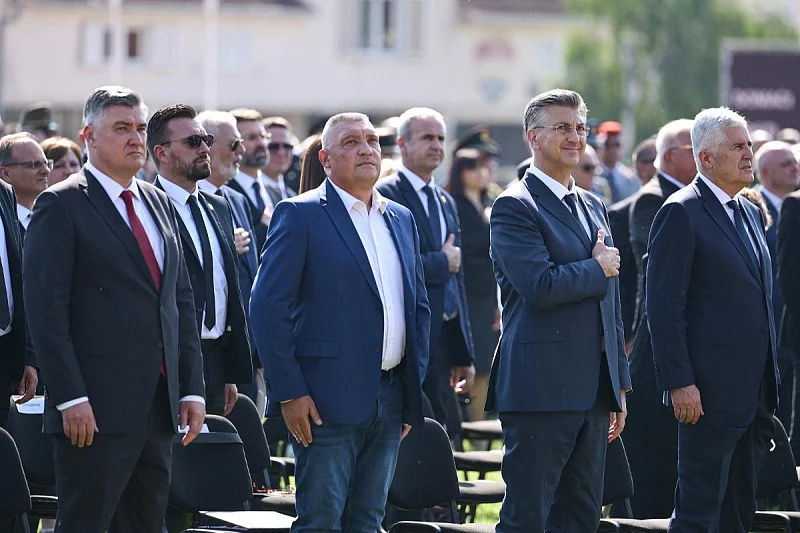
Croatia marked the 31st anniversary of the military and police operation “Storm” (Oluja) in Knin on Tuesday, with Prime Minister Andrej Plenković and President Zoran Milanović using the commemoration to address the operation’s role in ending the war in Bosnia and Herzegovina and to warn about Serbia’s military buildup.
Speaking at the central ceremony in Knin, Milanović described Serbia’s growing military capabilities as a regional security concern, arguing that Croatia should focus less on political rhetoric and more on developments that could have direct security implications.
“We should not react to every verbal absurdity that comes across the Danube. However, what is happening in the material sphere, namely the arming, is something we need to deal with,” Milanović said.
He argued that Serbia’s military buildup affects Croatia’s security and carries both financial and potential military consequences.
Referring to the significance of Operation Storm, Milanović said: “Without the Croatian Army, there would have been no Dayton.”
He added that Croatia had won the war while Serbia continued to strengthen its military and repeatedly stated that Operation Storm must never happen again.
Plenković, meanwhile, emphasized the operation’s broader consequences for Bosnia and Herzegovina, particularly the situation in Bihać.
“Storm was a brilliant victory. Storm saved Bihać from an impending humanitarian catastrophe, changed the balance of power in Bosnia and Herzegovina and opened the way to peace and the Dayton Agreement,” Plenković said.
The Croatian prime minister also addressed the issue of missing Croatian servicemen, describing them as victims of the regime of former Serbian president Slobodan Milošević.
The annual commemoration in Knin traditionally includes a display of the capabilities of the Croatian Armed Forces. This year’s ceremony featured flyovers by Rafale fighter jets and a large number of Croatian military helicopters.
Croatian Defence Minister Ivan Anušić said the anniversary brought mixed emotions but that pride and happiness ultimately prevailed.
He said Croatia had managed to end the war and establish a free and independent state in 1995 despite having been given little chance of achieving victory when the conflict began in 1991.
Operation Storm remains one of the most significant and contested events of the wars of the 1990s. Croatia commemorates it as a decisive military victory and a key step toward ending the conflict, while Serbia and representatives of the Serb community continue to commemorate the displacement and deaths of Serb civilians during and after the operation.