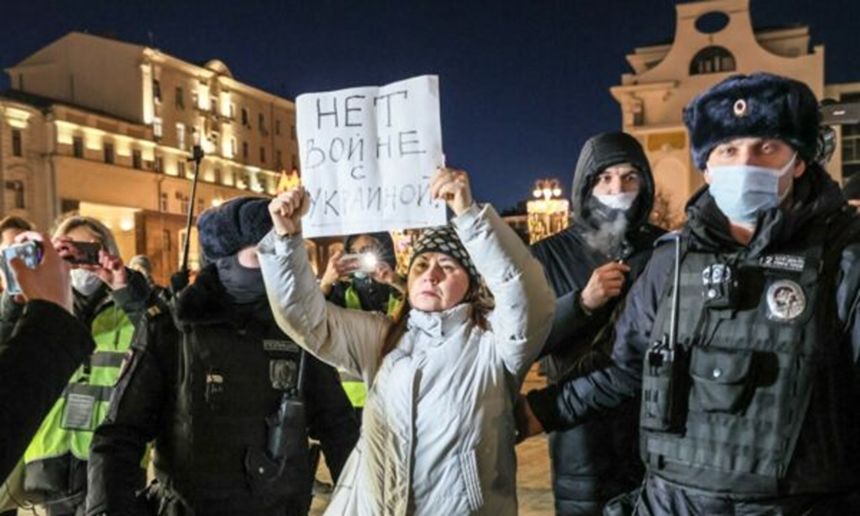
At a time when he left Russia in September 2022, Aleksandr Menyukov was witnessing a criminal investigation targeting one of his close friends — a poet whose public street readings of anti-war verses were treated as a crime.
Hundreds of thousands of Russians fled the country after President Vladimir Putin ordered a military mobilization that same month to reinforce the invasion of Ukraine. For Menyukov, who provided legal assistance to Russians opposing the war, the breaking point came when he was severely beaten during a police raid on his apartment in Moscow.
In Kazakhstan, he rushed to obtain a new passport before his existing one expired, a process made even more difficult by the large number of other Russians trying to secure their documents at the same time. A few months later, he ended up in Poland on a humanitarian visa.
Now, Menyukov’s life — and potentially that of thousands, if not tens of thousands, of Russians living abroad — could become significantly more difficult.
Under a law signed by Putin on August 4, Russian citizens living abroad who have been convicted by Russian authorities of administrative or criminal offenses will be prohibited from carrying out basic legal procedures, such as renewing passports or notarizing documents, including marriage certificates.
The measure could affect activists who have worked with foreign-funded organizations, ordinary Russian citizens who communicate with organizations labeled as “undesirable,” or individuals who simply question the enormous losses suffered by the Russian military in Ukraine.
Human rights lawyers, activists, and Russians living abroad have described the measure as “civil death,” warning that it could trap people in a legal and bureaucratic limbo with very limited options for protection.
“If I had been in Poland when my Russian passport expired and these restrictions had already been in force, I would have been denied the right to apply for a new passport,” Menyukov said in an interview from Warsaw. “That is how it works. And now this will become a major problem for Russians.”
“Technically, Russian citizens will not lose their citizenship,” said Tanya Lokshina, a Russian researcher at Human Rights Watch. “They will remain Russian citizens, but without access to legal services. De facto, it is similar to being stateless.”
The goal, according to Russian lawyer Gleb Bogush, who now lives in Berlin, “is to send a message and create a chilling effect both among those who have left the country and those who remain.”
Russian officials have openly expressed their intentions.
“All those who have gone abroad and are harming the state are not opposition figures; they are traitors, they are criminals,” said Vyacheslav Volodin, speaker of Russia’s lower house of parliament, after lawmakers approved the bill.
“An apartheid system”
For more than two decades, Russian authorities have gradually expanded their legal arsenal to punish dissent, censor independent media, shut down civil society organizations, and silence opposition figures.
These measures include the “foreign agents” law, which targets individuals and groups receiving foreign funding, as well as legislation against “undesirable organizations,” which bans foreign groups deemed a threat to national security and criminalizes cooperation with them.
Since Russia launched its full-scale invasion of Ukraine in 2022, authorities have introduced even harsher measures.
People who publish information about Russian military casualties or alleged war crimes committed in Ukraine can face prosecution for “discrediting the Russian armed forces.” Russian citizens who refer to Ukrainian territories illegally annexed by Moscow as Ukrainian land can be accused of undermining Russia’s territorial integrity.
Under the new law, Russians living abroad who have been convicted for certain crimes could effectively lose what legal experts consider a fundamental right under international law: access to consular services.
“The strategy is not to strip Russian citizens of their citizenship. The strategy is to weaponize citizenship,” Bogush said. “It is another building block in creating a system of partial apartheid: separating a specific group of people whom the system considers enemies or ‘undesirable.’”
“If someone who left Russia for political reasons is labeled a ‘defector,’ they will become a ‘cancelled citizen’ inside the country,” said First Department, a group of Russian legal activists.
For example, if a Russian citizen abroad needs a marriage certificate, birth certificate, or proof of no criminal record from Russia, obtaining these documents could become impossible.
The measures also allow authorities to freeze bank accounts and prevent individuals from selling property, including apartments or vacation homes, or transferring ownership to relatives.
“A war against its own citizens”
The law also allows officials to open bank accounts on behalf of individuals accused of violating Russian laws and effectively manage those accounts — for example, using pension payments to cover court-imposed fines or other obligations.
“This is truly a law of civil death,” Lokshina said. “If you do not remain silent and continue speaking openly, sooner or later you will face prosecution.”
The legal uncertainty faced by Russians abroad is further complicated by the fact that several countries, both inside and outside the European Union, have made it more difficult for Russian citizens to obtain residence permits, work permits, or citizenship.
“For many of them, they also have no real support in the countries where they live. People persecuted by the Russian government often face collective suspicion in the places where they reside,” Bogush said.
The adoption of this law comes as the Kremlin attempts to maintain its war effort in Ukraine while minimizing the scale of Russian military losses. At the same time, Russia’s economy is showing signs of pressure, fueling domestic dissatisfaction.
Kremlin analysts say authorities are also concerned about upcoming parliamentary elections, where a weaker-than-expected result for candidates from the ruling United Russia party could damage the narrative of national unity.
“Putin is not only escalating the war against Ukraine; he is also escalating the war against his own citizens,” Bogush said.