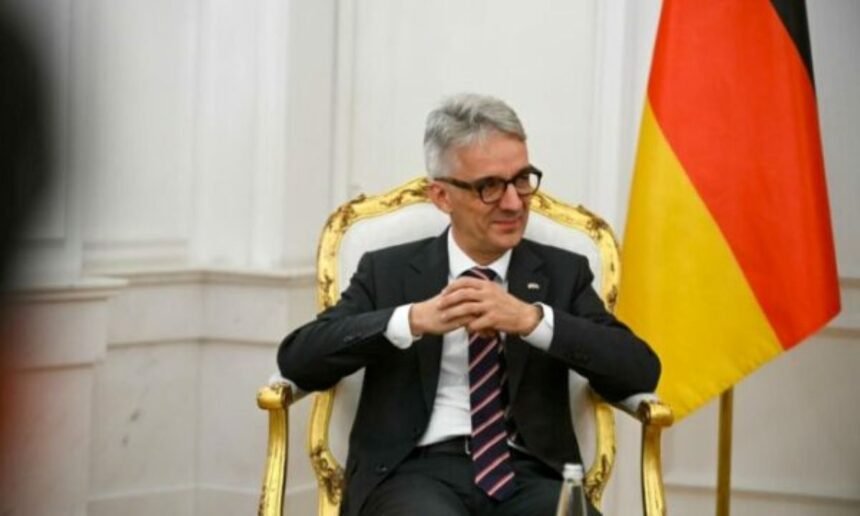
Germany has joined the European Union in warning against statements that could undermine the normalization of relations between Kosovo and Serbia, after Serbian President Aleksandar Vučić raised the possibility of changing the course of the Ibar River.
In a response to Gazeta Express, the German Embassy in Kosovo said Vučić’s remarks about potentially diverting the river do not contribute to the objective of normalizing relations between Prishtina and Belgrade and called on all sides to avoid statements and actions that could obstruct progress in the dialogue.
“As we have stated before, Germany remains committed to Kosovo’s independence and its European integration. To make progress on this path, Kosovo and Serbia must continue the normalization of their relations through dialogue,” the embassy said.
“Statements regarding a change in the course of the Ibar River do not support this objective. Once again, we call on all actors to refrain from statements and actions that hinder progress toward normalization through dialogue,” it added.
Vučić said on Sunday that Serbia was considering changing the course of the Ibar on its territory, citing what he described as the mistreatment of Serbs in Kosovo.
“We have already invited experts dealing with this issue, the construction sector, engineers and others. Since they are mistreating our people so much, let us see—we have various reasons for changing the course of the Ibar, and then we will see what the Albanians will do and how they will behave,” Vučić said.
The Serbian president had previously raised the idea in December 2024, following the explosion that damaged the Ibar-Lepenc canal in Varage, near Zubin Potok. While denying Serbian involvement in the incident, Vučić said at the time that proposals to alter the river’s course had existed since 1985.
The European Union issued a similar warning on Tuesday. EU spokesperson Anitta Hipper said statements concerning possible changes to the course of rivers, as well as actions that could undermine normalization, should be avoided.
“This can only be achieved through dialogue. We also recall that progress in the dialogue between Belgrade and Prishtina is a prerequisite for either side to advance on its European path,” Hipper said.
Kosovo’s acting president, Albulena Haxhiu, has described the proposal to divert the Ibar as “absurd,” “threatening” and “chauvinistic.”
The issue has also triggered a diplomatic exchange between Albania and Serbia.
Albanian Foreign Minister Ferit Hoxha said water must not be used as a tool of political pressure or as a means of punishing another country or population.
“Rivers should carry water, not threats, and borders should define jurisdictions, not divide our responsibility for peace,” Hoxha wrote on X.
His Serbian counterpart, Marko Đurić, responded by accusing Hoxha of attempting to divert attention from what Belgrade describes as violations of the rights of Serbs in Kosovo.
Albanian Prime Minister Edi Rama subsequently entered the debate, dismissing attempts to shift the discussion from transboundary water management to issues such as “Greater Albania” and Kosovo’s status as “political folklore” in Belgrade.
“Serbia is completely free to manage resources within its jurisdiction. What it cannot reasonably argue is that the potential consequences for another country somehow stop magically at the Serbian border. Ultimately, that is why international water law exists,” Rama said.
The debate comes as concerns have also emerged over developments around the Ibar Bridge in Mitrovica. NATO’s KFOR has recently confirmed a gradual transition of its permanent presence at the bridge, citing improvements in Kosovo’s security situation and an optimization of its deployment.
Asked about the development, the German Embassy did not comment specifically on the role of the Kosovo Police but reiterated Berlin’s support for KFOR and its mandate.
“Germany remains committed to its contribution to KFOR, mandated by the Bundestag, as well as to KFOR’s mission to maintain a safe and secure environment for all people living in Kosovo,” the embassy said.
The renewed dispute over the Ibar comes amid heightened political tensions between Kosovo and Serbia and growing international calls for both sides to avoid rhetoric or actions that could further complicate the normalization process.