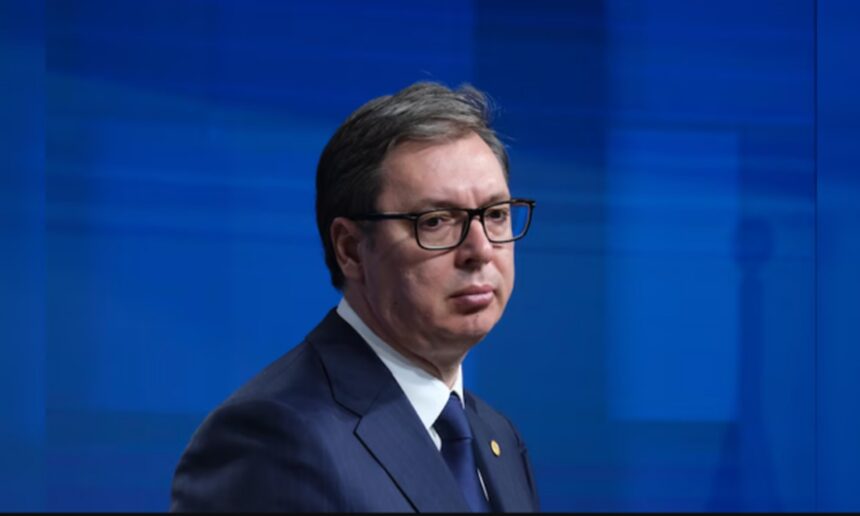
Serbian President Aleksandar Vučić has again raised the possibility of changing the course of the Ibar River, saying that Serbia could involve international experts in examining the controversial proposal.
Speaking during a visit to Ivanjica, Vučić referred to the issue for the fourth time in three days, amid strong criticism from Kosovo, the United States, the European Union and Albania.
Asked about the growing reactions to his earlier remarks concerning the Ibar and Kosovo, Vučić said the proposal had generated numerous interpretations and should ultimately be assessed by experts.
“There are countless interpretations. We will form a commission, a working group, and then look at everything, the documents and so on,” Vučić said, according to Kossev.
He added that international experts could also potentially be involved in examining the proposal.
Vučić first revived the idea of altering the Ibar’s course in recent days, saying Serbia was considering the possibility of diverting the river within its territory. He linked the proposal to what he described as the treatment of Serbs in Kosovo.
The idea has drawn strong criticism because the Ibar supplies the Ujman/Gazivoda reservoir, a critical source of water for Kosovo. Any major reduction in the river’s inflow could have consequences for water supplies, agriculture, industry and energy production in Kosovo.
The European Union and Germany have both warned that statements concerning a possible change in the river’s course do not contribute to the normalization of relations between Kosovo and Serbia and have called on all sides to avoid statements and actions that could undermine the dialogue.
The United States has likewise emphasized that normalization between Kosovo and Serbia remains essential to regional peace and stability.
Kosovo officials have described Vučić’s proposal as threatening and politically motivated, while Albania has also criticized the idea, stressing that transboundary water resources cannot be used as an instrument of political pressure.
Despite the criticism, Vučić has continued to publicly promote further examination of the proposal, now suggesting that a formal commission or working group could review existing plans and documentation, potentially with international technical expertise.