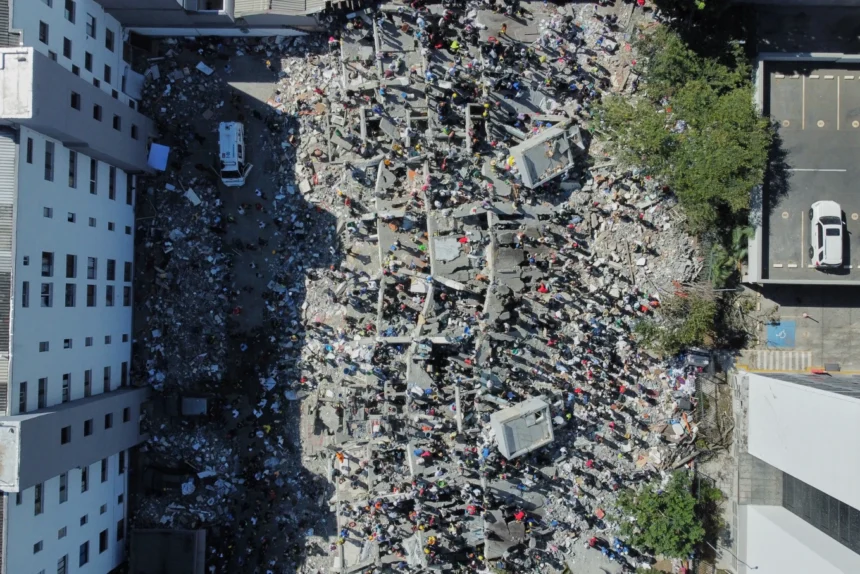
Rescue teams and volunteers continued a desperate search through collapsed buildings across western Colombia on Tuesday, as the death toll from a powerful 7.4-magnitude earthquake rose to at least 181 and thousands of people remained missing.
The earthquake struck Monday, causing widespread destruction in cities and rural communities, collapsing buildings, damaging roads and crushing vehicles. More than 2,500 people were reported injured, while Colombian President Abelardo de la Espriella said at least 195 people were officially missing. Civilian-run databases, however, suggested the number could be closer to 4,000.
Rescuers worked around the clock in Cali, Pereira, Manizales and Quibdo, using heavy machinery, search dogs and hand-to-hand efforts to clear rubble. Teams repeatedly called for silence when they believed they heard signs of life beneath the debris.
At least one woman was pulled alive from the rubble on Tuesday, offering a rare moment of hope amid the devastation.
The first 48 to 72 hours after a major earthquake are considered critical for rescue operations, although survivors can remain alive for longer when they have access to water and food.
Rural communities face the greatest challenges
The full scale of the destruction remains unclear, particularly in remote areas of Chocó, one of Colombia’s poorest and most neglected regions.
President de la Espriella said more than 1,000 homes had been destroyed, with many more damaged. He traveled to Quibdo, near the earthquake’s epicenter, and ordered the deployment of the military, police, engineers, rescue workers and search dogs.
Local leaders said, however, that many communities along the Atrato River remain difficult to reach. Some can only be accessed by boat, through dense jungle or by air, making it difficult to deliver aid and assess casualties.
Sterling Palacios, a religious and environmental leader in Chocó, said entire communities had been devastated and that continuing aftershocks were forcing residents to sleep outdoors.
The Colombian Geological Service recorded more than 100 aftershocks following the initial earthquake.
“There are towns where people have lost everything,” Palacios said, warning that it could take weeks to fully assess the scale of the destruction.
The response is further complicated by armed groups operating in parts of Chocó, where violence and territorial disputes have historically restricted access to some communities.
Families search for missing relatives
Across the affected region, families have been searching for relatives who remain unaccounted for, with many turning to citizen-run databases and social media to share photographs and information.
In Pereira, Jairo Vargas traveled about 220 kilometers from Medellín after his brother disappeared when his apartment building collapsed.
“I’m absolutely certain he’s here,” Vargas said as heavy machinery cleared the ruins. His brother’s car remained outside the destroyed building.
Other families faced similar uncertainty in rural communities where communications were disrupted by the earthquake.
In El Cairo, local authorities estimated that about 80 percent of the town was damaged. Families were still waiting for information about residents who could not be reached.
First major test for Colombia’s new president
The disaster represents the first major crisis for de la Espriella, who took office only days before the earthquake after a divisive election.
The president has sought to present the disaster response as a national effort, pledging to mobilize the full resources of the state and promising that Chocó would no longer be treated as “the land of the forgotten.”
The government’s ability to reach isolated communities and coordinate rescue and relief operations could become a defining test of the new administration.
The United States has announced $15.5 million in emergency assistance for shelter, food and other humanitarian needs, while governments across Latin America have also offered support.
In Pereira and Cali, authorities imposed nighttime curfews and introduced restrictions on private vehicles to keep roads open for ambulances, police and rescue teams.
For families still waiting for news, however, the immediate priority remains finding survivors beneath the rubble.