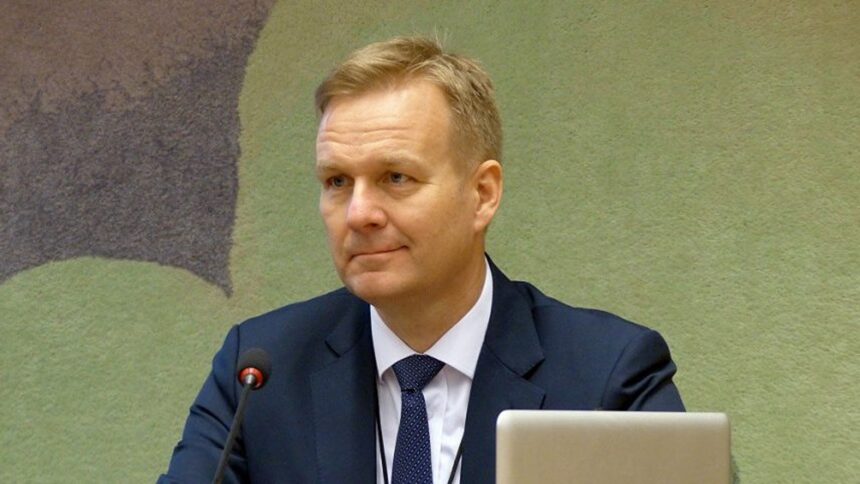
EU Special Representative for the Belgrade-Prishtina Dialogue Peter Sorensen has said that the Brussels dialogue “is not dead” and that the process is continuing, producing concrete results including recent progress on the issue of missing persons.
In an interview with Serbian daily Danas, Sorensen said the dialogue had also produced practical agreements that directly affect the lives of citizens.
“The dialogue continues and has delivered concrete results, including recent progress regarding missing persons and practical agreements that affect citizens’ lives,” Sorensen said.
However, he acknowledged that implementation of the 2023 Agreement and its Ohrid Implementation Annex remains insufficient.
“Implementation of the 2023 Agreement is still insufficient. Both sides need to accelerate the fulfillment of their obligations. There is no alternative to the normalization process,” he said.
Asked how Kosovo’s institutional crisis was affecting his work, Sorensen avoided commenting on Kosovo’s domestic politics but stressed that functioning institutions are important for implementing agreements.
“Fully functional institutions, of course, facilitate decision-making and implementation. At the same time, the commitments undertaken in the normalization dialogue remain valid regardless of electoral or political cycles,” he said.
Sorensen said the EU would continue facilitating the process and supporting implementation of commitments by both parties.
EU Presses Prishtina on Serbian Community Self-Management
Regarding his call for Prishtina to begin negotiations on arrangements for the self-management of the Serbian community, Sorensen said the request was not new.
“This is not something new. It is a longstanding obligation and an obligation included in the Implementation Annex agreed in Ohrid in March 2023,” he said.
He stressed that the EU expects both Kosovo and Serbia to fully implement their obligations under the 2023 Agreement and its annex.
“Political or electoral developments do not change these obligations,” Sorensen said.
On Kosovo’s justice system, Sorensen said the EU had welcomed the withdrawal of resignations by Serbian judges, prosecutors and support staff, while expressing concern over subsequent decisions that affected the process.
“The EU continues to emphasize the importance of the rule of law and of a judicial system that reflects Kosovo’s multiethnic character,” he said.
EU Rejects Serbia’s Reliance on Resolution 1244 for the Dialogue
Asked about Belgrade’s position that the dialogue should be conducted in accordance with UN Security Council Resolution 1244, Sorensen said the EU-mediated process is based on a different UN resolution.
“The EU-mediated dialogue is based on UN General Assembly Resolution 64/298 of 2010, which welcomed the EU’s readiness to facilitate the dialogue,” he said.
Sorensen acknowledged that Kosovo and Serbia continue to have fundamentally different positions on status, but said that this is precisely why the normalization dialogue exists.
“The purpose of the normalization dialogue is to enable them to address practical issues, normalize relations and implement commitments they have already undertaken,” he said.
EU Leads Dialogue, US Remains Key Partner
Regarding the role of the United States, Sorensen emphasized that the dialogue is led and facilitated by the European Union.
“The United States is an important partner, and close coordination between the EU and the US supports the normalization process,” he said.
However, he stressed that ultimate responsibility for implementing the agreements remains with Kosovo and Serbia.
“External partners can facilitate and support the process, but the parties themselves must fulfill their obligations,” Sorensen said.
Asked about claims that Serbian President Aleksandar Vučić lacks a constitutional mandate to negotiate and that some of the solutions agreed in Ohrid conflict with Serbia’s Constitution, Sorensen said the EU does not intervene in the parties’ internal constitutional matters.
“The EU does not decide on matters related to the internal constitutional arrangements of either party,” he said.
At the same time, he reiterated the EU’s position that the 2023 Agreement and its Implementation Annex are binding on both sides.
“The EU’s position is clear: the 2023 Agreement and its Implementation Annex are binding on both parties and form part of their European path. The EU expects both sides to fully fulfill their obligations,” Sorensen concluded.