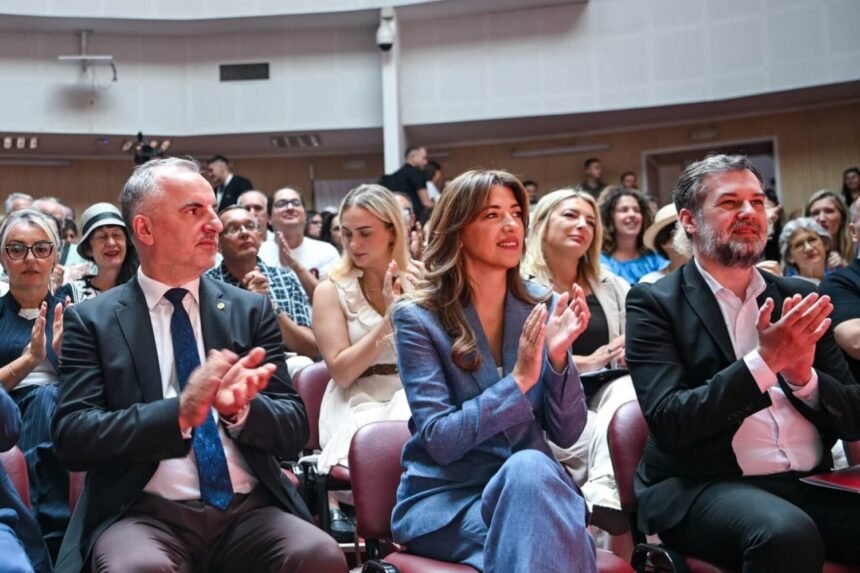
Acting President of the Republic of Kosovo, Albulena Haxhiu, attended the opening ceremony of the 44th International Seminar on Albanian Language, Literature and Culture.
In her speech, Haxhiu emphasized that Albanian has historically been a key pillar of cultural and political continuity for Albanians, particularly during periods when they lacked their own institutions.
She noted that today, linguistic inequalities are no longer expressed only through laws and political restrictions, but increasingly through technology and access to digital knowledge.
“Even when languages are equal before the law, they are not necessarily equal in the spaces where knowledge is produced and circulated.”
Haxhiu warned that the historical marginalization of Albanian must not simply reappear in technological form.
“It would not be progress if the linguistic hierarchies of the past disappeared from the law, only to return through technology.”
She highlighted the importance of decades of academic work dedicated to Albanian, including the contributions of scholars such as Idriz Ajeti and Robert Elsie, whose research, documentation, translations and digitization efforts helped expand the presence of Albanian beyond the territories where it is spoken.
Addressing the future of the language, Haxhiu stressed that digitalization and artificial intelligence are becoming increasingly important to Albanian’s survival and development.
“Albanian cannot remain a language of the past in a world that is building the future with algorithms.”
She argued that Albanian must be strengthened through research, digitization, publishing, translation and the development of new technological tools so that it can remain a fully functional language in education, science, technology and cultural production.
Haxhiu also emphasized that the Albanian-speaking community is no longer defined solely by geography. Digital communication, migration and multilingualism are creating new ways for people around the world to learn, use and contribute to Albanian.
She concluded by calling for stronger institutional support for those working to document, enrich and modernize the Albanian language, stressing that policymakers must listen to researchers and linguists when determining where Albanian is gaining ground, where it is losing functions, and what must not be neglected.