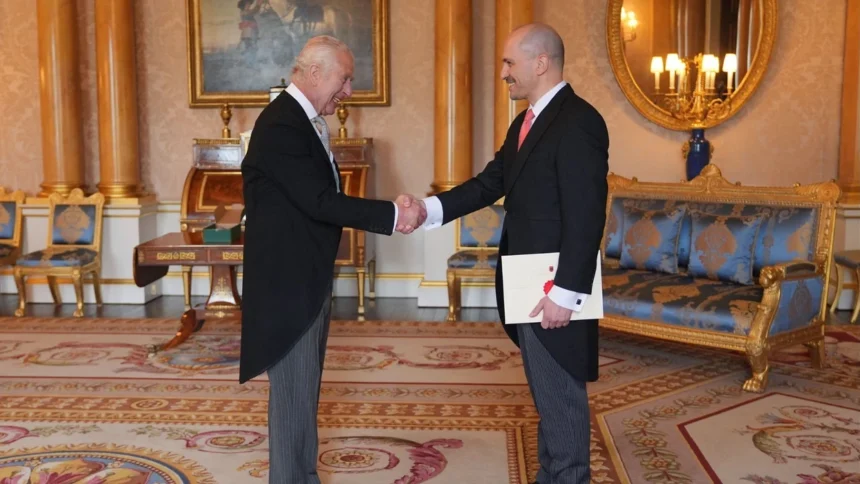
Albania’s ambassador to the United Kingdom, Uran Ferizi, has criticized what he described as continued “hysterical” and “crazy” attacks by British right-wing politicians and media over the arrival of more than 12,000 Albanians across the English Channel in small boats in 2022.
Ferizi said the surge was real, exceptional and short-lived, but argued that the Albanian community in Britain continues to be portrayed through the prism of those events by Reform UK and sections of the British media, including The Daily Telegraph.
He called on Nigel Farage’s Reform UK to stop what he described as “Albanian-spotting,” arguing that Britain’s visa policy at the time may also have contributed to the vulnerability of some people to smugglers and human traffickers.
According to a 10-page report prepared by Ferizi’s office, based largely on UK Home Office data and research by the Migration Observatory at the University of Oxford, 12,658 Albanians crossed the English Channel in 2022. While representing a dramatic increase, the figure accounted for only around 1% of total long-term migration to Britain that year.
Arrivals subsequently fell sharply, and the Albanian Embassy’s analysis suggests that most of those who arrived during the 2022 surge have since left the UK.
Ferizi, who first experienced Britain as a teenager after entering the country clandestinely before later studying mathematics at the University of Oxford, said the continued political focus on Albanians had become excessive.
“A noisy minority in British politics and the media has kept the Albanian migration crisis alive long after it ended in the official data,” Ferizi said, according to The Guardian.
He argued that direct engagement with the Albanian community can challenge stereotypes and criticized politicians for focusing on nationality rather than broader social and economic issues.
According to the ambassador’s report, Albanian applicants for UK visas had an approval rate of 65.5% between 2018 and 2025, compared with around 90% for other Western Balkan countries. More than 70,000 Albanian visa applications were rejected during the period.
Ferizi said the figures warranted greater scrutiny, arguing that restrictions on legal migration routes could make some young Albanians more vulnerable to smugglers and traffickers.
“When the legal route is exceptionally difficult, you cannot talk about the irregular route as if the two have no connection,” he said.
The report does not claim that visa refusals directly caused the increase in English Channel crossings. Instead, it raises the possibility that limited access to legal routes may have contributed to the vulnerability of some young Albanians to criminal networks.
“The increase was real,” Ferizi said. “But it was exceptional, it was short-lived, and Britain is still talking about Albanians as if 2022 never ended.”
Ferizi also criticized The Daily Telegraph’s coverage of Albanians, accusing the newspaper of portraying the community primarily through the lens of criminality.
He referred to a 2024 article that claimed one in 50 Albanians in Britain was in prison, describing the figure as the highest rate for any nationality. Ferizi argued that comparisons should account for factors such as age and gender, which he said would significantly alter the figures.
His comments come amid continuing political debate in Britain over irregular migration, small-boat crossings and immigration policy, with Albanian migrants having become a recurring focus of political and media discussion.