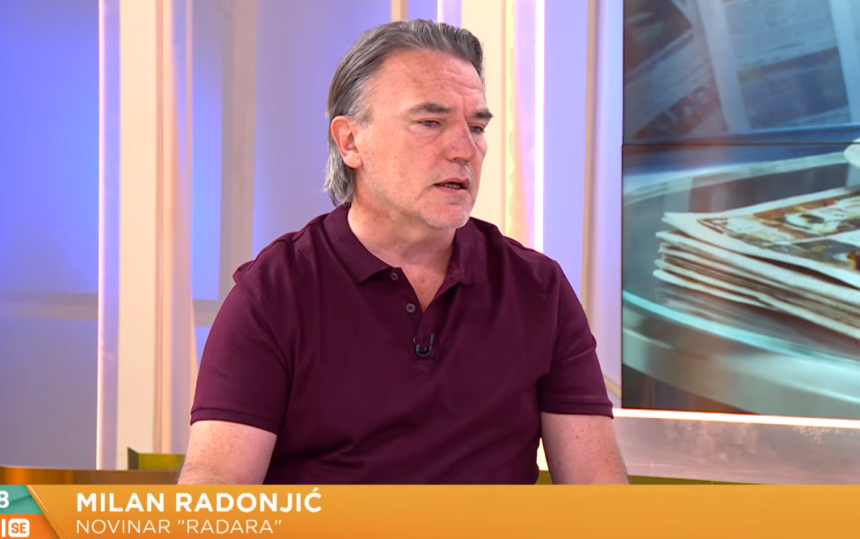
Journalist Milan Radonjić of the Serbian weekly Radar has criticized Belgrade’s policy toward Kosovo, arguing that the Serbian government’s rhetoric increasingly diverges from its actions on the ground and that its policies have, in recent years, harmed the interests of Kosovo Serbs.
Speaking to TV Nova, Radonjić discussed recent developments in northern Kosovo, including the case of Nenad Rašković from Dren, the Gazivoda reservoir, changes to the main bridge over the Ibër River, the political situation in Prishtina and Serbian President Aleksandar Vučić’s recent remarks about potentially altering the course of the river.
“It would be equivalent to a declaration of war”
Commenting on Vučić’s statements about possible intervention in the course of the Ibër, Radonjić warned that such a move would have serious international consequences because water resources can have a cross-border character.
“We have seen such situations in global examples. We have the situation with the Nile between Ethiopia and Egypt, with major dams that were planned, or elsewhere in the region – the Sava and other rivers,” Radonjić said.
He argued that taking control of an internationally significant water resource could become a cause of conflict.
“That is actually grounds for war if you take away a water resource that has an international character,” he said.
Although Belgrade could defend such a move by citing its refusal to recognize Kosovo as an independent state, Radonjić said the international community would likely interpret it differently.
“The authorities will, of course, defend themselves by saying that they do not recognize Kosovo as a separate state, but I think that in the eyes of the international community it would be exactly that – it would be equivalent to a declaration of war,” he said.
Radonjić also dismissed the feasibility of changing the course of the Ibër, describing the proposal as technically unrealistic and potentially harmful to Serbs living in Kosovo.
“That is absolutely, I think, not only technically unfeasible and impossible – you would actually leave your own people living there without water as well,” he said, describing the proposal as an unrealistic threat of retaliation.
“Acute problems are being ignored”
Radonjić contrasted Vučić’s statements about possible developments decades into the future with what he described as immediate problems facing Kosovo Serbs.
“We are talking about the acute problems of people whose houses are being demolished, who are being unlawfully deprived of their freedom, who are experiencing, one could say, an occupation-like situation, because they lived in one way for several decades and now everything has changed, while the authorities are making announcements about something that could happen in 20 years – and will not happen even then,” he said.
He argued that there is an increasingly wide gap between Belgrade’s political rhetoric and its actual policies toward Kosovo.
“We have reached a point where rhetoric and practice are moving in completely opposite directions,” Radonjić said.
“We have powerful propaganda saying one thing, while actions say something completely different.”
“The authorities in Belgrade are often the greatest threat to Serbs”
Discussing the case of Nenad Rašković from Dren, who said members of the Kosovo Police tied him to a tree and beat him, Radonjić placed much of the responsibility for the current position of Kosovo Serbs on Belgrade’s policies.
“Unfortunately, over all these years it has become clear that the authorities in Belgrade are most often the greatest threat to Serbs living in the region. In recent years, Kosovo Serbs have been treated in this way as well,” he said.
Radonjić also criticized the withdrawal of Serbs from Kosovo institutions and the consequences that followed.
“Kosovo Serbs still live where they have always lived, but they have almost no influence over the institutional functioning of the police and municipalities,” he said.
He was also critical of the Srpska Lista, saying the party now appears to have little influence among Kosovo Serbs.
“We see that Srpska Lista almost seems not to exist. Kosovo Serbs have mayors, but those people are nowhere to be seen, nor do they have any influence or credibility among Kosovo Serbs after everything that has happened. The people there have been left completely to their own devices,” Radonjić said.
Main bridge could bring “new incidents”
Radonjić also addressed the gradual transition of permanent KFOR presence from the main bridge over the Ibër.
In his assessment, changes to KFOR’s presence could enable Kosovo authorities to make a decision on reopening the bridge to vehicular traffic.
“Opening the bridge in that context would mean the possibility of new incidents,” he said.
He described a potential reopening as, in effect, a forced unification of the northern and southern parts of Mitrovica, while arguing that the international community has not spoken out sufficiently about developments in North Mitrovica.
Calls for an independent political alternative
Radonjić said Kosovo Serbs need a political alternative capable of representing their interests independently of Belgrade.
“What is necessary is for a kind of political alternative to emerge among Kosovo Serbs that can articulate their real interests and try to protect those interests,” he said.
“Nothing can be expected from Belgrade in that regard,” he added.
Accuses Kurti of “copying” Belgrade
Radonjić also commented on the political situation in Prishtina and accused Kosovo Prime Minister Albin Kurti of continuing to use developments in northern Kosovo for political purposes.
“Kurti continues to use the credit he gained by establishing absolute control over northern Kosovo. He continues to spend that credit, that authority he gained among the nationalist part of Kosovo society,” Radonjić said.
He then drew a parallel between Kurti and the authorities in Belgrade.
“I think there are certain similarities and parallels with the authorities in Belgrade,” he said, adding that Kurti, in his view, is “in some way copying what is happening in Belgrade, using it for his propaganda and for building a kind of personality cult that has already emerged in Kosovo around his political activities.”