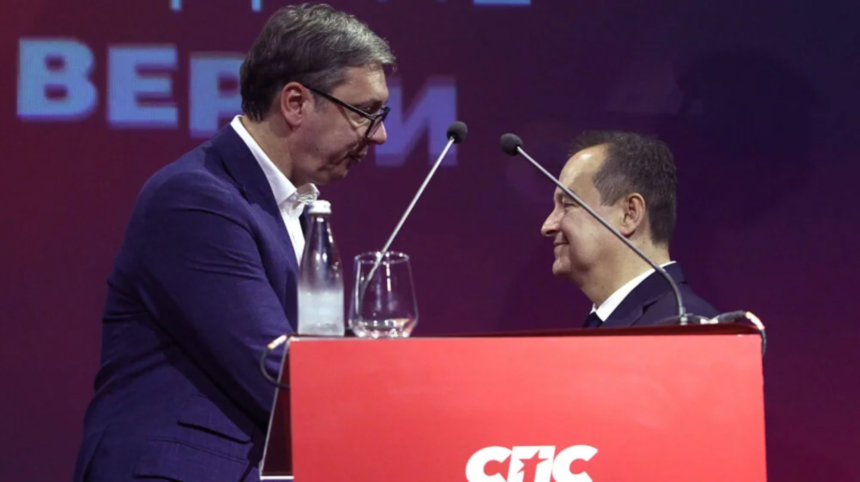
The latest public dispute between Aleksandar Vučić, the Serbian Progressive Party (SNS) and Ivica Dačić’s Socialist Party of Serbia (SPS) raises serious questions about whether Serbia is witnessing a genuine political rupture—or another carefully calculated political performance ahead of the next elections.
Dačić has announced that the SPS intends to participate in the elections independently, together with its traditional partners, rather than entering a pre-election coalition with Vučić’s SNS. On the surface, this could look like an attempt by the Socialists to distance themselves from Vučić and present themselves as an independent political force.
But the situation becomes far more complicated when Dačić simultaneously leaves the door open for cooperation with SNS after the elections.
Vučić, meanwhile, claims that there is “no drama” surrounding the SPS decision and says he does not consider it a betrayal. Yet at the same time, he insists that SNS must now be prepared to win a parliamentary majority on its own and suggests that the question of who will govern together can be decided only after the election.
That contradiction deserves attention.
If the separation is genuine, why is Dačić already emphasizing the possibility of a post-election coalition with Vučić? And if Vučić truly sees no problem with SPS running independently, why publicly emphasize that SNS must now win the majority alone?
The accusations of “betrayal” and “stabbing Vučić in the back” coming from pro-government media also raise another possibility: is this conflict being deliberately amplified to create the impression that SPS is breaking away from Vučić?
Such a strategy could serve both sides.
For Dačić and SPS, presenting themselves as independent could help attract voters who are increasingly dissatisfied with Vučić but are not prepared to support the opposition. SPS could therefore position itself as a separate political alternative while still preserving the possibility of returning to coalition with SNS once the votes are counted.
For Vučić, the arrangement could be equally useful. If SPS attracts dissatisfied SNS voters, it could prevent those votes from moving directly toward the opposition. After the elections, Vučić could then bring a weakened SPS back into government as a coalition partner—with even less political leverage than before.
In other words, what appears to be a confrontation could potentially function as a division of political roles.
Dačić gets to claim independence. Vučić gets to claim dominance. SNS presents itself as the only force capable of governing alone, while SPS attempts to survive by appealing to voters who have grown tired of the progressives.
And if the two parties eventually reunite after the election, voters could simply be presented with the argument that “circumstances” required another coalition.
That is precisely why the public should be skeptical.
The political relationship between Vučić and Dačić is not new. SPS has repeatedly been a coalition partner of the dominant political force in Serbia, while Dačić has remained one of the most experienced figures in Serbian politics. Their political survival has often depended on maintaining influence regardless of changing circumstances.
This makes the current “break” particularly difficult to take at face value.
There is also a significant risk for both sides. If SPS genuinely runs independently and falls below the electoral threshold, Dačić could lose the political leverage he has maintained for years. But if SPS performs strongly enough to become decisive after the election, Dačić could once again become the kingmaker he has been at crucial moments in Serbian politics.
For Vučić, however, an independent SPS also carries risks. If the result is close, Dačić could potentially choose another coalition partner. At the same time, if SPS successfully attracts voters who previously supported SNS, Vučić could lose parliamentary seats that he would otherwise control directly.
So perhaps the most important question is not whether Vučić and Dačić are fighting.
The real question is whether they are fighting at all.
The constant accusations, the public distancing, the warnings about betrayal, followed by assurances that cooperation remains possible after the elections, create the appearance of a political conflict while leaving the door wide open for the same power structure to continue afterward.
Serbian voters therefore have every reason to ask whether they are witnessing a genuine political transformation—or simply another electoral strategy designed to redistribute votes without fundamentally changing who holds power.
If SNS and SPS eventually return to government together, the current confrontation could look less like a political divorce and more like a carefully choreographed campaign designed to keep voters divided, redirect dissatisfaction and ultimately preserve the same political arrangement.
The question is not whether Vučić, Dačić and their parties are capable of manipulating the political narrative. The question is whether Serbian voters are once again being asked to believe that a carefully managed political spectacle is a real break with the system they have been governing together for years.