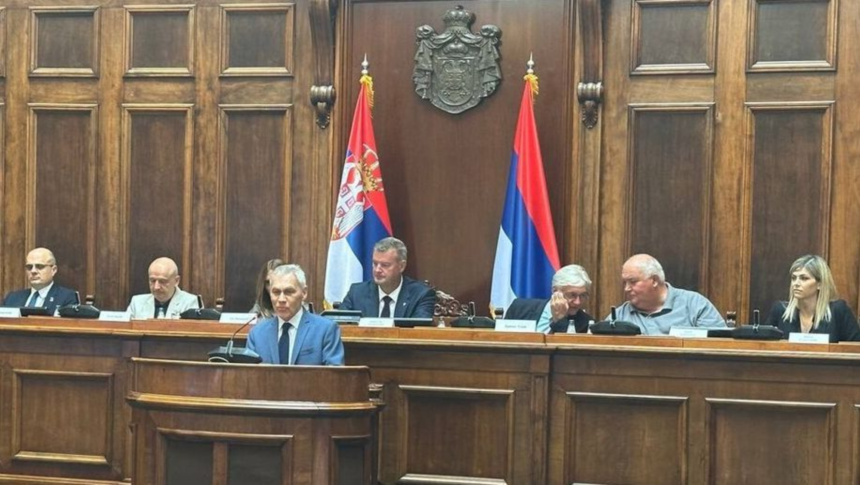
Russian Ambassador to Serbia Aleksandar Bocan-Harčenko has once again used the claim of “ethnic cleansing” of Serbs in Kosovo to promote Moscow’s political narrative, presenting Russia as the supposed defender of the Serb community and accusing Kosovo institutions of pursuing a campaign against them.
Speaking at a conference in Serbia’s National Assembly dedicated to the “suffering of Serbs in Kosovo,” Bocan-Harčenko claimed that Russia is doing everything possible to prevent what he described as the “ethnic cleansing” of Kosovo.
However, the ambassador provided no evidence demonstrating that Kosovo institutions are carrying out an organized campaign of ethnic cleansing against Kosovo Serbs.
The allegation is particularly serious. “Ethnic cleansing” refers to the deliberate and systematic removal of an ethnic or religious population from a particular territory. It cannot simply be used as a political label for disagreements over government decisions, policing operations, institutional changes or tensions between authorities and a minority community.
There are genuine issues affecting Kosovo Serbs that deserve attention. International actors have raised concerns over political tensions, security incidents, access to services and measures taken by Kosovo authorities, particularly in the north. These issues should be addressed through dialogue, the rule of law and independent mechanisms.
But acknowledging those problems is not the same as accepting the claim that Kosovo is conducting ethnic cleansing.
Bocan-Harčenko’s statement instead fits a familiar Russian and Serbian propaganda narrative in which Kosovo is portrayed as systematically targeting Serbs, while Moscow presents itself as their international protector.
The political context is important. Russia remains one of Serbia’s strongest international supporters and continues to oppose Kosovo’s independence. The ambassador himself emphasized that supporting Serbia internationally is a major priority of Russian foreign policy.
His intervention therefore cannot easily be separated from Moscow’s broader geopolitical interests in the Balkans.
The setting of the statement is also revealing. The conference brought together Serbian and Russian political figures who framed the Kosovo issue through a strongly nationalist and ideological lens. Such events contribute to a narrative in which Serbs are portrayed exclusively as victims, Kosovo exclusively as the aggressor, and Russia as the power supposedly standing between the Serb community and its alleged destruction.
That narrative ignores the complexity of the situation.
Kosovo has a constitutional obligation to protect the rights of all its communities, including Kosovo Serbs. Those rights must be respected, and government actions that negatively affect minority communities should be subject to scrutiny and accountability.
But legitimate criticism of Kosovo institutions does not automatically constitute evidence of ethnic cleansing.
If Moscow or Belgrade has concrete evidence of an organized campaign to forcibly remove Kosovo Serbs because of their ethnicity, that evidence should be presented to the relevant international institutions and independently verified.
Until then, the language used by the Russian ambassador should be understood in its political context: as part of a broader propaganda campaign surrounding Kosovo, rather than as an established description of events on the ground.
The protection of Kosovo Serbs is a legitimate concern. Exploiting their concerns to promote a geopolitical narrative is something entirely different.
Rights should be defended with facts and evidence—not weaponized through propaganda.