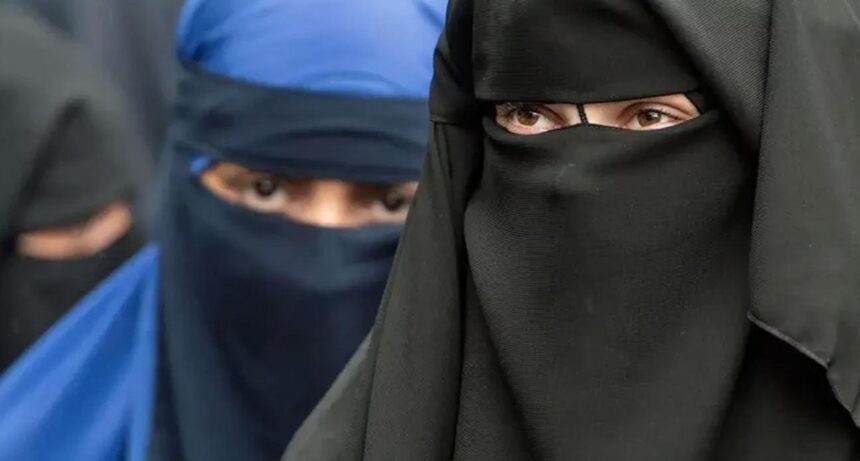
Portugal has banned full face coverings in public places after President António José Seguro signed legislation originally proposed by the right-wing Chega party.
Seguro approved the measure on Tuesday, saying it addressed an issue of “great social and cultural sensitivity,” according to a statement from the Belém Palace, the presidential residence in Lisbon.
The president said amendments made to the legislation during the parliamentary process had persuaded him to sign the bill into law.
In supporting the measure, Seguro cited social integration, non-discrimination and public safety, as well as relevant rulings by the European Court of Human Rights concerning face coverings.
“The uncovered face constitutes a structuring dimension of social trust and a characteristic of Portuguese society,” the presidency said. It argued that everyday social interaction is based on mutual recognition and the ability to establish direct relationships between people.
The statement also emphasized gender equality, arguing that requiring women to conceal their entire faces creates an asymmetry incompatible with principles of equal dignity between men and women.
“At the same time, in a free society such as ours, every person must be able to live according to their identity and beliefs within a set of shared rules,” the presidency said, referring to the concept of a “shared experience” recognized by the European Court of Human Rights.
The legislation has drawn criticism from Amnesty International Portugal, which described the measure as discriminatory and warned that it could infringe on the rights of Muslim women who voluntarily choose to cover their faces.
The new law places Portugal among a growing number of European countries that have introduced full or partial restrictions on face coverings in public spaces, including France, Belgium, Austria, Denmark and the Netherlands.
The measure is expected to remain a subject of debate over the balance between public security, social integration and individual freedom of religion and expression.