Serbian President Aleksandar Vučić has intensified his campaign against the gradual reduction of KFOR’s permanent presence at the main bridge over the Ibar River in Mitrovica, sending NATO Secretary General Mark Rutte a letter that challenges the Alliance’s security assessment and calls for the bridge not to be reopened to vehicle traffic.
The intervention comes after KFOR began gradually reducing its permanent presence at the bridge earlier this month, describing the move as part of an optimization of its deployment based on an improved security situation in Kosovo. NATO has stressed that the process is gradual and reversible if security developments require it.
Vučić’s letter, published by Kosovo Online, describes KFOR’s decision as “premature” and argues that the Alliance’s security assessments failed to adequately account for risks to Serbs and other non-Albanian communities.
The Serbian president has also asked NATO to prevent the opening of the bridge to vehicle traffic and accused Kosovo institutions of what he called “terror” against Serbs, including persecution, arrests and demolitions.
But the letter has also exposed a striking difference between Vučić’s diplomatic language toward NATO and his rhetoric for domestic audiences.
From “the Turk” to General Ulutaş
Only days before sending the letter, Vučić referred publicly to KFOR commander Major General Özkan Ulutaş not by name or rank, but as “the Turk” while discussing the bridge.
In the letter to Rutte, however, Ulutaş is identified formally as “KFOR commander General Özkan Ulutaş.”
The contrast is significant.
For a NATO audience, Vučić uses the language of military hierarchy, security assessments and institutional responsibility. For a Serbian domestic audience, his description of the same commander was framed through ethnicity.
The change in terminology does not alter Vučić’s underlying position: in both cases, he disputes Ulutaş’s assessment of the security situation and seeks to prevent the gradual transfer of security responsibilities at the bridge.
What changes is the register — from nationalist rhetoric at home to diplomatic language abroad.
Challenging a decision Belgrade does not control
Vučić’s central procedural argument is that KFOR’s decision was taken without Serbia’s agreement.
That claim raises a fundamental question about Belgrade’s role in KFOR’s decision-making.
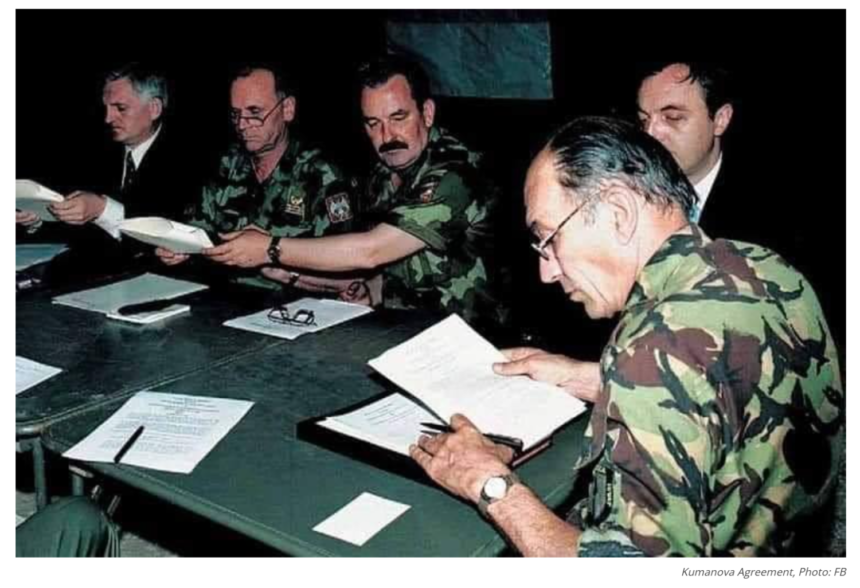
KFOR operates under the framework of UN Security Council Resolution 1244 and NATO command. The Military Technical Agreement signed in 1999 established KFOR’s authority to deploy and operate in Kosovo and gave its commander authority over the security aspects of the mission.
Serbia therefore has an established channel of communication with KFOR, but that does not amount to a veto over the Alliance’s operational decisions.
Vučić has repeatedly emphasized contacts between Serbian military officials and KFOR commanders, including communications involving Serbian Chief of General Staff Milan Mojsilović. Those contacts are important for coordination and deconfliction, but they do not transform Serbia into a decision-making party within NATO’s chain of command.
That distinction is largely absent from Vučić’s argument.
Instead, his letter presents consultation as though it should translate into consent.
NATO has defended its assessment
KFOR has justified the change in its deployment by pointing to improvements in Kosovo’s security environment.
KFOR commander Özkan Ulutaş has said the optimization process is being carried out gradually and can be reversed if relevant security developments require it.
NATO has also said that any decision concerning the possible reopening of the bridge to vehicle traffic must take into account the needs of all local communities.
The Alliance’s position therefore does not amount to an unconditional endorsement of opening the bridge. At the same time, it does not support Vučić’s demand that the process be halted simply because Belgrade objects.
The distinction matters because the bridge is not merely a Serbian-Kosovo political dispute. It is one of the most sensitive security points in Mitrovica, connecting the predominantly Albanian south with the predominantly Serb north.
Any reopening would therefore have consequences for multiple communities, not only the population Vučić invokes in his correspondence.
Vučić’s broader claims deserve scrutiny
The Serbian president’s letter also contains a series of claims about alleged attacks, arrests, property demolitions and the treatment of Serbs in Kosovo.
Some of these issues are serious and deserve investigation. But Vučić frequently presents disputed allegations as established facts, while offering little public methodology for some of the figures cited.
That approach is particularly problematic when the same claims are presented to NATO as part of an argument that the Alliance’s own assessment of Kosovo is fundamentally deficient.
A credible diplomatic argument requires more than a catalogue of politically charged allegations. It requires evidence, identifiable cases and a distinction between verified incidents, disputed claims and political interpretation.
Vučić’s letter often blurs those categories.
The politics behind the bridge dispute
The timing of the intervention is also politically significant.
On the same evening that Vučić discussed his letter to Rutte on Serbian public television, he announced that parliamentary elections would likely be held on October 18 or 25.
That does not prove that the Kosovo issue is being used primarily for electoral purposes, but it places the rhetoric in a politically consequential context.
For years, Vučić has built a political strategy around presenting himself as the defender of Serbia’s interests in Kosovo while simultaneously maintaining close relations with Western governments and institutions.
The latest dispute fits that pattern.
He is asking NATO to block a decision taken within a NATO-led mission while continuing to rely on the Alliance as a central security actor in Kosovo.
At the same time, his rhetoric portrays developments affecting the Serb community as evidence of an increasingly hostile environment, reinforcing the political narrative that Belgrade must remain the community’s principal protector.
A diplomatic letter, but a familiar political strategy
Vučić’s letter is formally diplomatic and carefully structured. It uses the language NATO expects: security assessments, institutional responsibility, international agreements and protection of communities.
But beneath that language lies a familiar political strategy.
Belgrade seeks to preserve maximum influence over developments in northern Kosovo while limiting the ability of Kosovo’s institutions to assume responsibilities previously carried by international actors.
The KFOR withdrawal from the bridge is therefore important not only because of the bridge itself, but because it represents a gradual shift in security responsibility.
For Vučić, that shift reduces one of the few remaining areas in which Serbia can indirectly influence the security architecture of northern Kosovo.
His opposition is consequently about more than traffic.
It is about control, leverage and the political meaning of international security arrangements that have governed the bridge for more than two decades.
NATO’s response so far has been measured: the Alliance says any decision on the bridge must consider all communities, while KFOR maintains that its deployment is being optimized in response to improved security conditions and that the process can be reversed if necessary.
That leaves Vučić with a difficult argument to sustain.
He can challenge NATO’s assessment and appeal to Rutte, but he cannot turn Serbia’s political preferences into an operational veto over a NATO-led mission.
And the contrast between his public rhetoric and his diplomatic language illustrates the broader problem: the same Serbian president who can reduce a NATO commander to an ethnic label before a domestic audience can address that commander by his full rank and name when speaking to the Alliance.
The general, in other words, has a name.
The question is whether Vučić’s political strategy can continue to operate in two languages without the contradiction becoming impossible to ignore.