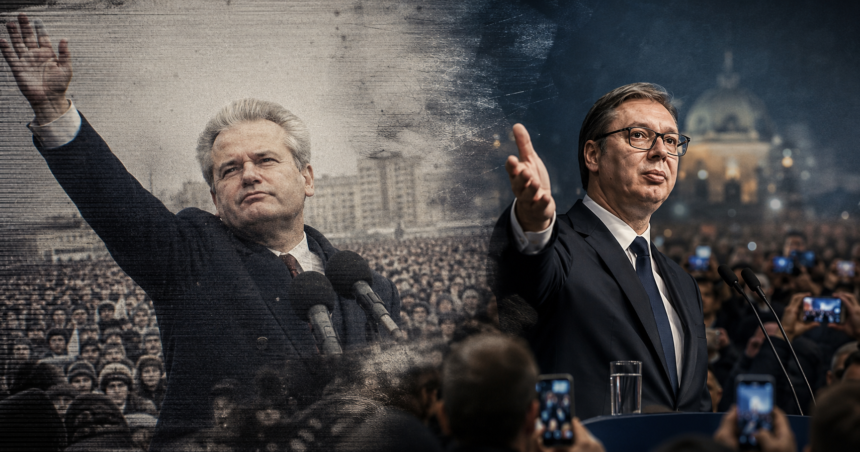
Vučić once described Slobodan Milošević, the man widely known as the “Butcher of the Balkans” as “a great Serbian leader.”
But it appears that his admiration for Milošević does not end with words.
Serbia’s current president, Aleksandar Vučić, who also served as Minister of Information during Slobodan Milošević’s regime, appears to still be playing with the same kind of propaganda once associated with his former political boss.
The latest example came during his visit to the Preševo Valley on August 22, an area populated predominantly by Albanians, just two days after snap parliamentary elections were announced in Serbia.
There, he was welcomed by a group of local Serbs, some of whom began complaining to him about Albanians having jobs. Despite Albanians forming the local majority, residents complained to Vučić about Albanians being employed in the police and the municipality.
The scene closely resembled the gatherings held by Slobodan Milošević decades ago, where his supporters complained that “Albanians have infiltrated among us.”
This time, some of those gathered around Vučić even complained about Albanians speaking Albanian rather than Serbian.
When one woman complained that people working in Presevo did not know Serbian, Vučić responded that they did know Serbian, “they just don’t want to speak it.”
His response pushed the conversation even further.
The woman then said she should “give him a slap so that he learns to speak Serbian,” referring to an Albanian-speaking worker at a pharmacy.
The performance surrounding Vučić went so far that some of those gathered to welcome him were already wondering how they would “possibly manage” once he was no longer president.
“And when you leave, when you’re no longer president, what are we supposed to do then?” one woman asked him.
The whole spectacle, played out in front of the cameras, bears striking similarities to scenes from the Milošević era, a period in which Milošević himself also faced mass protests against his rule.
Today, Serbia is once again witnessing prolonged mass protests. For around 18 months, demonstrations led largely by students have challenged Vučić’s government, with protesters and opposition figures accusing the authorities of corruption, links to organized crime, political and media repression, and human rights violations.
Vučić and his government deny those accusations.
In the end, that political script did not save Milošević.
And considering that Vučić himself served as Milošević’s Minister of Information, one question remains:
Was the script written by Vučić and played by Milošević — or written by Milošević and now played by Vučić?