
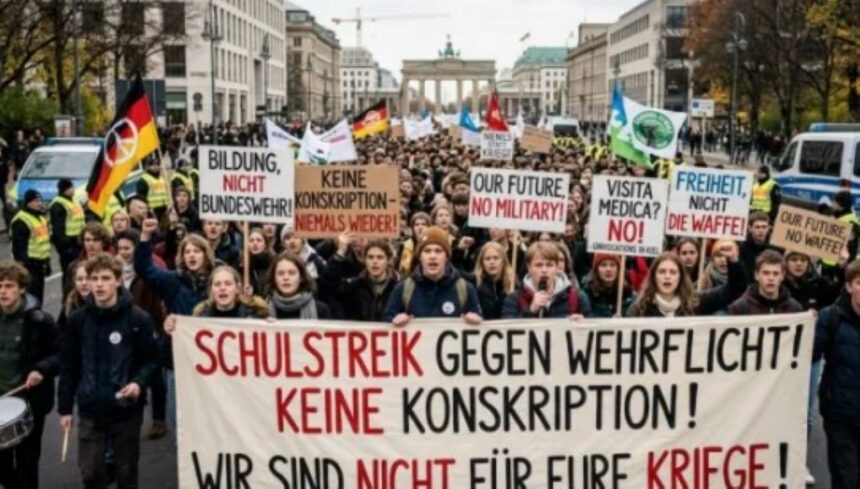
More than 45,000 students have boycotted classes and taken to the streets across Germany to protest the government’s plans to reform military service, amid fears that the country could gradually reintroduce compulsory conscription.
The demonstrations took place in around 100 German cities, including Berlin, Hamburg, Frankfurt, Kiel and Munich, marking a broad mobilization of young people against the government’s new defense policies under Chancellor Friedrich Merz.
“We will not take part in your wars,” was one of the main slogans chanted by protesters opposing the possibility of being forced to serve in the military.
According to Italian news agency Adnkronos, the protests were organized by the alliance “Schulstreik gegen Wehrpflicht,” meaning “School Strike Against Compulsory Military Service.”
“The rich want war, young people want a future,” the movement said on its official website, arguing that the government’s policies risk turning military service into an obligation for younger generations.
Although active military service in Germany remains voluntary, students warn that new registration procedures and mandatory medical examinations could lay the groundwork for the gradual return of conscription.
Bela Breitner, a spokesperson for the student movement, told German news agency DPA that mandatory registration procedures had begun earlier than expected. The process was initially not expected to start before July 2027, she said.
According to Breitner, the developments indicate that the German government is serious about expanding the recruitment system and creating the conditions for a possible return to compulsory military service.
One of the main sources of opposition is the introduction of mandatory medical examinations for young people born in 2008 and later. Organizers claim that the procedures also affect individuals who have explicitly stated that they do not wish to serve in the armed forces.
While registration for active military service and enlistment remain voluntary under the current reform, failure to complete the required forms or attend mandatory medical examinations may result in administrative or financial penalties.
Students have criticized these procedural requirements, arguing that they place pressure on young people and could encourage them to enter military service against their wishes.
The protesters are demanding the withdrawal of the military service modernization law and the immediate suspension of mandatory medical examinations linked to recruitment.
The government of Chancellor Friedrich Merz, meanwhile, aims to strengthen Germany’s military capabilities as European security faces growing challenges, particularly following Russia’s war against Ukraine.
Under the government’s plans, military service is to remain voluntary during the current phase of the reform. The long-term objective is to increase the number of active-duty military personnel to 260,000.
However, the possibility of introducing compulsory recruitment mechanisms if the number of volunteers proves insufficient has heightened concerns among young people.
The demonstrations highlight how the debate over the future of Germany’s armed forces has moved beyond political and military institutions to directly involve the generation most likely to be affected by the changes.
As Berlin seeks to expand its defense capabilities, tens of thousands of students are demanding assurances that their futures will not be determined by an obligation to wear a military uniform.