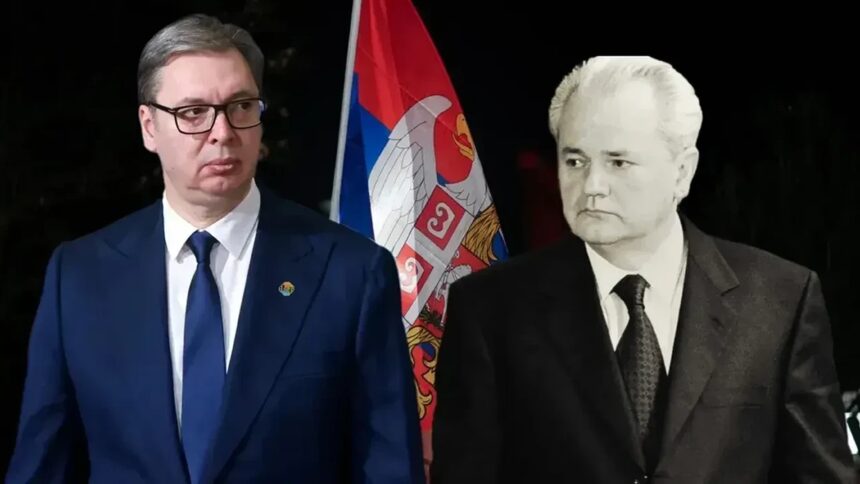
Security expert Gurakuç Kuçi has reacted to Serbian President Aleksandar Vučić’s recent visit to the Presheva Valley, where Vučić promised a local resident that either he or his son would be contacted within 48 hours regarding a possible job with Serbia’s Security Intelligence Agency (BIA).
Kuçi argues that the statement goes beyond a simple promise of employment, linking it to what he describes as an attempt by Belgrade to strengthen political and institutional control over the Presheva Valley.
According to Kuçi, intelligence and security institutions can become instruments of political control in authoritarian systems, while recruitment into such structures may also be influenced by political interests.
He considers Vučić’s remarks particularly significant because they concern BIA, one of Serbia’s main security institutions.
Kuçi also argues that Belgrade is reinforcing a narrative in which Serbs in the Presheva Valley are portrayed as a threatened community and the Serbian state as their protector.
“In this context, he needs as many people as possible inside the security institutions who are directly connected to the regime and willing to implement its political objectives,” Kuçi wrote on X.
Kuçi draws a historical parallel between Vučić’s rhetoric and Slobodan Milošević’s famous speech in Fushe Kosova on April 24, 1987, when Milošević told Serbs: “No one will dare to beat you.”
He also connects this approach with Vučić’s statement that whatever local Albanian authorities do not do for Serbs, “we will do for you from Belgrade.”
According to Kuçi, such rhetoric presents Belgrade as the defender of Serbs against Albanians while simultaneously turning local governance into an ethnic issue.
At the same time, Kuçi points to the problems faced by Albanians in the Presheva Valley, including the de-registration of residential addresses, institutional underrepresentation and limited employment opportunities in state and security institutions.
He specifically refers to the situation in Bujanoc, claiming that no new Albanian police officers have reportedly been recruited there for approximately a decade.
“While Serbs are being promised employment, support and direct intervention from Belgrade, Albanians continue to face gradual administrative and institutional elimination,” Kuçi said.
The security expert argues that this approach could further deepen ethnic divisions in the Presheva Valley. In his assessment, the pattern begins by portraying Serbs as victims, followed by increased hostility and mistrust toward Albanians, and ultimately the central government presenting itself as their protector.
Kuçi warns that such policies could increase pressure on Albanians in the Presheva Valley and create conditions in which administrative marginalization could develop into more direct forms of pressure and exclusion.
His comments came after Serbian lawyer Čedomir Stojković published a video in which he also raised concerns about the alleged political use of BIA, including interference in electoral processes and pressure on voters.
Stojković argued that Vučić’s statement points to direct political influence over Serbia’s intelligence service and called for stronger international monitoring of electoral processes in Serbia.