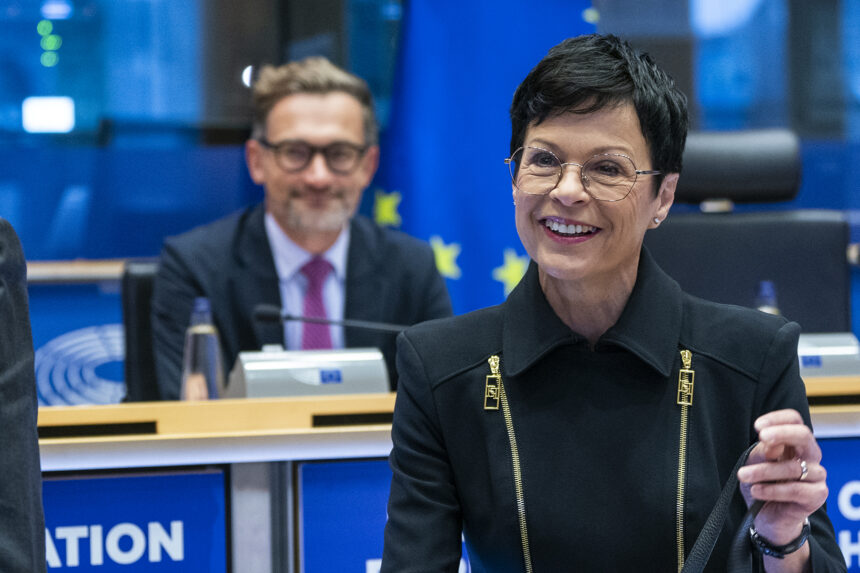
The European Union is preparing to rethink how future enlargement will work, with Commissioner for Enlargement Marta Kos calling for a more flexible and gradual approach to bringing new countries into the bloc.
Speaking at the Croatian Ambassadors’ Conference in Zagreb, Kos argued that Europe’s changing geopolitical environment requires the enlargement process to change as well. She described the current moment as a potential “new Helsinki moment”, drawing a comparison with the period after the Cold War that paved the way for the EU’s major eastern enlargement.
Kos highlighted Montenegro as the leading candidate, while praising Albania for its progress in meeting key rule-of-law standards. She also pointed to technical progress made by Ukraine and Moldova and Iceland’s decision to restart its accession process.
According to Kos, the EU needs to address four major issues before it can successfully accommodate more than 30 member states.
Reforming the EU from within
A larger Union, Kos argued, will require institutions capable of making decisions more quickly and responding effectively to crises.
She suggested that some institutional and decision-making reforms could be introduced without reopening the EU treaties—a process that could take years and require difficult ratification procedures.
Among the possible changes is reducing the number of areas in which a single member state can block decisions affecting the entire Union. Kos also referred to expanded cooperation mechanisms that allow groups of EU countries to move forward on certain initiatives without waiting for all members to participate.
Stronger safeguards for democracy
Kos also called for stronger protections to ensure that future members continue respecting democratic standards and the rule of law after joining the EU.
She warned that the Union must avoid admitting countries that could later undermine its fundamental principles, describing such potential risks as “Trojan horses.”
The proposal, however, could raise difficult questions about equality among EU members and the possibility of creating different levels of membership.
Montenegro’s ambassador to the EU, Petar Marković, indicated that Podgorica would support stronger safeguards provided they were based on objective criteria and applied on a case-by-case basis.
Moving away from the “all or nothing” approach
Kos argued that the traditional accession model must evolve because negotiations can take many years, while geopolitical competitors can exploit that uncertainty.
Instead of forcing candidate countries to wait until full membership before receiving meaningful benefits, she advocated a gradual integration model.
Countries could increasingly participate in EU systems and benefit from closer economic and institutional ties while continuing to work toward full membership.
Examples already available include participation in SEPA and integration into the EU’s energy networks, although Kos stressed that these steps alone are not sufficient.
The issue has gained additional urgency because of Ukraine’s accession process and the broader geopolitical implications of anchoring Kyiv firmly within Europe.
Managing the impact of future members
The final issue concerns the consequences of enlargement for existing EU members.
Kos said Brussels must prepare transitional arrangements to ensure that the arrival of new members does not create sudden economic or institutional pressure and that the EU budget remains capable of financing its priorities.
How future members would participate in EU funding is already becoming one of the most sensitive issues in discussions over the bloc’s next long-term budget.
Overall, Kos’s message is clear: the EU wants enlargement to move faster, but it also wants stronger safeguards, deeper preparation and a more gradual path toward membership.
With Montenegro currently viewed as the frontrunner and Albania making notable progress, the debate is increasingly shifting from whether the EU should enlarge to how the Union itself must change to accommodate its next generation of members.