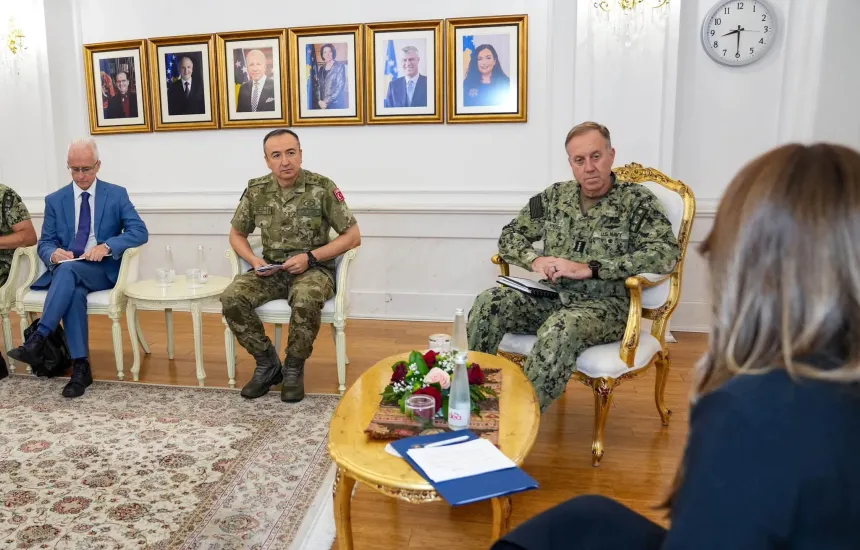
NATO Joint Force Command Naples Commander Admiral George Wikoff has said that KFOR’s presence on the main bridge over the Ibër River is determined by security assessments, but that the decision on whether the bridge should reopen to vehicle traffic does not fall within KFOR’s mandate.
Speaking about the gradual reduction of KFOR’s permanent presence at the bridge, Wikoff said the decision on reopening it belongs to the European Union and Kosovo’s relevant institutions.
“Decisions regarding KFOR’s presence on the Mitrovica Bridge are based on our assessment of the security situation. KFOR does not have a mandate to determine whether the bridge should be opened or not. That is for the EU and the relevant institutions in Kosovo to determine once KFOR completes its permanent presence at the bridge,” Wikoff said.
He added that KFOR personnel would remain present in the surrounding areas.
KFOR says deployment could be reversed
KFOR said it continues to fulfill its mandate in Kosovo while gradually optimizing its deployment to ensure that its mission remains fit for purpose.
The NATO mission said the process is being carried out gradually and in coordination with Kosovo’s institutions, the EU, the Kosovo Police and the EU Rule of Law Mission in Kosovo (EULEX), as well as other local and international stakeholders.
KFOR emphasized that the process could be reversed if developments affect Kosovo’s long-term security or regional stability.
“KFOR will continue to regularly assess the situation on the ground and maintain a tailored deployment to contribute to the long-term security of all people living in Kosovo,” the mission said.
KFOR Commander Maj. Gen. Özkan Ulutaş reiterated that the mission remains committed to the security of all communities in Kosovo.
“Our commitment to the security of all people living in Kosovo is unwavering,” Ulutaş said, pointing to continued patrols, observation posts and engagement with local communities.
KFOR said its presence would be increased in some areas where necessary, without limiting the adjustments to North Mitrovica or northern Kosovo.
Permanent presence at bridge being phased out
KFOR announced on August 10 that it had begun gradually withdrawing its permanent presence from the main bridge over the Ibër as part of the broader optimization of its deployment.
The move has renewed debate over the future of the bridge, which has remained a politically and security-sensitive crossing between the northern and southern parts of Mitrovica.
Acting Prime Minister Albin Kurti said Kosovo’s institutions were in continuous communication with KFOR regarding the full reopening of the bridge and the eventual transfer of responsibility for its security to the Kosovo Police.
Kurti argued that the continued closure of the bridge to vehicle traffic had become difficult to justify following the construction of alternative bridges.
“After the construction of the new bridges, it has become absurd for that bridge to remain closed,” Kurti said, arguing that the unrestricted movement of people and goods would benefit both the economy and regional peace and security.
The issue has also drawn the attention of Serbian President Aleksandar Vučić, who has written to NATO Secretary General Mark Rutte regarding the future of the bridge.
Wikoff’s comments make clear that KFOR’s role is focused on assessing and maintaining the security environment rather than determining the political or administrative status of the crossing. Any decision on reopening the bridge will therefore remain with Kosovo’s institutions and the EU-led dialogue framework, subject to the security conditions on the ground.