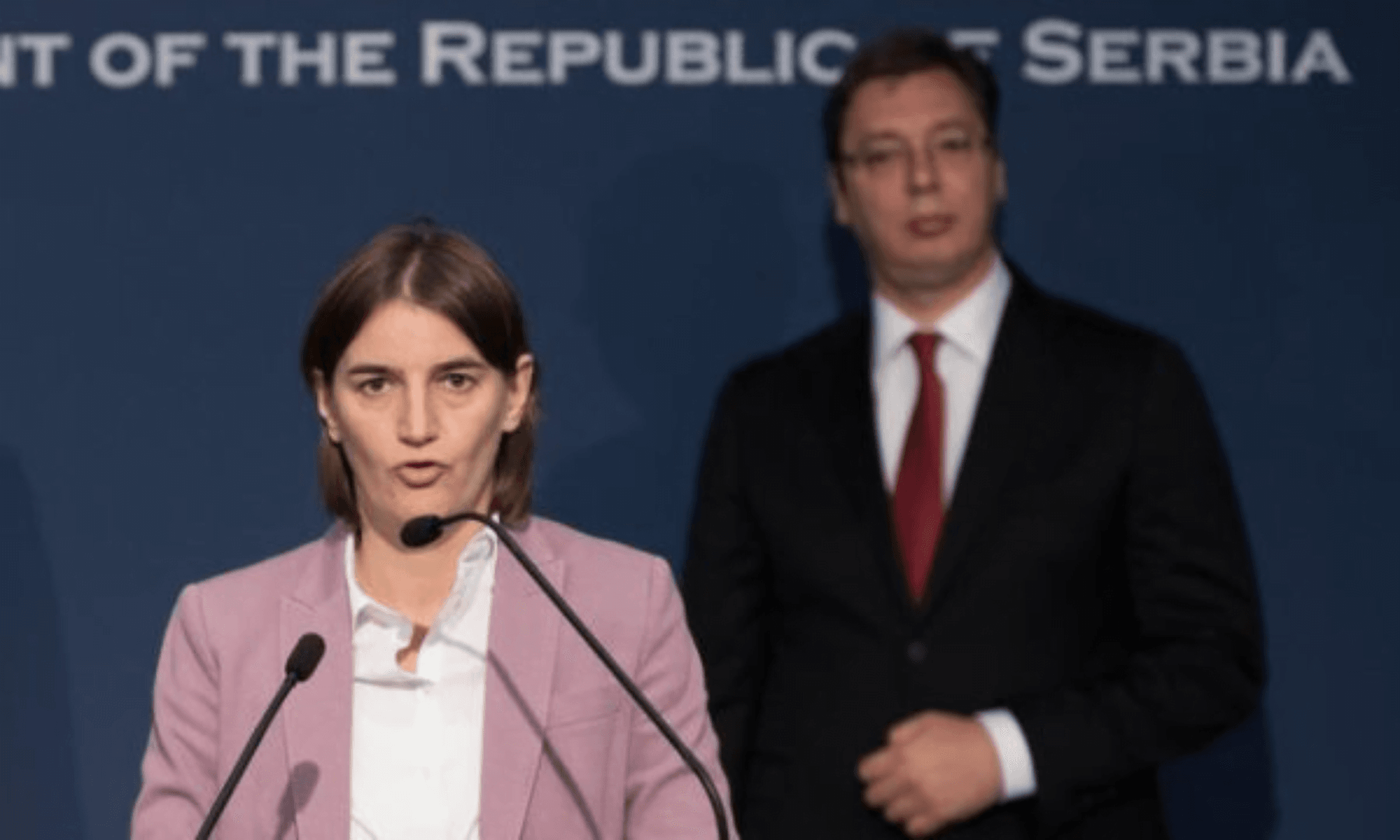
Serbia’s parliamentary speaker Ana Brnabić has suggested that the Constitution could be amended to allow President Aleksandar Vučić to return to the presidency after serving as prime minister, prompting renewed debate over whether the ruling Serbian Progressive Party is seriously considering such a scenario.
Brnabić made the remark while visiting an SNS campaign stand on Saturday, suggesting that Vučić could become prime minister first and that the Constitution could then be changed to enable him to return to the presidency.
Although the comment initially appeared to be a joke, legal and political experts interviewed by N1 say it may have reflected a genuine preference within the ruling camp, while questioning whether such a constitutional change would be politically and legally feasible.
Professor Svetislav Kostić of the Faculty of Law described Brnabić’s statement as an “outpouring of honesty” about what the ruling party would actually like to see happen. At the same time, he argued that the political conditions required for such a constitutional amendment are increasingly unlikely to exist.
Under Serbia’s Constitution, changing the fundamental provisions governing the presidency requires a two-thirds majority in parliament, followed by a referendum in cases affecting constitutional principles.
Kostić argued that even if the ruling party could theoretically secure the necessary parliamentary majority, it is unlikely to do so in the future.
Why would Vučić want to return as president?
Political analysts also questioned whether Vučić would actually benefit from returning to the presidency.
Nemanja Nenadić of Transparency Serbia noted that there is no constitutional limit on the number of times an individual can serve as prime minister and argued that the powers formally assigned to the prime minister are considerably broader than those of the president.
From that perspective, Vučić could retain greater formal executive authority as prime minister without needing a constitutional amendment.
However, political scientist Duško Radosavljević pointed to the significant symbolic and political power attached to the presidency in Serbia, particularly under Vučić.
Although the Constitution formally assigns executive authority primarily to the government, political reality has often depended heavily on the individual occupying the presidency and the extent of his influence over the ruling political structure.
Radosavljević argued that Vučić is fully aware of the political importance of the presidency and may therefore have little interest in accepting a role subordinate to another head of state.
Constitutional change and the concentration of power
The proposal has also raised broader concerns about the relationship between constitutional reform and the concentration of political power.
Radosavljević said he hoped Brnabić’s proposal was merely a joke, arguing that changing the Constitution specifically to facilitate the political ambitions of one individual would be damaging to Serbia.
He warned that such a move could further open the way toward direct authoritarian rule, at a time when concerns about democratic institutions and the separation of powers have already intensified.
The debate comes amid growing political uncertainty in Serbia and speculation over the timing of future parliamentary and presidential elections.
For now, Brnabić’s comments remain a political proposal rather than a formal initiative to amend the Constitution. But the reaction they have generated has revived a fundamental question: whether Serbia’s constitutional framework is being discussed as a set of rules governing the state or as a mechanism that could be adjusted to accommodate the ambitions of a single political leader.