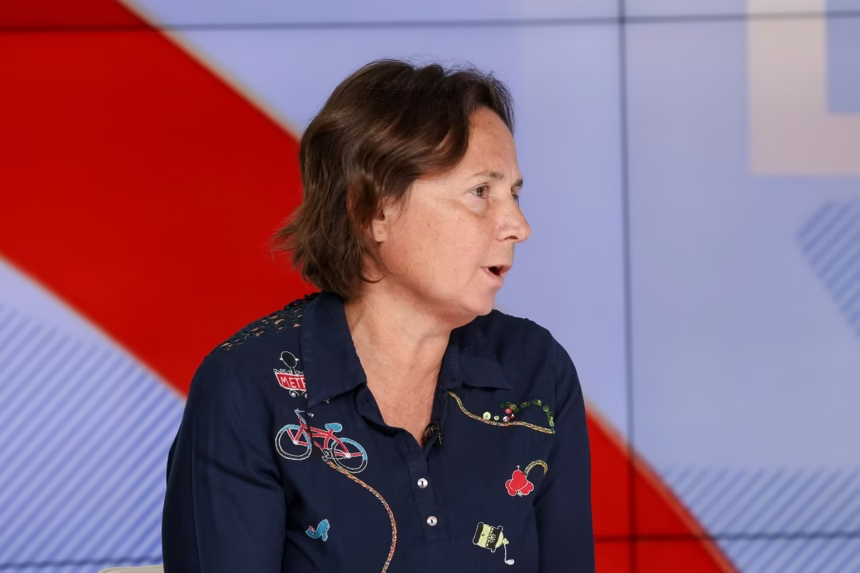
Estela Radonjić Živkov, a conservator and former deputy director of Serbia’s Republic Institute for the Protection of Cultural Monuments, has accused state institutions of attempting to discredit her because of her testimony in the legal proceedings concerning the redevelopment and removal of protected status from Belgrade’s Generalštab complex.
Radonjić Živkov was questioned by Serbia’s Interior Ministry on Tuesday over a criminal complaint filed against her by the Ministry of Culture. She said she believes the proceedings are part of institutional pressure intended to undermine her credibility as a witness.
“I am addressing the public to draw attention to the open institutional pressure and attempt to discredit me as a witness in the court proceedings concerning the demolition and redevelopment of the Generalštab complex in Belgrade,” Radonjić Živkov said in a statement.
She said she is one of the key witnesses in the case against Culture Minister Nikola Selaković and claimed that the minister’s defense team had previously indicated that it would seek to challenge the personal and professional credibility of witnesses.
Radonjić Živkov appeared before the Anti-Corruption Service of the Criminal Police Directorate as a citizen, accompanied by her legal team. On the advice of her lawyers, she said she declined to provide further statements regarding what she described as an unfounded case.
According to Radonjić Živkov, the criminal complaint filed by the Ministry of Culture concerns administrative procedures and a public procurement process for conservation works at the historic Manasija Monastery in August 2023.
She further alleged that the ultimate objective of the proceedings could be to have her arrested shortly before the next hearing in the Generalštab case, creating a public perception that she is corrupt and damaging her credibility before the court.
“As a professional who has spent decades protecting this country’s cultural heritage, I refuse to be a victim of political retaliation because of my testimony in the Generalštab case,” she said.
Police investigation into heritage institute
Belgrade’s Higher Public Prosecutor’s Office previously said it had asked police to collect information to verify allegations contained in a criminal complaint filed against the former director and deputy director of the Republic Institute for the Protection of Cultural Monuments.
Police investigators had also visited the institute without prior public notice and seized documentation related to public procurement procedures from 2023, including records concerning conservation work at Manasija Monastery and the archaeological site of Caričin Grad.
The prosecutor’s office has not publicly established that Radonjić Živkov committed a crime, and the investigation remains ongoing.
Generalštab case
The broader Generalštab case concerns allegations surrounding decisions that led to the removal of legal protection from the former Yugoslav Army General Staff complex in central Belgrade, a site widely regarded as an important part of Serbia’s modern architectural and historical heritage.
Culture Minister Nikola Selaković is among those facing charges, alongside Goran Vasić, director of the Republic Institute for the Protection of Cultural Monuments; Aleksandar Ivanović, director of the Belgrade City Institute for the Protection of Cultural Monuments; and Slavica Jelača, a secretary at the Ministry of Culture.
According to the indictment proposal, Selaković, together with the other defendants, exceeded his official powers between May and November 2024 and participated in procedures that prosecutors say unlawfully contributed to the removal of the buildings’ protected status.
Prosecutors allege that the defendants knowingly took steps toward removing the protection despite the absence of the legally required conditions, causing serious damage to Serbia’s cultural heritage.
The defendants have the right to challenge the allegations, and their criminal responsibility has not been established by a final court ruling.
Radonjić Živkov’s allegations of political retaliation have likewise not been independently established. Her case comes as the Generalštab proceedings continue to attract significant political and public attention in Serbia.