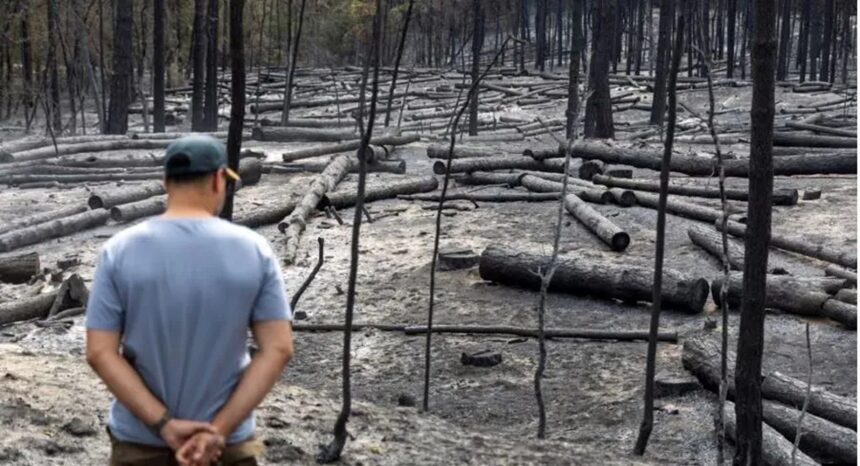
As firefighters battle wildfires in several parts of Serbia, with the most critical situation reported in Deliblato Sands, various claims about the causes of the fires have been circulating on social media and in parts of the Serbian media.
From speculation about what may have caused the fires to accusations that state authorities failed to respond in time, some of the claims made publicly have not been independently confirmed.
Radio Free Europe examined the misinformation and unverified claims surrounding the ongoing firefighting efforts.
Several tabloids and pro-government media outlets in Serbia reported on August 23 that an incendiary device had allegedly been launched from Kosovo in an attempt to start a fire in Serbia. The reports cited unofficial information and a video that allegedly showed the device falling to the ground.
A day later, Serbian President Aleksandar Vučić, speaking during a visit to Kraljevo in central Serbia, said that a “parachute weapon” had been found.
“The objective is clear, but the investigation is still ongoing,” Vučić said when asked about the alleged “fireball” launched from Kosovo.
He did not specify where the device had allegedly been launched from or where it had been found, saying only that significant forces were operating in the area and that an investigation was under way.
Device appears similar to a weather probe
The photograph of the device published by Serbian media has not been identified as AI-generated by available image-authentication tools.
However, the device appears to have features more consistent with a meteorological probe used to measure weather conditions.
Such probes are typically carried into the atmosphere by weather balloons and may be equipped with a small parachute, which allows the measuring equipment to descend safely after the balloon bursts at high altitude.
Weather-probe housings are often made from lightweight materials such as Styrofoam or plastic tubes. Unlike standard meteorological probes, however, the device shown in the published images does not appear to contain clearly visible measuring instruments, a GPS transmitter or a battery. Instead, it appears to consist largely of a sealed tube.
The tube bears the marking “Lot 1048”, indicating its manufacturing origin and suggesting that it is a commercially produced plastic component.
Three days after the allegations concerning the alleged “parachute weapon” emerged, Serbian authorities had provided no further details.
According to Vučić, the investigation was being conducted by the police, the Security Intelligence Agency (BIA) and the Military Security Agency (VBA).
Radio Free Europe sent inquiries to all three institutions seeking information about the investigation but received no response before publication.
There was also no response from the Higher Public Prosecutor’s Office in Novi Pazar, which had reportedly ordered an investigation.
Kosovo Police rejected the allegations immediately after reports emerged about an alleged incendiary device launched from Kosovo.
“No such weapon, as described in the media, has been used by the authorities of the Republic of Kosovo,” Kosovo Police said.
The police also stated that its units had not observed anything resembling such a device being launched from Kosovo into Serbian territory.
The reports about the alleged device appeared one day before Vučić visited the Raška District, including Novi Pazar, Raška and Kraljevo, areas located along the route towards Kosovo.
‘Strange, with patches’ — Vučić comments on the Deliblato fire
On August 23, Vučić travelled by helicopter to the Deliblato Sands area, where the first fire broke out on July 21 and intensified from August 5.
After inspecting the area, Vučić told firefighters that the destruction of vegetation and forests was extensive.
He also described what he considered an unusual pattern in the burned areas.
“It is very strange, somewhat patchy,” Vučić said, describing areas where vegetation had burned heavily alongside sections that remained green.
He later acknowledged that one of the main factors affecting the spread of the fire was changing wind direction.
“You protect one area, and then another one is affected. Within a day, the wind changes direction,” he said.
Before Vučić’s remarks, authorities had already provided an explanation for the unpredictable spread of the fire.
On August 8, Roland Kokai, director general of Vojvodinašume, said the fire’s behaviour was not unusual because three different wind patterns meet in the area.
He explained that the fire could therefore spread unpredictably, particularly in pine forests, where pine cones can be carried considerable distances by the wind.
Vojvodinašume also reported on August 6 that high temperatures and strong winds with changing directions had contributed to the rapid spread of the fire.
The Deliblato Sands Special Nature Reserve, located in southeastern Vojvodina, consists largely of acacia and pine forests.
Experts note that pine trees can burn rapidly because of their resin, dry needles and cones.
Wind farms, oil and gas claims
Social media users have also questioned whether planned investments, including a potential wind farm, could be linked to the fires in Deliblato Sands.
On August 26, Serbia’s Minister of Mining and Energy, Dubravka Đedović Handanović, rejected the claims, saying there were no plans to build a wind farm in the area.
“The fire does not ‘clear space’ for construction. Deliblato Sands remains a protected natural resource,” she said in an Instagram post.
Vučić also dismissed claims that the fires had been deliberately started to facilitate investment or because oil and gas had allegedly been discovered in the area.
He said reports suggesting that the fires were linked to underground gas or oil deposits were false.
Authorities investigate spread of false information
On August 22, Serbia’s Higher Public Prosecutor’s Office in Belgrade announced that it would seek to identify and prosecute people spreading false information about the Deliblato Sands fire on social media.
The prosecution said the investigation concerned suspected incitement of panic and disorder, but did not specify which statements were being investigated.
Serbia’s Special Prosecutor’s Office for High-Tech Crime did not respond to Radio Free Europe’s questions about the outcome of the investigation before publication.
Public has the right to ask questions, legal expert says
Vesna Rakić Vodinelić, a professor of law, told Radio Free Europe that domestic case law distinguishes between the public’s right to information and the deliberate spread of panic.
She said that when an issue is of significant public interest — particularly when it may pose a risk to an unspecified number of people — citizens have the right to ask questions about how a fire started.
She argued that the circulation of different theories online, including claims that the fire was deliberately started or that the government may have had an interest in developing the area, was partly a consequence of statements coming from Vučić himself.
Rakić Vodinelić also said that, in the absence of credible information from the authorities, it can be difficult for the public to distinguish verified information from speculation.
Questioning what happened, she argued, should not automatically be considered the spreading of panic when authorities have yet to provide reliable information about the cause of the fire.