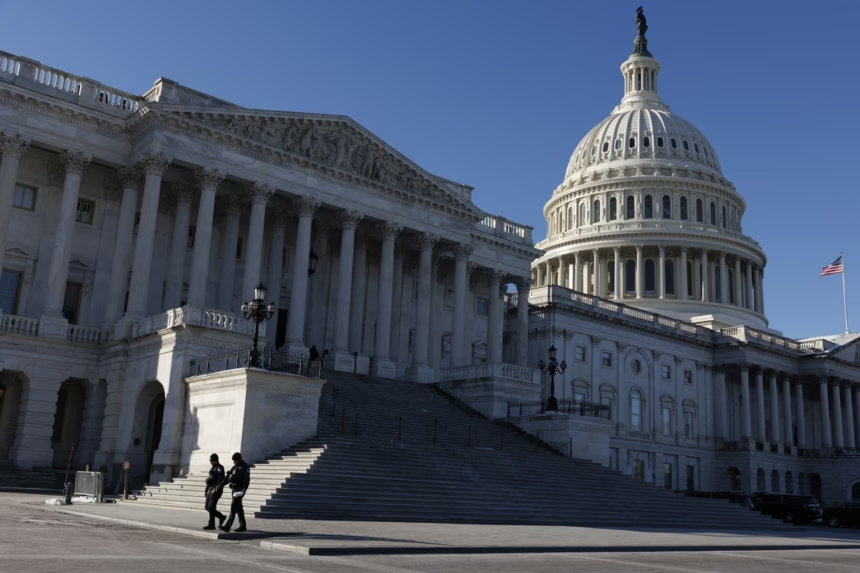
U.S. Congressmen Joe Wilson, a Republican from South Carolina, and William Keating, a Democrat from Massachusetts, have introduced legislation criticizing Serbia’s government over what they describe as democratic backsliding, pressure on independent media and increasingly close ties with Russia, China and Iran.
The proposed legislation, referred to as the “Serbia Act,” calls for sanctions and visa restrictions against individuals accused of undermining democratic institutions, engaging in corruption, violating human rights or contributing to instability in the Western Balkans.
The initiative marks a significant shift from the otherwise improving relationship between Belgrade and Washington, which launched a strategic dialogue on July 16. It is also the first U.S. congressional measure since Donald Trump returned to the White House to explicitly address Serbia’s domestic political situation in such detail.
The measure remains only a proposal and would have to pass both chambers of Congress and be signed by President Donald Trump before becoming law.
“President Vučić has aligned himself with the war criminal Putin, the Chinese Communist Party, and the terrorist regime in Tehran, against the rule of law,” Wilson said in a statement cited by Insajder. He also pointed to the mass protests in Serbia and accused Vučić of attempting to divert attention through “bellicose rhetoric and destabilization of the region.”
Focus on protests and the Novi Sad station tragedy
The proposed legislation states that Serbia has experienced significant democratic backsliding and problems with the rule of law under President Aleksandar Vučić and his Serbian Progressive Party.
It also criticizes the authorities’ response to student and civic protests, alleging excessive use of force and increased pressure on independent media.
Particular attention is given to the collapse of the railway station canopy in Novi Sad, which killed 16 people. The congressmen call for an independent and transparent investigation into the disaster and accountability for those responsible.
They also call on the U.S. secretary of state to pressure Serbian authorities to conduct an independent investigation into both the station tragedy and allegations of excessive force against protesters.
Concern over Serbia’s ties with Russia, China and Iran
Another major section of the proposed legislation addresses Serbia’s growing political, economic and security ties with Russia and China, despite the country’s status as an EU candidate.
The measure also highlights Serbia’s relations with Iran, including Belgrade’s decision to send a representative to the funeral of Iranian Supreme Leader Ayatollah Ali Khamenei.
Wilson and Keating argue that the United States has a strategic interest in strengthening relations with a Serbia that is democratic, Euro-Atlantic oriented and less vulnerable to malign foreign influence.
They therefore propose targeted sanctions and visa restrictions against individuals who destabilize the Balkans, support malign Russian activities, undermine democratic institutions, engage in corruption or violate human rights.
Conditions for continuing the U.S.-Serbia strategic dialogue
The proposed legislation would require the U.S. secretary of state, in coordination with the secretary of defense and the director of national intelligence, to report to relevant congressional committees within 180 days of enactment.
The report would address Russian and Chinese influence in Serbia, progress in investigations into the Novi Sad station disaster and alleged excessive force against demonstrators, and the extent to which the strategic dialogue between Washington and Belgrade advances shared U.S. objectives.
It would also examine support for independent media and civil society organizations, judicial reform, Serbia’s foreign-policy alignment with the EU and NATO, and democratic conditions in the country.
Wilson and Keating further argue that the U.S. secretary of state should suspend participation in the strategic dialogue unless it addresses free and fair elections, judicial reform, the fight against corruption, media freedom, freedom of assembly and Serbia’s relations with Russia and China.
If those conditions are not met, the proposal says State Department personnel should not participate in the dialogue or use congressional funds allocated for it.
At the same time, the congressmen leave open the possibility of closer U.S.-Serbia relations if Belgrade makes progress on the issues outlined in the legislation.
“If Serbia works toward these objectives,” the proposal says, Washington should seek to strengthen relations with Belgrade at multiple levels.
Keating previously sponsored the Western Balkans Democracy and Prosperity Act, which was passed by Congress and entered into force in December 2025. Wilson has also recently supported efforts to move the 2027 OSCE Parliamentary Assembly session away from Belgrade because of Serbia’s relations with Russia and China.
The proposed “Serbia Act” therefore places increasing scrutiny from Washington on Serbia’s domestic democratic record and foreign-policy orientation, while still leaving the door open for stronger bilateral relations if Belgrade addresses the concerns raised by the U.S. lawmakers.