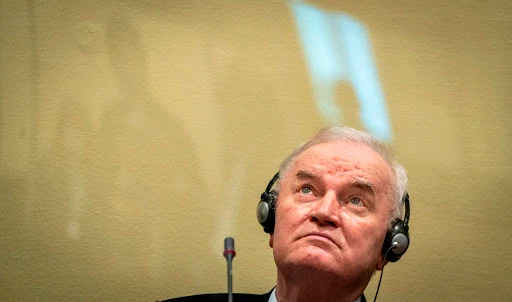
Serbia’s opposition Freedom and Justice Party (SSP) said Thursday, following the death of former Bosnian Serb military commander Ratko Mladić, that no person who committed war crimes should ever be presented as a role model for future generations.
Mladić, the former commander of the Army of Republika Srpska and a convicted war criminal, died in The Hague at the age of 84 while serving a life sentence for crimes committed during the war in Bosnia and Herzegovina.
In its statement, SSP contrasted those who sought to glorify Mladić with the Serbian officials who ultimately fulfilled the country’s international obligations by arresting him and transferring him to the Hague Tribunal.
“While some promised that their homes would be safe houses for Mladić and demanded that Zoran Đinđić Boulevard be renamed after him, others fulfilled the international obligations Serbia had,” SSP said.
The party recalled that Mladić was arrested and transferred to the International Criminal Tribunal for the former Yugoslavia, where he was convicted of multiple war crimes, including the killing of thousands of people in Srebrenica.
SSP said the crimes committed under Mladić’s command had cast a “deep shadow” over Serbia and the Serbian people, arguing that generations who had no involvement in the crimes nevertheless continued to bear the consequences of their association with them.
“Generations of people who did not participate in those crimes and bear no responsibility for them have grown up and will continue to grow up carrying the burden of the fact that Serbia’s name is associated in the world with crimes, especially those in Srebrenica,” the party said.
SSP called on societies across the former Yugoslavia to confront the historical record rather than avoid it, stressing that victims should be remembered and honored regardless of their nationality.
“It is time for all peoples in this region to finally stop running away from the facts, pay respect to the victims and clearly say that crime has no nationality and that no one who committed a crime can be a role model for future generations,” SSP said.
The statement comes amid sharply divided reactions in Serbia following Mladić’s death, with opposition parties and human rights advocates emphasizing his convictions and the need to confront the legacy of the Bosnian war, while parts of Serbia’s political and media establishment have continued to portray him in a more favorable light.