Russia’s influence in the Western Balkans is not simply a diplomatic preference. According to former U.S. diplomat Matthew Palmer and Serbian diplomat Srećko Đukić, it has become part of a broader strategy aimed at exploiting the region’s divisions and slowing its integration with the European Union and NATO.
And Serbia remains one of Moscow’s most important footholds.
Palmer argues that Russia actively looks for “cracks” and weaknesses within European structures and attempts to widen them. The Western Balkans, with its unresolved conflicts, competing nationalisms and fragile political institutions, offers fertile ground for precisely that strategy.
Serbia’s relationship with Moscow sits at the centre of this picture.
While Belgrade officially maintains its ambition to join the European Union, it continues to preserve close political, economic and security ties with Russia. Moscow, meanwhile, openly portrays Serbia as a partner under pressure from the West.
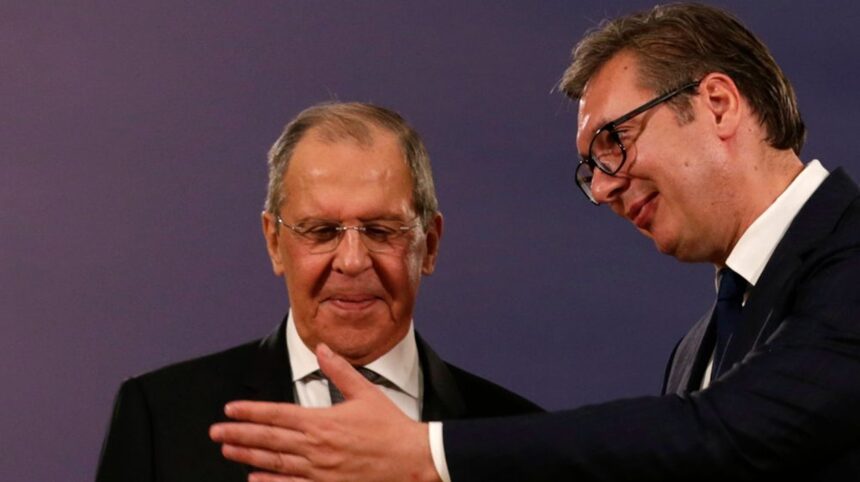
Russian Foreign Minister Sergey Lavrov has repeatedly defended President Aleksandar Vučić against what he describes as EU pressure, while Russia continues to emphasise its support for Serbia over Kosovo and other regional issues.
For critics, this creates an increasingly uncomfortable contradiction: Serbia wants the economic and political benefits of European integration while continuing to preserve a strategic relationship with a power whose geopolitical interests frequently run directly against the European security order.
The Kosovo issue is another crucial part of the equation.
According to Đukić, Russian influence in Serbia feeds on narratives surrounding history, religion, nationalism and the belief that Kosovo can somehow be reclaimed. Such narratives, he argues, help keep nationalist mobilisation alive and prevent the region from moving beyond the conflicts of the 1990s.
The result is a familiar cycle: unresolved disputes fuel nationalism, nationalism fuels political confrontation, and confrontation creates precisely the instability from which external powers can benefit.
Serbia caught between two worlds
The article paints Serbia as a country caught between two competing geopolitical directions.
On one side stands the EU and NATO, offering economic integration, institutional reform and a European security framework. On the other stands Moscow, offering political backing, energy cooperation and unwavering support for Belgrade’s position on Kosovo.
But maintaining both relationships comes at a price.
The longer Serbia refuses to make a clear strategic choice, the easier it becomes for Moscow to retain influence and the harder it becomes for the Western Balkans to fully escape the geopolitical shadow of the past.
That is precisely why Russia’s role in the region is so controversial.
A Balkan region firmly anchored in European structures would leave Moscow with far less political space to operate. A divided, frustrated and permanently conflicted Balkans gives Russia considerably more room to manoeuvre.
And Serbia, through its continued partnership with Moscow and its unresolved confrontation over Kosovo, remains at the heart of that geopolitical tension.
For the region, the question is therefore no longer simply whether Russia wants influence in the Balkans.
The more uncomfortable question is how long Serbia can continue serving as Moscow’s bridge into the region while simultaneously claiming that its future lies in Europe.