Serbia is trying to reshape its energy sector. After years of relying heavily on Russian gas and fossil fuels, Belgrade is increasingly turning toward solar, wind and hydropower as it seeks to diversify its energy supply and gradually reduce its dependence on coal.
But as Serbia moves toward a greener energy system, another powerful player is becoming increasingly visible: China.
Chinese companies are no longer present only in Serbia’s mining, infrastructure and industrial sectors. They are increasingly involved in renewable energy projects as investors, majority owners, engineering contractors and suppliers of equipment and technology.
That growing presence raises an uncomfortable question for Belgrade: is Serbia genuinely diversifying its energy sector, or is it simply exchanging one form of strategic dependence for another?
The issue is particularly sensitive because energy infrastructure is not an ordinary commercial sector. Electricity generation, transmission networks, turbines, solar equipment, storage systems and digital control technologies are all closely connected to national security.
For years, Serbia’s dependence on Russia has demonstrated the risks involved in placing too much strategic weight on a single foreign partner. Now, as Belgrade attempts to reduce that dependence, China is gaining an increasingly important position in the country’s emerging green-energy market.
A green transition with a Chinese footprint
Serbia remains heavily dependent on coal for electricity production. At the same time, the country has committed to gradually moving away from coal because of its environmental impact and its obligations as an EU candidate.
Renewable sources accounted for roughly 30 percent of Serbia’s electricity production in 2025, with hydropower representing the largest share.
The government says it wants to accelerate the transition and insists that Serbia is working with partners from a wide range of countries, including those from Europe, the United States, Japan, China, the United Arab Emirates and Israel.
However, the Chinese presence is becoming increasingly difficult to overlook.
Chinese companies are involved in several major renewable-energy projects, particularly in wind and solar power. Their involvement varies from project to project: in some cases they provide financing or construction services, while in others Chinese companies have become the actual owners of energy assets.
This distinction matters.
A foreign company building a project for the Serbian state is not necessarily the same as a foreign company owning the project and receiving the long-term revenues generated by it.
According to Stefan Vladisavljev of the BFPE Foundation, Chinese participation in Serbia’s renewable-energy sector is beginning to move beyond the model that characterized the early years of China’s Belt and Road Initiative.
Chinese capital is increasingly entering Serbia’s energy market directly, either independently or alongside companies from other countries.
That means the question is no longer simply who is building Serbia’s energy infrastructure.
It is also who owns it, who controls the technology and who ultimately benefits from it.
Serbia already knows the price of energy dependence
The debate cannot be separated from Serbia’s existing relationship with Russia.
Serbia still receives around 80 percent of its natural gas through imports from Russia. The country’s energy vulnerability became even more visible after the United States imposed sanctions on Serbia’s oil company NIS because of its majority Russian ownership.
While Belgrade has been seeking a solution for NIS, including discussions involving Hungary’s MOL, the broader lesson from Europe’s energy crisis has become impossible to ignore.
Russia’s invasion of Ukraine exposed the geopolitical risks of excessive dependence on a single energy supplier.
For the European Union, reducing dependence on Russian fossil fuels has therefore become not only an economic and environmental objective, but also a strategic and security priority.
Renewable energy is one of the main ways to achieve that goal.
But there is a complication.
Replacing Russian gas with renewable energy may reduce dependence on Moscow, while increasing dependence on Chinese technology, equipment or ownership could create a different strategic vulnerability.
China dominates the renewable-energy supply chain
China occupies an extraordinary position in the global renewable-energy industry.
The country dominates major parts of the supply chains for solar panels, batteries and other clean-energy technologies. According to the International Energy Agency, China accounts for more than 80 percent of global manufacturing capacity across the main stages of solar-panel production.
China is also the world’s largest renewable-energy market.
This dominance makes completely avoiding Chinese technology extremely difficult, particularly for countries such as Serbia that are attempting to expand renewable capacity quickly and at relatively low cost.
For Belgrade, Chinese companies can offer something that many governments find attractive: financing, construction capacity, technology and the ability to deliver large infrastructure projects relatively quickly.
The problem is that the same advantages can create long-term strategic dependence.
As Serbia’s renewable sector expands, Chinese companies could increasingly occupy several positions simultaneously: investor, owner, builder, technology provider and equipment supplier.
That concentration is precisely what European security experts are warning against.
Vetrozelena: a major test case
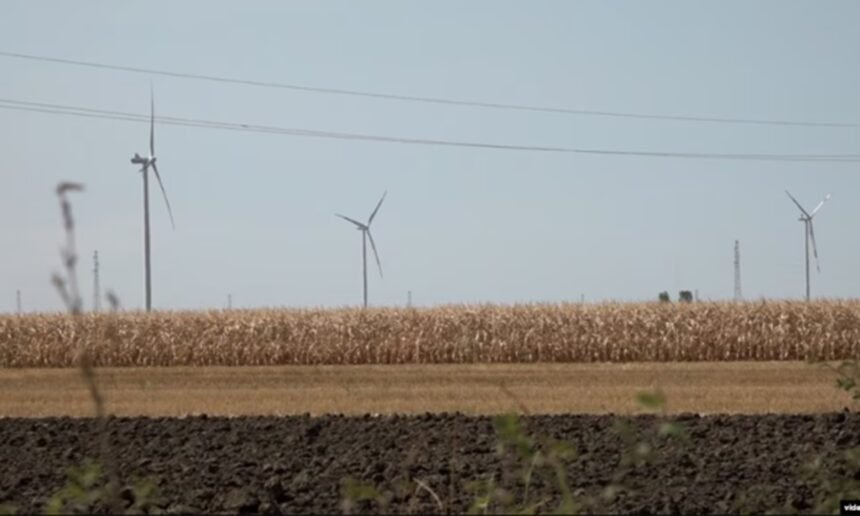
One of the clearest examples is the Vetrozelena wind farm near Pančevo.
When completed in 2027, the project is expected to have a capacity of around 300 megawatts, making it one of Serbia’s largest wind-energy projects.
The project was initiated by CWP Europe. In 2023, the company announced a strategic partnership with the Chinese state-owned PowerChina Resources, which acquired a 51 percent stake and became the majority owner.
Another 39 percent is held by Hong Kong-based Carren Holdings, while CWR Europe retains 10 percent, according to publicly available Serbian business-registry data.
PowerChina describes the project as its first controlling investment in renewable energy in Serbia.
Its subsidiary Sinohydro Bureau 5 is responsible for construction.
From an economic perspective, the project represents an important expansion of Serbia’s renewable-energy capacity.
From a strategic perspective, however, it illustrates the growing role of Chinese capital in Serbia’s energy infrastructure.
The concern is not necessarily that a Chinese company owns a wind farm.
The concern is what happens when ownership is combined with control over technology, digital systems, maintenance and remote access.
The security question behind the turbines
Modern energy infrastructure is increasingly digital.
Wind turbines, solar installations and electricity-management systems rely on connected technologies that can be monitored, updated and, in some circumstances, accessed remotely.
That creates a new category of vulnerability.
Caspar Hobhouse of the EU Institute for Security Studies has warned that excessive reliance on Chinese technology could create risks involving remote access, data collection and potential disruption of energy infrastructure.
The concern is straightforward: if a foreign actor has significant technological access to strategically important infrastructure, that access could theoretically become a security vulnerability.
The issue is therefore not simply about where a turbine was manufactured.
It is about who controls the software, who manages the equipment, who can access the system remotely and what happens if political relations deteriorate.
For a country increasingly integrated into the European energy system, such risks could extend beyond Serbia’s borders.
The Western Balkans are becoming increasingly interconnected with the European energy network. A serious disruption originating in one country’s infrastructure could therefore have consequences elsewhere.
Another Chinese-controlled wind project
Vetrozelena is not the only example.
The Crni Vrh wind project in eastern Serbia is planned to have a capacity of around 150 MW and is expected to become operational in 2027.
The project is controlled by Crni Vrh Power, whose ownership is divided between two Chinese companies: state-owned Shanghai Electric Power, with 51 percent, and CMC Capital, with 49 percent.
Before the acquisition by Chinese investors, the company had been entirely Serbian-owned.
The project also has a politically notable history. Half of the previous ownership was held by Nikola Petrović, described publicly as a godfather of Serbian President Aleksandar Vučić.
The financial details of the transaction were not publicly disclosed.
Chinese company Mingyang Smart Energy is the principal technology and equipment supplier for the wind farm.
The company’s chairman, Zhang Chuanwei, described the cooperation as another example of the “steel friendship” between Serbia and China.
The phrase is politically significant.
Serbia has cultivated particularly close relations with Beijing in recent years, presenting China as an important strategic and economic partner.
The energy sector is now becoming another arena in which that relationship is taking concrete form.
China enters the solar sector as well
The Chinese presence is not limited to wind power.
In 2024, Serbia signed a memorandum with Shanghai Fengling Renewable to develop a massive combined wind-and-solar energy complex near Bor.
The planned project would have around two gigawatts of renewable capacity and would also include facilities for producing green hydrogen.
The electricity would be used by Serbia Zijin Copper, the Chinese-owned mining company operating in Bor.
Zijin Mining holds 63 percent of Serbia Zijin Copper, while the Serbian state owns the remaining 37 percent.
This creates another interesting connection between Chinese ownership and Serbia’s energy system.
A Chinese-owned mining operation could increasingly be supplied by electricity generated through projects involving Chinese capital and technology.
That creates an integrated economic ecosystem in which Chinese companies are present not only in resource extraction, but also in the energy infrastructure required to power those activities.
Serbia has also signed agreements with Chinese companies for solar-panel manufacturing, renewable-energy development and potential energy-storage projects.
The question of ownership
The Serbian government argues that Chinese participation should not automatically be interpreted as a security threat.
Officials point out that Serbia works with companies from numerous countries and that Chinese participation often involves engineering, procurement and construction rather than ownership.
That distinction is important.
Not every Chinese-built project represents Chinese control.
However, the ownership structure of several major projects demonstrates that Chinese involvement is sometimes much deeper.
When Chinese companies provide financing, build the infrastructure, supply the technology and retain ownership of the resulting energy assets, the relationship becomes considerably more strategic.
This is where Serbia’s diversification strategy faces its biggest challenge.
Diversification is not simply about having more suppliers.
It is also about avoiding excessive concentration of ownership, technology and strategic control in the hands of one external power.
Washington is also watching Serbia’s energy choices
The United States has encouraged Serbia to diversify both its energy sources and its suppliers.
American officials have emphasized the importance of selecting reliable partners and strengthening energy security.
From Washington’s perspective, Serbia’s future economic opportunities will depend significantly on the investment decisions, public policies and international partnerships it chooses today.
The message is clear: energy policy is increasingly becoming foreign policy.
For Serbia, the choice between European, American, Chinese and other partners is therefore not simply an economic calculation.
It is also a geopolitical one.
Europe is tightening its approach
The European Union has already begun treating renewable-energy security as a strategic issue.
In May, the EU moved to restrict funding for solar inverters from countries it considers high-risk, including China.
The reason is that modern inverters are not passive pieces of equipment. They can communicate with electricity networks and, depending on their configuration, may be accessed remotely.
Security experts therefore warn that compromised or manipulated equipment could potentially be used to interfere with electricity systems.
This has turned what once appeared to be a purely technical question into a national-security issue.
For Europe, the lesson from Russia’s energy dependence is becoming broader:
strategic dependence is dangerous regardless of whether the dependency involves gas pipelines, oil companies, digital infrastructure or renewable-energy technology.
Serbia’s difficult balancing act
Belgrade now faces a complicated balancing act.
It wants to reduce its dependence on Russia without damaging its relationship with Moscow.
It wants to deepen its European integration while maintaining close economic and political relations with Beijing.
It wants to accelerate the green transition without becoming dependent on a different foreign power for the technology and capital needed to achieve it.
And it wants cheaper, faster infrastructure without sacrificing long-term control over strategic assets.
The answer will depend largely on how Serbia structures future projects.
Foreign investment itself is not necessarily a problem. Chinese participation is not automatically a security threat, just as European or American investment is not automatically risk-free.
The critical questions are different:
Who owns the infrastructure? Who controls the technology? Who has access to the systems? Who provides the equipment? Who finances the project? And can Serbia continue operating it independently if political relations with the investor deteriorate?
Those questions are becoming increasingly important as Serbia’s energy transition accelerates.
The irony is that Serbia’s green transition, which is intended to make the country more independent, could simultaneously create new forms of dependence.
After decades of Russian dominance in Serbia’s energy sector, the country now has an opportunity to build a more diversified system.
But diversification will mean more than replacing Russian gas with Chinese megawatts.
If Serbia wants genuine energy sovereignty, it will need a system in which no single foreign power—whether Russia, China or anyone else—can acquire disproportionate influence over the infrastructure that keeps the country running.
The transition to clean energy may be inevitable.
The real question is who will control Serbia’s green future.