
Five European Union countries expect to be ready by 2027 to send irregular migrants to return centers outside the EU.
The countries are Denmark, Austria, Germany, the Netherlands, and Greece.
The interior ministers of the five countries met in Copenhagen on Friday, where they agreed on a common model for centers known as “return hubs.”
Asylum seekers whose applications have been rejected would be sent to these centers, particularly those who cannot be returned to their countries of origin.
The five countries are negotiating with one or more non-EU countries. The potential partner countries have not yet been officially identified. According to media reports, Uganda and Rwanda are among the leading possibilities.
Danish Migration Minister Morten Bødskov said the aim is for the first migrants to be transferred to a partner country outside the EU in 2027.
He said the centers would not be “prisons” or “detention camps.” Instead, he described them as facilities where partner countries would give migrants “a new opportunity,” Euronews reported, according to Sinjali.
The five countries will finance the centers themselves. They may also provide additional funding, trade partnerships, or other incentives to partner countries.
The joint document states that the centers will be established through equal partnerships based on mutual benefit.
Austrian Interior Minister Gerhard Karner said the goal is to reduce irregular migration to the EU to zero.
Meanwhile, talks with potential partner countries are continuing. Greek Minister Thanos Plevris said the discussions are becoming deeper and more concrete, adding that he hopes an agreement will be announced soon.
The five ministers will meet again in Munich at the end of September.
Agreements with countries outside the EU will determine procedures for migrants, as well as conditions of stay and the responsibilities of the European states involved.
The project will be developed in cooperation with international organizations, including the United Nations High Commissioner for Refugees (UNHCR) and the International Organization for Migration (IOM).
The countries say the centers will operate in accordance with EU law and international obligations.
In June, the European Parliament approved new migration rules allowing member states to establish return centers outside the EU through agreements with third countries.
Final approval of the return regulation is expected in the autumn.
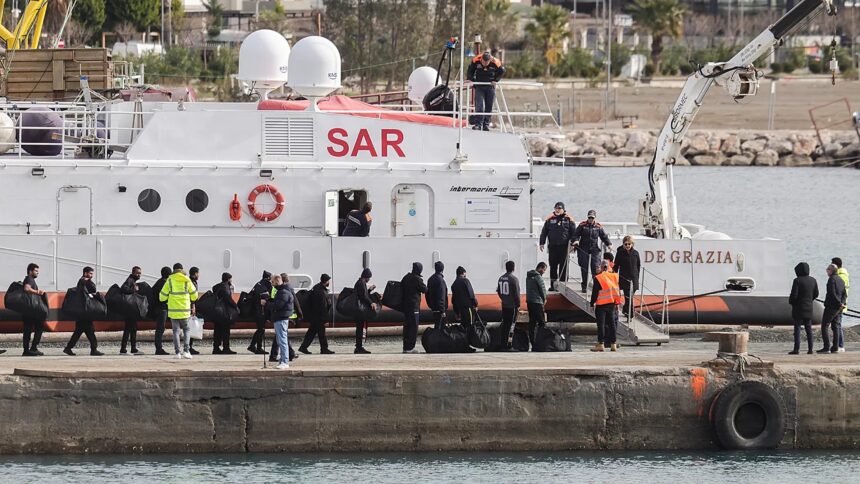
Most EU countries appear to be interested in this model. Italy already has a similar project with Albania.
In June, 19 EU governments described the approach as an innovative solution for managing migration.
However, the centers have raised concerns over human rights and compliance with EU law.
Non-governmental organizations have criticized the idea. Michele LeVoy, director of PICUM, said sending migrants to centers outside the EU could separate children, adults, and families from the lives they have built in Europe. He also warned of prolonged detention in unfamiliar countries.
Previous attempts to send migrants to countries outside the EU have not been particularly successful.
The United Kingdom abandoned its plan to send asylum seekers to Rwanda, where their asylum applications would have been processed.
Denmark had a similar plan but abandoned it in 2023 and shifted its strategy toward a European approach.
Italy initially planned to accommodate around 3,000 migrants per month in its centers in Albania. However, according to reports, only around 500 migrants in total have been sent there since the facilities were converted into deportation centers in March 2025.
The Italian project has cost more than €670 million.
A recent study by an Italian university found that keeping migrants in these centers has cost Italy significantly more than accommodating them within Italian territory.