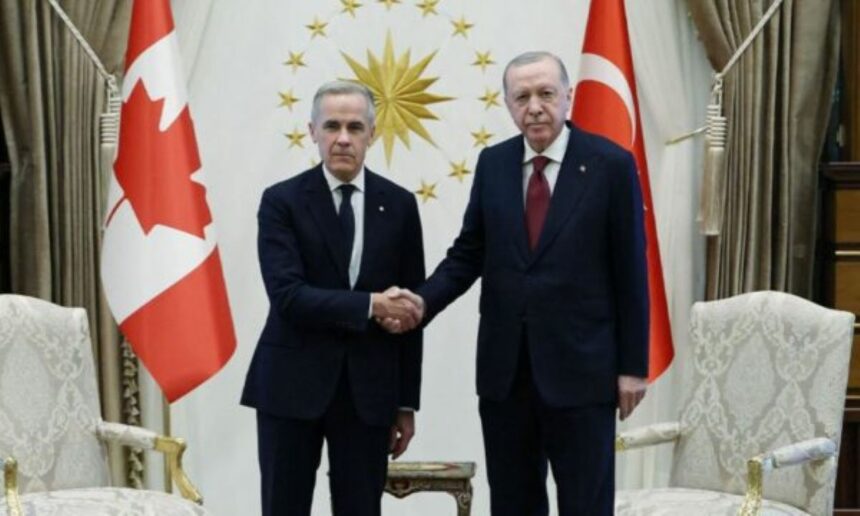
Canadian Prime Minister Mark Carney and Turkish President Recep Tayyip Erdoğan have agreed to elevate relations between their countries to a “strategic partnership,” as Ottawa seeks to diversify its trading relationships and reduce its economic dependence on the United States.
The two NATO allies announced the agreement during Carney’s visit to Türkiye, marking the first bilateral visit by a Canadian leader to the country. The new partnership will focus on four main areas: trade and investment, defence and security, energy, and people-to-people relations.
During the ceremony in Ankara, ministers from both countries signed cooperation agreements covering energy, defence and air transport. The partnership will also include a three-year action plan aimed at creating jobs and expanding opportunities for Canadian and Turkish citizens.
“We have planted the seeds of something new: a strategic partnership that will create new opportunities for our workers and businesses, as well as greater security and prosperity for both our peoples,” Carney said alongside Erdoğan at the presidential palace.
“With care and commitment, this cooperation will develop for generations to come,” he added.
Erdoğan described Carney as a leader demonstrating “common sense and vision” on the global political stage, saying the two countries had taken a historic step toward closer cooperation.
“Today, we have bridged the long-standing gap between Türkiye and Canada. We are now beginning a new era in relations between our two countries,” Erdoğan said.
He added that both governments aimed to increase bilateral trade from its current level of approximately $3 billion to $5 billion initially, with a longer-term target of $10 billion.
Free trade talks and energy cooperation
Carney announced that negotiators from the two NATO allies would meet in Ankara next month to begin the first round of free trade negotiations.
Export Development Canada and Türkiye’s Eximbank are also expected to sign a new agreement designed to help businesses from both countries cooperate on projects in third countries.
According to a Turkish diplomatic source, the countries’ energy ministers will explore cooperation in nuclear energy, critical minerals and liquefied natural gas (LNG).
Carney is also scheduled to meet prominent Turkish business leaders and investors in Istanbul on Friday.
Türkiye is seeking new investments and partnerships to support its expanding defence industry, planned nuclear power plants and mining sector. The country has also held discussions with Canadian engineering firm AtkinsRéalis, South Korea’s Korea Electric Power Corporation and China’s State Power Investment Corporation regarding potential construction of its second and third nuclear power plants.
At the NATO leaders’ summit in July, Carney and Erdoğan launched negotiations on a free trade agreement. Türkiye also agreed to become a founding member of Canada’s Defence, Security and Resilience Bank.
Canada lifted restrictions on arms exports to Türkiye in 2024, including those affecting optical technology used in Turkish drones exported to dozens of countries.
Canada seeks alternatives to US trade dependence
Although bilateral trade remains relatively modest, economic ties between Canada and Türkiye have expanded in recent years. Türkiye accounted for less than 0.3% of Canada’s total merchandise trade, valued at 4.34 billion Canadian dollars, or approximately $3.09 billion, according to the figures cited in the report. Bilateral trade has nevertheless increased by nearly 50% over the past five years.
The visit forms part of Carney’s broader strategy to diversify Canada’s economy amid trade tensions with the United States. US President Donald Trump has imposed broad tariffs and questioned the sovereignty of Canada, prompting Ottawa to seek stronger commercial relationships elsewhere.
“This trip is part of a geopolitical necessity to show the Americans that we are not sitting around waiting for them,” said Besma Momani, a political science professor at the University of Waterloo.
Over the past year, Canada has signed more than 20 trade agreements as Carney pursues a goal of doubling exports to markets outside the United States over the next decade.
In January, he travelled to Beijing to repair strained relations with China, securing an agreement that significantly reduced tariffs on electric vehicles and canola seeds.
Despite concerns about Chinese interference in Canadian politics, Carney has described China as a more “predictable” trading partner than the United States. Canada nevertheless continues to send almost 70% of its exports to the US market.
Canada’s main exports to Türkiye include lentils, aircraft and electronic equipment. Its imports from Türkiye include medical equipment, fishing vessels, aircraft engines and jewellery.
Human rights concerns remain
The closer economic relationship also comes amid criticism of Türkiye’s domestic political environment. The Turkish authorities’ crackdown on opposition figures in 2024 and arrests targeting members of the LGBTQ+ community have raised concerns among rights advocates.
Carney has placed less emphasis on human rights issues than some of his predecessors, prompting questions about how Canada will balance economic interests with its stated commitment to equality.
“Carney will have to maintain a very careful balance in Türkiye, opening up new economic prospects for Canada while also trying to preserve his country’s role as a middle power in efforts to promote equality,” said Anna Agathangelou, a political science professor at York University.
The Turkish government maintains that the judiciary is independent and denies that investigations or court proceedings are politically motivated.
The new strategic partnership signals a significant effort by both countries to deepen economic and security cooperation, while Canada continues to broaden its international partnerships amid uncertainty over its longstanding trade relationship with the United States.