
Sputnik Serbia has shown its readers how to judge the EU’s new ambassador before he even says anything. Belgrade tested the same method with the KFOR commander three weeks ago; the platform being used is one Brussels had asked Serbia to shut down.
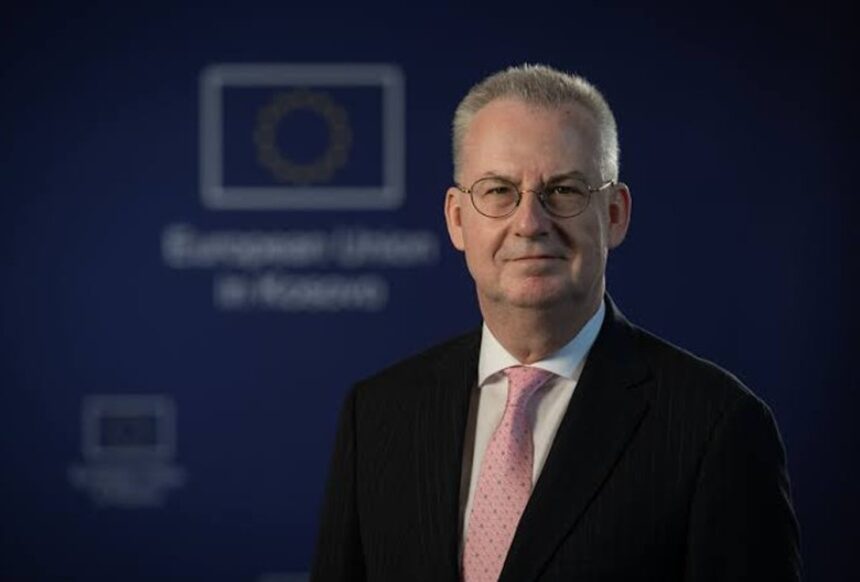
Sputnik Serbia is not broadcast in Kosovo. It is broadcast in Tirana, in Serbian, to an audience that can essentially be rounded down to zero, which is why we examine it here. On the evening of September 3, one day after Dirk Schuebel took office as the European Union’s ambassador in Pristina, the outlet published an assessment of him under the headline “History Repeats Itself: What Germany Is Bringing to Pristina.” The accompanying illustration was a computer-generated image of three flags. The analysis was provided by Stevica Deđanski of the Center for International Cooperation, and its first finding had nothing to do with anything the new ambassador had said or done.
A word about the venue, because the venue is part of the message. Sputnik Srbija is the Belgrade-based news operation of Rossiya Segodnya, staffed by journalists paid from Moscow and publishing in Serbian since 2015. Its content is freely available for republication, and Serbian tabloids close to the government, including Informer and Večernje novosti, regularly republish it; the same is done by the public broadcaster in Republika Srpska. Montenegro banned the outlet in April 2022. Serbia has chosen to portray its continued presence as a matter of sovereignty. On June 26, Serbia’s Information Minister Boris Bratina told RT Balkan that EU calls to block RT Balkan and Sputnik amounted to censorship. On July 8, after eight EU member states refused to open Cluster 3, Aleksandar Vučić cited the closure of Russian media as one of two objections and said Serbia would not do so. What follows was published on a platform Belgrade has chosen to maintain at the cost of its accession process.
“Germans have been Serbia’s old ‘friends’ throughout history, and that is already a sufficient signal of what we can expect,” Deđanski wrote. The quotation marks around “friends” are his. The signal was supposedly sufficient: the biography came first, the mandate and first-day statements came after it, and everything was interpreted through the lens of the former. Only afterward did the text turn to Schuebel’s posts, selecting one particular episode. As EU ambassador to Minsk, he “was accused by Minsk of interfering in the 2020 presidential elections.” The accuser remains unnamed. It was the Lukashenko government, following elections the EU refused to recognize, and the accusation was directed at virtually every Western mission that autumn. Schuebel remained in Minsk after member states withdrew their ambassadors; he was summoned and ordered to leave in June 2021, four days after the Ryanair sanctions, and his accreditation was not renewed. The credential Sputnik presents as a stain is that Aleksandr Lukashenko wanted him gone.
The Framework Was Ready Before the Man
Deđanski’s central claim is that the appointment represents “the European Union striking back at America,” which, under the current administration, has supposedly decided to “listen, more or less, to Serbia and the Serbs in Kosovo on fundamental human rights.” Germany and Brussels, he argues, are now “trying to put things back where they belong, which is that Serbia gets nothing and Pristina gets praised.” In the same passage, he acknowledges that Washington’s new approach has not brought “much help.” We note the concession because it is the only point where the text engages with its own evidence.
The method has a recent precedent in Bosnia, and its history there is worth exactly one paragraph. Before Christian Schmidt arrived as High Representative in 2021, Milorad Dodik announced that Republika Srpska would consider Schmidt “a tourist.” In June 2023, its assembly blocked implementation of his decisions and complained that the state Constitutional Court had been compromised by three foreign judges—a German, an Albanian, and a Swiss. In September 2025, in Moscow, Dodik compared Schmidt to Hitler. When Schmidt announced his departure this May, Dodik wrote that he was “leaving Bosnia and Herzegovina in the same way he arrived: without legitimacy.” When Schmidt used the Bonn Powers, it was German imposition; when he refrained from using them, he remained a tourist. There was no possible outcome that could have moved him out of that category, because the category had been assigned at passport control rather than in office.
A Framework That Works in Both Directions
Deđanski’s argument about “credentials” contains a two-way valve. Anything the EU Office does that Belgrade dislikes can now be attributed to Germany’s inherited bias, an interpretation requiring no evidence because history has already supplied it. And anything Belgrade receives—from dialogue, from Brussels, from Washington—will be measured against what an honest mediator supposedly would have offered, with Germany serving as the reason the outcome fell short. The framework cannot lose. A concession secured is a concession Germany tried to block. A concession denied is a concession Germany prevented. The ambassador arrives already condemned to the first category and already credited with the second, and neither depends on a single decision he has yet made.
The Source, Prepared in Advance
The person matters less here than the office. Schuebel holds three positions—ambassador, head of the EU Office, and EU Special Representative for Kosovo—and through them he becomes one of the principal channels through which Brussels will know what is happening in the north, in Serbian parallel structures, in the next security incident, and in the dialogue. His reporting will reach the European External Action Service and member states as the Union’s own account. Deđanski’s text attacks that account before there is an account to challenge. Once the Belgrade media environment has conditioned its audience to see the reporting official as a German with inherited motives, any finding that contradicts Serbia’s version comes with a ready-made response that does not engage with the finding itself. The argument will not need to disprove the evidence; it will only need to identify the passport of the person who reported it.
Belgrade tested the same substitution in another international office three weeks ago. On August 17, speaking at Tiršova Children’s Hospital about the reopening of the Ibar Bridge, Vučić did not refer to Major General Özkan Ulutaş by name or rank, and he did not mention NATO. Instead, he referred to him as “the Turkish guy, the KFOR commander.” Three days later, in his letter to NATO Secretary General Mark Rutte, he identified the same officer as “General Özkan Ulutaş,” with his rank and surname intact. The register was chosen according to the audience. For Brussels and Mark Rutte, the institution; for the domestic audience, the ethnicity that explains the decision before the decision itself is examined. With KFOR, he was the Turk. With the EU Office, he is the German. What is new in the Schuebel case is the timing. The mechanism of discounting has been installed before there is anything to discount.
The setting in which this operation is taking place is what makes it extraordinary. Serbia holds candidate status and is negotiating accession clusters. Its government has officially rejected, including in statements to the outlet itself, the Union’s request regarding Russian state media, and its president has acknowledged a blocked cluster as a cost. One of the media outlets maintained under that protection has now published a case against the Union’s own representative in Kosovo, based on his nationality. Brussels describes Russian information operations as a security threat in its strategic documents. Its enlargement policy has treated Belgrade’s decision to host and protect one as an accession-management problem. Deđanski’s article removes the distinction between these two files: the Russian platform Brussels is trying to manage in Belgrade is now being used to prepare the case against Brussels’s own representative in Pristina.
What Brussels Actually Sent
The reading should be fair, because a biography is a legitimate document and Brussels chose this appointment deliberately. Schuebel’s predecessor, Aivo Orav, came to Pristina from Skopje and Podgorica. Schuebel comes from the Russia Division of the European External Action Service, which he headed twice, with Moldova, Kyiv, the Eastern Partnership office, and Minsk among his previous responsibilities. Kosovo is his first posting in the Western Balkans. The Belgrade-funded outlet Kosovo Online noticed this on July 13, the day the Council appointed him, and published a profile under the headline “Advocate of Sanctions Against Russia.” The reading was accurate. The Council placed a diplomat whose most recent expertise is Russia in charge of a Balkan file involving the only candidate country that refuses to align with the Union’s Russia policy, and Schuebel’s first message in office thanked Kosovo for its voluntary alignment with the Common Foreign and Security Policy.
So Belgrade’s media understood the appointment on the day it was made, and understood it correctly—seven weeks before Sputnik arrived at the German angle. In July, the signal was described as expertise: a sanctions specialist placed next to a non-aligned candidate. In September, the same biography was republished as prejudice. Brussels conceived the appointment as one thing. Belgrade spent the intervening period translating it into another, and that translation is now circulating among the audience that matters to Belgrade, before Brussels has publicly explained its own purpose.
The Takeaway
Deđanski concludes by saying that anyone who does not understand what this appointment means “will never understand it; we are talking in vain.” We agree that the appointment speaks. The rest of his text is an instruction to the audience on how to listen for the next two years: every report from the EU Office in Pristina that Belgrade dislikes will have been written by a German, and every outcome that pleases Belgrade will have been produced by one. Bosnia shows how long such an instruction can last. Schmidt left with Dodik presenting his departure as justification for his arrival, and nothing in between was allowed to count.
Germany brought to Pristina a career built around watching Moscow. That is the biography. The passport was added afterward, in Belgrade, for local use. Serbia is teaching Brussels in advance why the evidence coming from its man in Pristina should carry a discount. The lesson is being delivered on a platform Brussels asked Belgrade to close, and Belgrade refused to close—even at the cost of an accession cluster; the cost changed neither the platform nor the behavior it enables. Belgrade has been given reason to believe that discrediting what the Union sees is cheaper than answering what the Union finds.