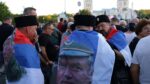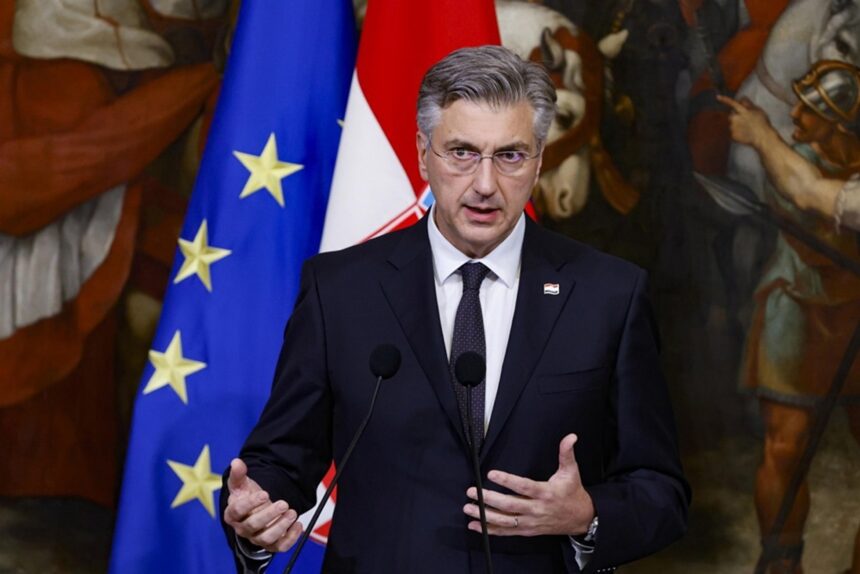
Croatian Prime Minister Andrej Plenković has criticized the European Commission’s response to the funeral of convicted war criminal Ratko Mladić in Belgrade, arguing that the reaction was far too limited and should have come from the highest levels of the European Union.
Plenković said it was inappropriate for the Commission to address an event of such political significance merely through a spokesperson, particularly given the presence of several Serbian government officials and political figures at the funeral.
“What happened today in Belgrade was an attempt by the official government not to be formal there — I mean the president, the prime minister and the speaker of parliament. But if you look at the number of ministers who were there, who are part of the establishment, that attempt to be and not be is clear to us,” Plenković told reporters in Zagreb.
His criticism comes after the European Commission said that Mladić’s funeral was not held with formal state honors. For Plenković, however, focusing narrowly on whether the ceremony formally constituted a state funeral misses the broader political message sent by the presence of government officials.
“The reaction should come from the top”
Plenković argued that the EU should respond at a much higher political level.
“I think it is wrong that the reaction was only at the level of an EC spokesperson,” he said, adding that European Commission President Ursula von der Leyen, Enlargement Commissioner Marta Kos and EU foreign policy chief Kaja Kallas should also address the issue.
He said Croatia would make its position clear to the European Commission.
Plenković also pointed to the participation of officials from Bosnia and Herzegovina’s Republika Srpska, arguing that the significance of the event extends beyond Serbia and directly concerns the region’s unresolved legacy of war crimes and genocide.
A political message beyond a funeral
For Plenković, the issue is not simply who attended a funeral, but what the public honoring of Mladić represents.
Mladić was convicted of genocide, crimes against humanity and war crimes by the International Criminal Tribunal for the former Yugoslavia, including responsibility for the Srebrenica genocide.
Plenković also recalled Mladić’s role during the wars in Croatia and Bosnia and Herzegovina.
“This is the man who was in command of the JNA when the massacre in Škabrnja took place, on the same day as Vukovar, on November 18. We don’t hear anything about that,” he said.
His remarks highlight a broader concern: that the glorification of convicted war criminals remains a serious obstacle to reconciliation and undermines the credibility of European efforts to promote accountability and democratic values in the Western Balkans.
EPP ties do not erase political differences
Plenković was also asked about the relationship between his Croatian Democratic Union and Serbia’s ruling Serbian Progressive Party, both of which are connected through the European People’s Party.
He rejected the suggestion that their membership in the same European political family means they share the same position on every issue.
Being part of the same political family, he said, does not mean agreeing on everything — particularly when it comes to the legacy of Ratko Mladić.
That distinction is particularly important in the context of Serbia’s EU aspirations. While Belgrade continues to pursue membership, its relationship with the legacy of the wars of the 1990s remains one of the most sensitive issues in its relations with neighboring countries and the European Union.
Plenković wants the issue raised internationally
Asked whether Croatia would seek sanctions against Republika Srpska leader Milorad Dodik, Plenković said the matter would be discussed at the international level.
He also argued that Dodik has become more acceptable to parts of the international community since stepping down from his official position.
However, he said the events surrounding Mladić’s funeral should now push the issue back onto the international agenda.
For Croatia and Bosnia and Herzegovina, Plenković said, Mladić remains associated with some of the darkest crimes of the wars of the 1990s.
His central message to Brussels was therefore clear: the public glorification of a convicted war criminal should not be treated as a minor regional controversy or addressed only through a spokesperson. It deserves a direct and unequivocal political response from the EU’s leadership.