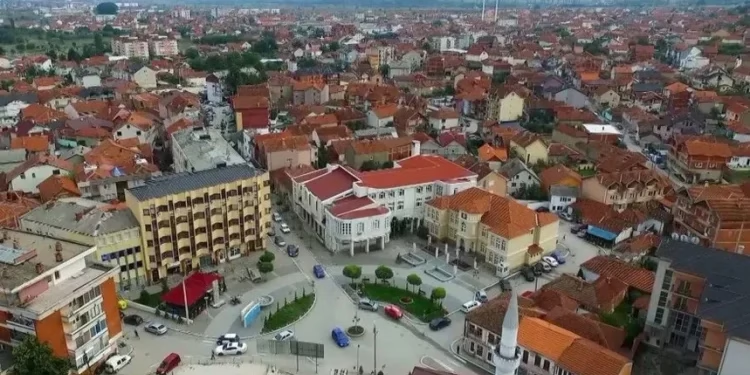
The situation of Albanians in Preševo, Bujanoc and Medvegjë has deteriorated significantly in recent years, with concerns ranging from the deactivation of residential addresses and limited access to public institutions to declining proportional representation, problems in education, shortages of Albanian-language textbooks and difficulties with diploma recognition.
Taken together, these developments have raised concerns among Albanian representatives and civil-society organizations over what they describe as a broader pattern of institutional discrimination against the Albanian community in southern Serbia.
Critics argue that such policies create sustained pressure on Albanians, making it more difficult to live, work and remain in their places of origin. In the long term, they warn, the pressure could accelerate the depopulation of the three municipalities.
Address deactivation
According to data from civil-society organizations and Albanian community representatives, more than 6,500 Albanians in Preševo, Bujanoc and Medvegjë have been affected by the deactivation, or “passivization,” of residential addresses.
The exact number remains difficult to establish because Serbia’s Interior Ministry does not publicly provide official data broken down by ethnicity.
Data published by the Youth Initiative for Human Rights indicates that at least 3,370 Albanians from the Preševo Valley were removed from electoral rolls during the period monitored by the organization. The study also raised concerns about the implementation of procedures, insufficient notification of citizens and the potential consequences for voting rights and access to other public services.
The issue has increasingly attracted international attention. Albania has raised the matter within the OSCE, calling for greater attention to what it describes as the disproportionate impact of address deactivation on Albanians in Preševo, Bujanoc and Medvegjë.
Kosovo institutions have also raised the issue with the European Union, while it has entered political discussions in the United States.
U.S. Congressman Keith Self, who has called for a dedicated State Department report on the treatment of minorities in Serbia, has identified address deactivation as one of the main concerns affecting Albanians in the Preševo Valley.
During a visit to Preševo in May 2026, Self said the U.S. delegation had observed what he described as real problems in relations between Albanians and Serbian institutions and that the visit was intended to provide a direct assessment of how minority communities are treated.
Kosovo Prime Minister Albin Kurti has repeatedly raised the issue with international partners. In a February 2025 letter to then-EU High Representative Kaja Kallas, Kurti described address deactivation as part of what he called systematic violations of the rights of Albanians and called for an independent investigation.
Kurti linked the practice to what he described as broader administrative marginalization and “ethnic cleansing through administrative means.” He raised the issue again during a meeting with Kallas in May 2026, expressing concern over the situation of Albanians in Preševo, Medvegjë and Bujanoc.
Albanian representatives have therefore called on Serbian authorities to publish comprehensive data on the number of people affected, the criteria used to deactivate addresses, the distribution of cases among the three municipalities and the consequences for citizens’ legal and administrative status.
Declining representation in the police
The decline in Albanian representation within Serbia’s police structures has become another major concern.
Under the multietnic police integration program, Albanian participation in the three municipalities reportedly reached 239 officers. According to figures compiled in an August 2026 report by Alban Alili, that number has since fallen to 152 — a reduction of 87 officers, or more than 36 percent.
The decline has not been offset by new recruitment.
Between 2016 and 2025, 369 positions were reportedly advertised within police structures covering the region. According to Albanian representatives and local sources cited in the report, Albanians did not secure any of those positions.
As a result, the generation of Albanian police officers recruited through the post-conflict integration program is gradually shrinking through retirement and departures without being replaced by new recruits.
Albanians are also significantly underrepresented in senior positions, including within the Vranje Police Directorate and the border police.
The lack of representation is particularly significant at levels where decisions are made and policies are implemented.
In municipalities where Albanians make up a substantial proportion of the population and Albanian has official-language status, limited representation can affect communication between citizens and security institutions, the use of Albanian in official interactions and public confidence in those institutions.
The figures on police representation, combined with the data concerning address deactivation, suggest that the institutional integration model established after the conflict has not been consolidated.
Serbian institutions have a clear responsibility to ensure equal treatment and proportional representation of minority communities.
Education, language and recognition of diplomas
Albanians in the Preševo Valley also continue to face difficulties in securing comprehensive education in the Albanian language, including access to adequate Albanian-language textbooks.
A significant number of young Albanians pursue higher education in Kosovo, but the recognition of diplomas and related administrative procedures have created additional barriers to their professional integration in Serbia.
Serbia and Kosovo have reached agreements concerning the recognition of higher-education diplomas issued by institutions on both sides, including for employment and further education.
However, implementation has remained incomplete, creating obstacles for people who completed their studies in Kosovo, including Albanians from the Preševo Valley.
Diploma recognition is particularly important because it can determine whether graduates are eligible for employment in public institutions.
Young Albanians therefore face a combination of limited opportunities to complete their education in Albanian and administrative obstacles to having qualifications obtained in Kosovo recognized in Serbia.
The combined effect can significantly reduce their opportunities for employment in public administration, healthcare, the judiciary and other public-sector institutions.
International pressure and accountability
International attention has helped keep the situation in the Preševo Valley on the political agenda, but Albanian representatives argue that statements of concern must be accompanied by concrete monitoring and sustained diplomatic pressure.
International visits and public statements have increased visibility around the issue. For residents of the valley, however, the central question is whether that attention will translate into measurable institutional changes.
The situation in Preševo, Bujanoc and Medvegjë points to a significant gap between Serbia’s legal obligations to guarantee equality and minority rights and the reality experienced by many members of the Albanian community.
Serbian authorities should therefore fulfill their constitutional and legal obligations to guarantee equality and minority rights and address practices that directly or indirectly result in discrimination or restrict those rights.
The international community, meanwhile, should not limit its response to expressions of concern. Sustained pressure, transparent monitoring and concrete mechanisms for accountability are needed to ensure that Albanians in Preševo, Bujanoc and Medvegjë can exercise their rights fully and participate equally in the institutions of the country in which they live.