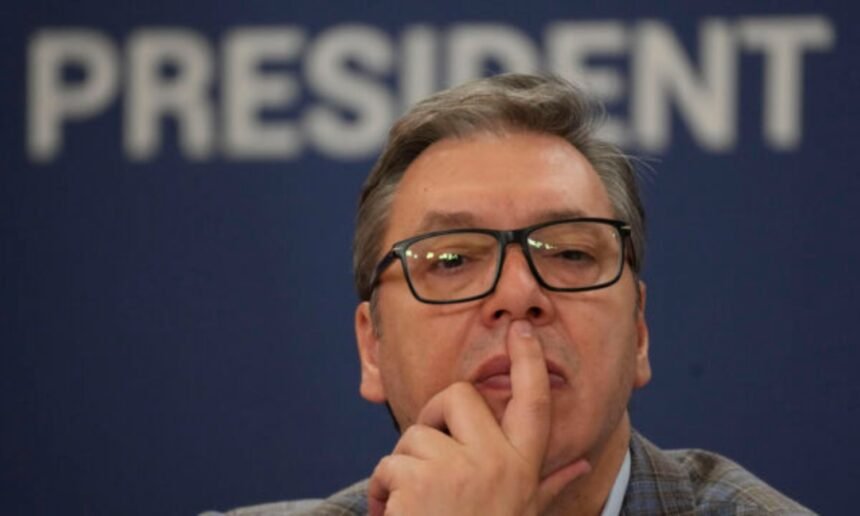
Aleksandar Vučić spent his final day as president of Serbia highlighting what he described as the achievements of his administration, portraying himself as a target of political violence and promising to work for a “decent and modern Serbia” even after leaving office.
Vučić resigned on September 27 after serving two terms as president. His resignation came ahead of Serbia’s snap parliamentary elections scheduled for October 25, in which he is the Serbian Progressive Party’s candidate for prime minister. On September 28, he formally handed presidential duties to then-Parliament Speaker Ana Brnabić, who became acting president.
On the day of his resignation, Vučić appeared on Serbia’s public broadcaster RTS, addressed supporters gathered outside the Presidency and later delivered a televised address in which he summarized his time in office and spoke about his plans for the future.
During his appearances, Vučić praised what he described as the government’s accomplishments, including infrastructure projects, roads, railways, healthcare facilities and the EXPO 2027 project. He said he had served Serbia “honestly” and “with integrity” and expressed pride in what he described as the country’s transformation during his tenure.
“I want us to fight together for a decent and modern Serbia,” Vučić told supporters outside the Presidency, while also saying he expected Serbia to have the strongest economic growth rate in the region next year.
He also claimed that SNS supporters had been subjected to attacks, including beatings, shootings and threats with knives. Vučić again rejected claims that a sonic weapon had been used during the mass demonstration in Belgrade on March 15, 2025, despite reports that hundreds of people sought medical assistance that day with symptoms they associated with the incident.
“Not President, but de facto leader of the regime”
Political scientist Dejan Bursać, a senior research associate at the Institute for Philosophy and Social Theory, told N1 that Vučić’s departure from the presidency did not mean the end of his political influence.
“He is no longer president of Serbia and is not at the head of the party, but he is de facto the leader of a regime,” Bursać said, describing Vučić’s final-day appearances as part of an election campaign.
According to Bursać, Vučić’s public messaging in recent months has sought to present him in a new political role, despite his having occupied senior positions in government for more than a decade.
Bursać argued that this approach was already visible during Vučić’s visits around Serbia over the past several months, when the president publicly criticized local officials, directors of public companies and ministers while, according to Bursać, having previously exercised substantial influence over their appointments.
He characterized this as part of a campaign strategy in which Vučić could present himself simultaneously as a political leader and an ordinary citizen seeking to “save” the country.
Presidential resignation ahead of parliamentary elections
Vučić said he was resigning specifically so that he could participate in the parliamentary election campaign without holding state office. He had previously announced that he would leave the presidency on September 27 and then campaign as an ordinary citizen.
The resignation triggered the constitutional procedure under which the parliamentary speaker temporarily assumes presidential duties. Brnabić is authorized to perform the duties of president for a maximum of three months, while a presidential election must be held within that period.
Vučić has said the first round of the presidential election should take place by the end of December.
His resignation therefore marks a change in formal office rather than an announced withdrawal from politics. He is now campaigning for the October 25 parliamentary elections as the SNS candidate for prime minister.
“We will defeat them”
During his final address as president, Vučić also delivered a direct campaign message to his supporters.
“We were not born in an office, and without an office we will defeat them,” he said, calling on supporters to secure a stronger result and repeating his message about building a “modern and decent Serbia.”
He also announced pardons for 49 people in connection with events during the previous year and a half, including individuals involved in protests and blockades. N1 reported that 12 members of a Novi Sad group and 11 people involved in incidents against protesters were among those pardoned.
Vučić described the pardons as an “act of mercy,” while maintaining his criticism of some of those involved in the protests.
The parliamentary election campaign will now continue with Vučić outside the presidency, while Brnabić performs the duties of acting head of state.